
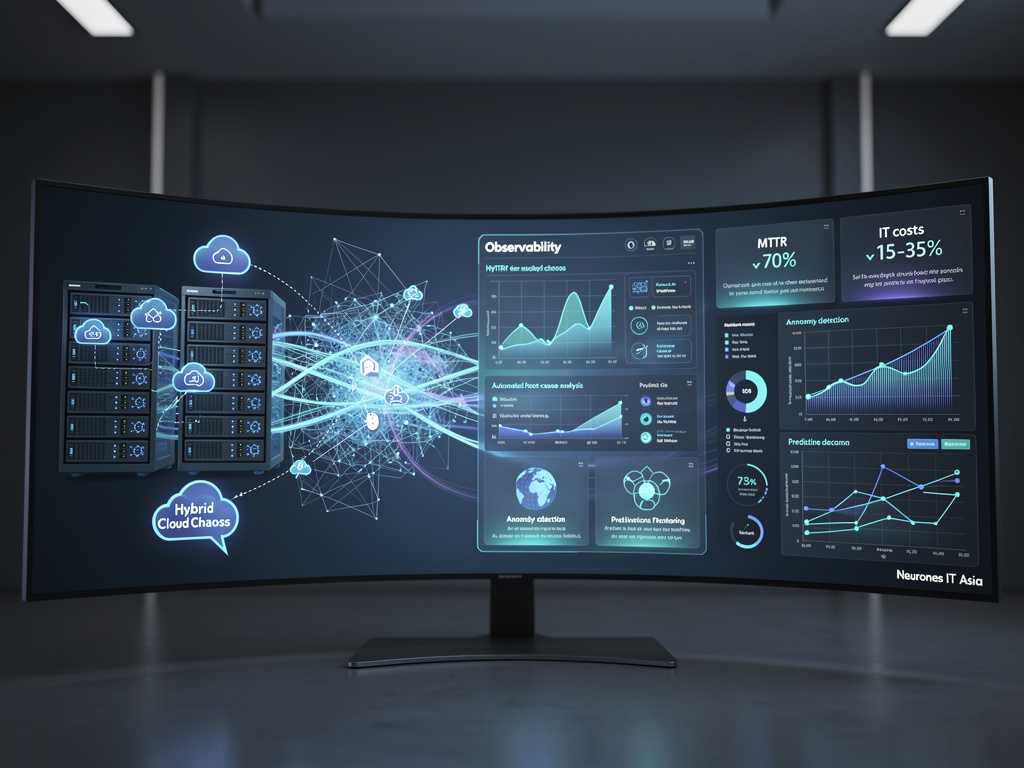
SINGAPORE—Enterprises cling to dashboards as proof of visibility, but a new report shatters that illusion. Only 9% of enterprise software applications achieve full end-to-end observability, leaving IT teams grappling with blind spots in hybrid and multi-cloud setups, according to a position paper from Manila Times relaying Neurones IT Asia’s findings.
Modern observability hinges on metrics, logs, and traces, yet signals often fragment across tools, fueling alert fatigue and dragging out investigations. Neurones IT Asia’s paper, titled “From Monitoring to Intelligence: How Observability and AI Redefine IT Operations,” argues the shift now targets better signal-to-noise ratios through cross-system event correlation and precise root-cause isolation.
AI-driven observability emerges as the game-changer, enabling earlier anomaly detection and context-rich insights that cut mean time to resolution (MTTR) by up to 70%, the report claims, while delivering 15%-35% drops in total IT operations costs via fewer escalations and sharper decisions.
Dashboard Illusion Exposed
IT leaders mistake static dashboards for comprehensive sight, but reality bites during outages. Fragmented telemetry in sprawling infrastructures hampers swift responses, as echoed in Laotian Times, which republished the Neurones press release. “Instead of reacting to symptoms after users are impacted, AI can help teams correlate events across systems,” it states.
This gap persists regionally, with limited adoption stalling progress. Neurones IT Asia, headquartered in Singapore with outposts in India, Hong Kong, and Australia, pushes AI to bridge it, having delivered over 1,000 solutions in platform, data, and software engineering as part of France’s Neurones IT Group.
Industry echoes amplify the urgency. Enterprise users of AI observability report 40-60% MTTR cuts by automating probes across IT stacks, per a IR guide on 2026 practices.
AI’s Precision Edge
AI excels at sifting noise, dynamically adjusting baselines, and predicting failures from patterns—tasks manual methods fumble. “AI-driven observability tools use machine learning to dynamically adjust baselines and detect anomalies in real time,” notes Lumigo.
Generative AI pushes further, shrinking MTTR from days to minutes in some cases. A Tribe AI analysis cites Sumo Logic’s ‘Generative Context Engine’ enabling broad log analysis, boosting efficiency and slashing troubleshooting expenses.
2026 forecasts predict agentic AI—autonomous agents handling logs, remediation, and prevention. “By 2026 AI will move from detecting anomalies to being an effulgent agent auto generating summaries of root cause analysis,” predicts Middleware.
Cost Pressures Mount
IT budgets strain under telemetry floods, but AI trims waste. IBM Instana touts 219% ROI and 90% less developer troubleshooting time, per IBM. Agentic AIOps yields 3x faster MTTR and 30% SRE headcount savings, says DevOps.com.
Synoptek slashed alert noise 80% and cloud costs 20% via AI observability for 1,200+ clients, as detailed by LogicMonitor. Grafana Cloud migrations yield dramatic bill reductions plus Adaptive Metrics for further savings.
Vendors like Dynatrace, with Davis AI for root-cause automation, and Logz.io’s Open 360 AI unify signals, per Logz.io. Netdata claims 80% MTTR cuts via Anomaly Advisor.
Enterprise Hurdles Persist
Adoption lags despite promise. Only 9% full observability underscores data-to-insight chokepoints. OpenTelemetry gains traction as a vendor-neutral standard, forecasted dominant by 2026 in Middleware.
Fragmentation plagues teams juggling tools. “Fragmented monitoring forces response teams to correlate data manually,” warns the IR guide. AI unifies, ingesting all sources for intelligent alerts.
Motadata eyes 2026 trends like AI prediction and SecOps integration, noting 82% of firms exceed hourly MTTR. “AI-powered insights will make observability more intelligent and predictive,” it states.


 WebProNews is an iEntry Publication