
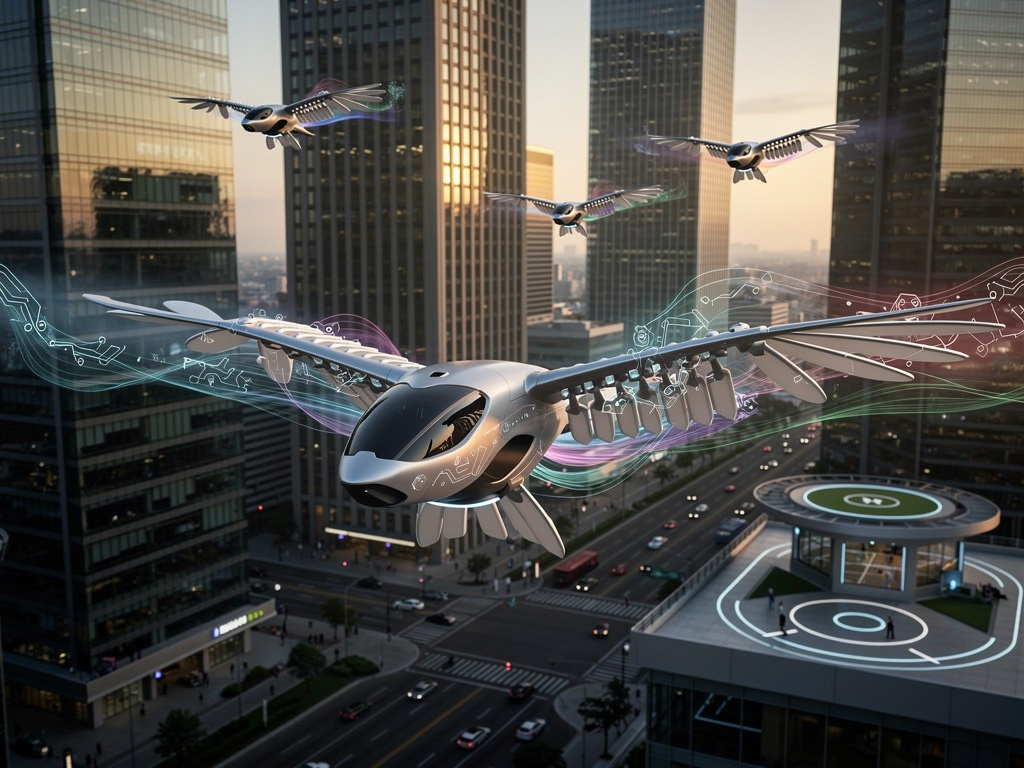
Shape-Shifting Skies: AI Powers Morphing Wings to Elevate VTOL Autonomy and Efficiency
In the rapidly evolving realm of aviation technology, vertical takeoff and landing (VTOL) aircraft are undergoing a transformative shift, driven by artificial intelligence and morphing wing designs. These innovations promise to enhance autonomous flight capabilities while significantly boosting energy efficiency. Recent developments highlight how AI integration allows wings to adapt in real time, mimicking the fluidity of bird flight to optimize performance across varying conditions. This convergence of biomimicry and advanced computing is not just theoretical; it’s already taking flight in prototypes and test beds around the world.
Engineers and researchers are drawing inspiration from nature to create wings that can change shape mid-flight, adjusting camber, span, and twist to suit specific phases like takeoff, cruising, or landing. This adaptability addresses longstanding challenges in VTOL design, where fixed-wing structures often compromise between stability and maneuverability. By incorporating AI algorithms, these systems can process sensor data instantaneously, making micro-adjustments that reduce drag and improve lift-to-drag ratios. Such advancements are crucial for urban air mobility, where efficiency translates directly to longer ranges and lower operational costs.
One standout example comes from avian-inspired drones, where morphing wings and tails enable resilient flight even in turbulent environments. According to a study published in npj Robotics, these drones use Bayesian optimization to fine-tune configurations during flight, achieving up to 11.5% energy savings at speeds of 8 to 12 meters per second. The research demonstrates how AI-driven controls handle the complexity of multiple actuators, ensuring stability despite cross-coupling effects. This approach marks a departure from traditional rigid designs, opening doors to more versatile unmanned aerial vehicles.
Biomimicry Meets Machine Learning
The fusion of biomimicry and AI is reshaping VTOL engineering. Inspired by birds that effortlessly alter their wing shapes, modern prototypes incorporate flexible materials and smart actuators. For instance, a bird-like robot developed in China features bat-style morphing wings, enabling self-takeoff and low-speed flight, as detailed in a report from TechXplore. This innovation underscores the potential for VTOLs to operate in confined spaces, a key requirement for urban environments.
AI plays a pivotal role by enabling autonomous decision-making. Machine learning models analyze airflow patterns, wind gusts, and payload changes to predict optimal wing morphologies. This predictive capability reduces the need for human intervention, paving the way for fully autonomous operations. In military applications, such technology could enhance stealth and agility, with tech companies proposing flying taxis adapted for defense uses, as noted in coverage from ePlaneAI.
Furthermore, energy efficiency gains are substantial. Morphing wings minimize drag by maintaining laminar flow over surfaces, a concept explored in projects like the HERWINGT initiative. According to Travel Radar, hybrid laminar-flow systems combined with morphing tech could cut fuel consumption dramatically, aligning with global sustainability goals in aviation.
Prototypes Pushing Boundaries
Recent flight tests illustrate the practical impact of these technologies. Boeing-backed Wisk Aero’s Generation 6 eVTOL, an autonomous air taxi, completed its maiden flight, showcasing advanced VTOL capabilities without a pilot on board. As reported by New Atlas, this prototype lifted off from a California facility, highlighting progress toward certification for passenger transport. The design integrates AI for navigation and efficiency, potentially disrupting urban commuting.
In India, defense researchers have advanced morphing wing technology with successful flight tests on live aircraft. The CSIR-National Aerospace Laboratories, funded by DRDO, demonstrated real-time geometric changes that enhance combat aircraft performance, per insights from Indian Defence Research Wing. This breakthrough positions India among leaders in adaptive aerodynamics, with implications for both military and civilian VTOLs.
Social media buzz on platforms like X amplifies these developments, with posts highlighting shape-shifting prototypes that adjust to aerodynamic conditions for better efficiency. Users discuss how vibrating micro-ridges, inspired by dolphin skin, could slash drag by up to 90%, drawing from biomimicry principles shared in various threads. Such online discourse reflects growing industry excitement and public interest in these innovations.
Challenges in Integration and Scalability
Despite promising strides, integrating AI-driven morphing wings into VTOLs faces hurdles. The complexity of controlling multiple degrees of freedom requires sophisticated algorithms to avoid instability. Researchers note that while avian-inspired designs excel in agility, ensuring resilience against failures—like actuator loss—demands redundant systems, as explored in the npj Robotics study referenced earlier.
Material science also poses challenges. Developing lightweight, durable composites that withstand repeated morphing without fatigue is essential. Advances in smart materials, such as shape-memory alloys, are critical, yet scaling these for larger aircraft remains a work in progress. Regulatory frameworks must evolve too, with aviation authorities scrutinizing autonomous systems for safety in densely populated areas.
Energy storage represents another bottleneck. While morphing wings improve efficiency, VTOLs rely on batteries or hybrid propulsion, where density limits range. Posts on X envision fleets of high-altitude drones harvesting solar energy via biomimetic structures, suggesting future synergies with renewable sources to extend operational endurance.
Global Innovations and Market Implications
Around the globe, initiatives are accelerating. In Europe, projects like those detailed in ScienceDirect review AI integration in morphing architectures, addressing challenges and forecasting trends. These comprehensive analyses predict widespread adoption by 2030, driven by demands for sustainable aviation.
In the U.S., companies like Wisk Aero are at the forefront, with their Gen 6 prototype’s flight marking a milestone in autonomous VTOLs, as covered in autoevolution’s report on the Boeing-backed craft. This development could shake up the air taxi market, offering cost-competitive alternatives to ground transport.
India’s progress, including a camber morphing demonstrator funded by the Aeronautical Development Establishment, emphasizes drag minimization through adaptive shaping, according to another piece from Indian Defence Research Wing. Such national efforts contribute to a diverse innovation ecosystem, fostering international collaborations.
Efficiency Gains and Environmental Impact
The efficiency benefits of AI-driven morphing wings extend beyond fuel savings. By optimizing flight paths and reducing emissions, these technologies support decarbonization efforts in aviation. A Science Robotics article on bioinspired morphing, available at Science.org, explains how large lifting surfaces in drones lead to better maneuverability but higher power use—morphing mitigates this trade-off.
Real-world applications include urban air taxis, where AI ensures safe, efficient routes amid skyscrapers. Geeky Gadgets explores how nature-inspired drones are revolutionizing aerial robotics through their coverage, emphasizing AI’s role in adaptive flight.
On X, discussions about hybrid drones like the Morpho UAV from Swiss firm Elythor highlight wind-adaptive wings, with posts noting independent pivoting for enhanced performance. These insights from social platforms underscore the technology’s versatility across civilian and defense sectors.
Future Trajectories in Autonomous Aviation
Looking ahead, the integration of morphing wings with AI could redefine VTOL autonomy. Visionary concepts, such as air-ground integrated transport, envision flying vehicles reshaping mobility, constrained mainly by battery tech, as outlined in posts from industry figures on X.
Aviation Titans discusses biomimicry in morphing wings for 2025, via their article, predicting efficiencies in mission phases like takeoff and cruising. This aligns with broader trends toward sustainable flight.
In military contexts, morphing tech enhances fighter jets, with India’s DRDO breakthroughs reported in Aerospace Global News, enabling real-time adaptations for superior combat edge.
Industry Adoption and Economic Factors
Adoption by major players signals market readiness. Wisk Aero’s progress, detailed in autoevolution, positions unique eVTOLs to compete on price with ridesharing, leveraging efficiency gains.
Economic incentives drive investment, with reduced operational costs attracting venture capital. X threads on sustainable auxiliary power for jets, like GoFlux concepts, illustrate how harvesting flight energy could eliminate extra fuel burn.
Ultimately, these technologies promise a new era of aviation, where AI and morphing designs converge to make VTOLs more efficient, autonomous, and environmentally friendly. As prototypes evolve into commercial realities, the skies may soon be filled with shape-shifting aircraft, transforming how we travel and transport goods.


 WebProNews is an iEntry Publication