
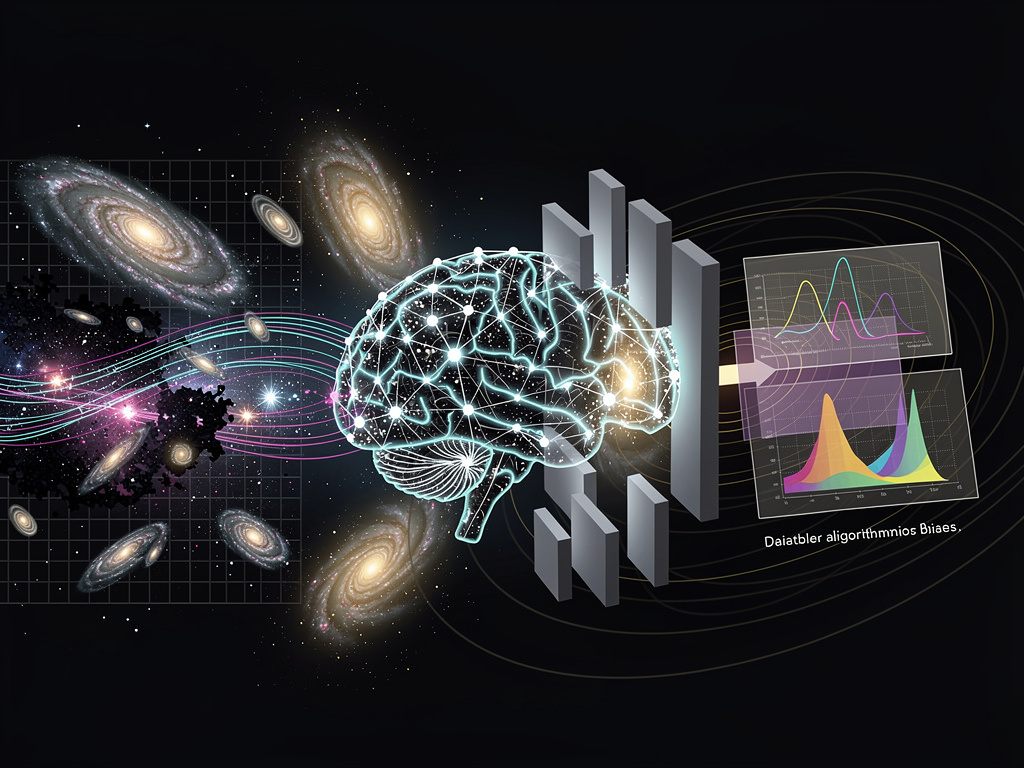
Physicists have spent decades building ever more expensive simulations to test ideas about dark energy, neutrino masses and possible tweaks to gravity. Now a team has shown that artificial intelligence can absorb the standard model of cosmology in a fraction of the usual time. The same work, however, reveals a stubborn catch. Once trained on the familiar, the AI sometimes refuses to see anything else.
The finding comes from a paper published this month in the Journal of Cosmology and Astroparticle Physics. First author Veena Krishnaraj, an undergraduate at Princeton University, and colleagues Adrian Bayer, Christian Kragh Jespersen and Peter Melchior trained neural networks using transfer learning. The networks first studied countless cheap simulations of the ΛCDM model. Only afterward did the researchers expose them to data drawn from theories that stretch beyond it.
Transfer learning slashed the number of costly beyond-standard-model runs by more than a factor of ten. Speed mattered. Upcoming surveys from the Vera C. Rubin Observatory and Euclid will drown researchers in data. Anything that cuts computational bills looks attractive. Yet the networks carried forward biases. They performed well when new physics sat far from the standard parameter space. They stumbled when the new signals overlapped with directions already explored inside ΛCDM.
“The negative transfer is not random,” Krishnaraj told Phys.org. “It is driven by underlying physical degeneracies in the model.” Different combinations of parameters can produce nearly identical observable effects on the cosmic web. The AI latched onto those associations during pre-training. Later it treated slight deviations as noise instead of evidence for something new.
The Gizmodo report on the study captured the tension cleanly. “When it comes to physics, AI seems to be as bound by prior biases as human scientists,” the article noted, linking the behavior to the same research.
Old knowledge becomes a cage
Degeneracies have long plagued cosmology. Neutrino mass and the amplitude of matter fluctuations trade off against each other in ways that look similar in large-scale structure data. The standard model already encodes these trade-offs. Pre-trained networks simply amplified them. In tests, the AI grew overconfident. It down-weighted genuine signals that sat inside the degenerate regions. Human physicists have spent careers learning to spot those traps. The machines had to be taught to forget parts of what they first mastered.
Francisco Villaescusa-Navarro, a co-author affiliated with the Flatiron Institute, helped frame the broader stakes. The work shows transfer learning can accelerate discovery. It also warns that without deliberate safeguards the tools may steer the field away from the very anomalies they were built to find. Some degeneracies are physical. Others may be baked into the network weights themselves. Distinguishing the two will demand new techniques, perhaps networks that actively unlearn or ensembles trained on deliberately contradictory priors.
News outlets picked up the story within hours of publication. ScienceDaily summarized the dual message on June 11: AI can uncover new physics faster but sometimes grows so confident in familiar patterns that it misses surprises. The coverage echoed the original paper’s caution without exaggeration.
Researchers outside the team have begun to weigh the implications. David Hogg at New York University, interviewed in a separate Science article about AI in astrophysics, has warned that unchecked automation risks stripping the field of human judgment. The Princeton group’s result supplies concrete evidence for that worry. Even when the AI works brilliantly on known problems, its inherited assumptions can blind it to the unknown.
So what now? One path involves hybrid training schedules. Pre-train on the standard model, then inject controlled noise or adversarial examples that force the network to explore degenerate directions more carefully. Another idea uses Bayesian neural networks that carry uncertainty estimates forward from the first training stage. When uncertainty spikes in overlapping parameter spaces, the system could flag those regions for heavier human scrutiny or additional simulation runs.
The paper itself stops short of prescribing fixes. Its authors instead map the terrain. Transfer learning works. It also fails in predictable ways tied to the physics. That predictability offers hope. Physicists can design around it. They cannot afford to ignore it.
Meanwhile the broader conversation about AI in physics continues. Some see machines as tireless assistants that free humans for creative leaps. Others fear a subtle erosion of taste and intuition. The new study lands squarely in the middle. It demonstrates real savings and real risk inside the same set of experiments. No hype. No dismissal. Just data.
Tomorrow’s cosmological analyses will almost certainly rely on networks that have seen millions of simulated universes before they ever touch telescope data. The question is whether those networks will inherit the full flexibility of scientific doubt or only the comfortable grooves of accepted theory. The Princeton team has given the community an early map of the trapdoors. How researchers step around them may decide whether AI becomes a genuine partner in discovery or merely a faster way to confirm what everyone already believes.
And the universe, as usual, keeps its secrets close. The machines that try to learn it must be taught not only to see but sometimes to doubt what they first thought they understood.


 WebProNews is an iEntry Publication