
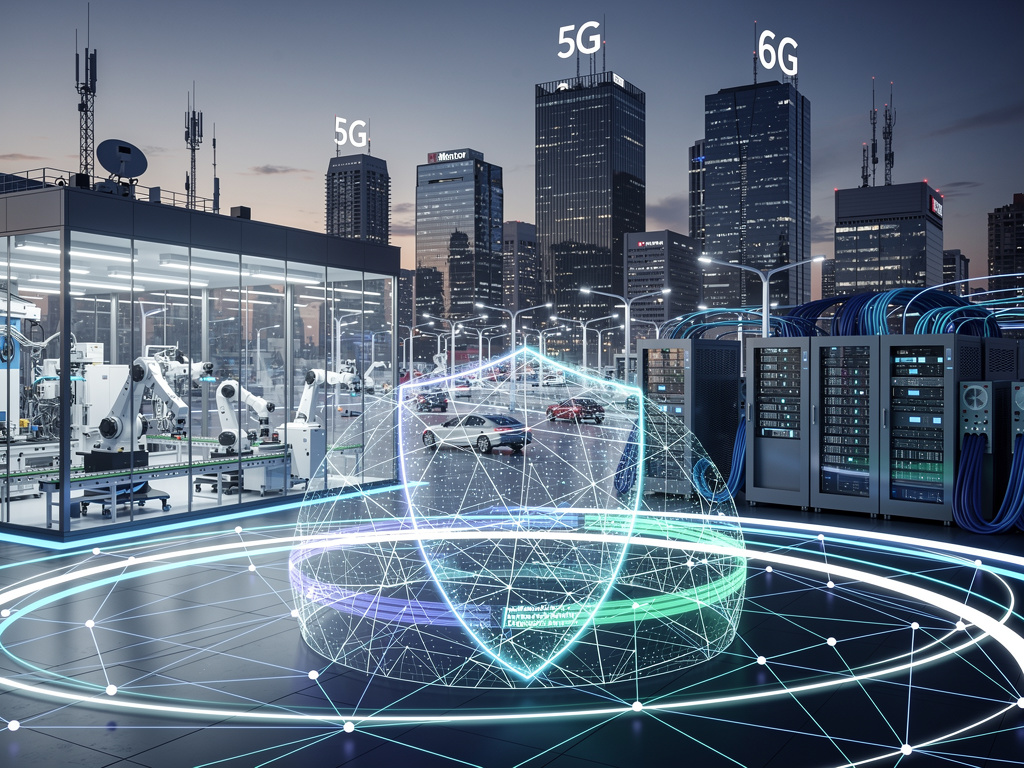
In 2026, the fusion of artificial intelligence, Internet of Things devices and telecommunications infrastructure is reshaping global operations, propelling factories, cities and transport systems into adaptive, human-centered networks known as Industry 5.0. Telecom providers, once mere conduits for data, now deploy AI at the network edge to process signals from billions of sensors in real time, slashing latency and enabling predictive maintenance across sectors from healthcare to manufacturing. This shift, detailed in a January 27 analysis by IoT For All, marks telecom evolution from reactive bandwidth suppliers to proactive intelligence orchestrators, with 5G fully deployed and 6G pilots accelerating ultra-reliable links.
Edge computing stands central, where AI models analyze IoT data streams locally rather than routing everything to distant clouds. Operators are rolling out platforms that autonomously balance traffic loads, foresee outages and allocate resources dynamically. “Telecom networks have evolved beyond traditional connectivity to serve as the backbone of hyperconnected environments,” writes Hemant Soni in the IoT For All piece. Such capabilities cut downtime in critical applications like remote surgeries or self-driving fleets, as noted in a December 2025 outlook from Neuralt, which forecasts 6G preparations boosting immersive industrial IoT.
Edge AI Transforms Data Overload
IoT devices generated 80 zettabytes of data in 2025, per Statista figures cited by SumatoSoft, equivalent to 3.1 billion years of HD video. AI sifts this deluge into insights, powering smart grid optimizations and personalized services via Internet of Everything frameworks. A 2025 Mordor Intelligence report projects the AI-in-IoT market hitting $60.71 billion this year, with 84% of enterprises viewing AI as essential for IoT initiatives. Telecom’s role amplifies here, embedding generative AI into infrastructures for context-aware responses, as IoT For All describes in applications like real-time congestion rerouting.
In manufacturing, Industry 5.0 emerges as IoT sensors feed AI for failure predictions and production tweaks, unified by telecom’s low-latency spines. GS E&C’s Life Weaver platform exemplifies this, integrating IoT and AI for urban ecosystems beyond siloed tech, according to the World Economic Forum. Factories now operate as living systems, blending automation with human oversight.
Smart Cities Embrace Predictive Urbanism
Urban centers leverage this triad for resilient planning, with AIoT driving traffic flow, energy distribution and disaster response. Binariks highlights cities using IoT for sustainability via AI automation, focusing on predictive security and real-time alerts in a March 2025 post projecting into 2026 trends. A systematic review in MDPI’s Smart Cities journal maps urban digital twins powered by IoT and AI, aligning with UN Sustainable Development Goals for infrastructure and climate action. Global AIoT markets are forecasted to reach $81.5 billion by year-end at a 37.2% CAGR, per a GII Research report.
Telecom trends underscore this momentum. Juniper Research’s 2026 report flags AI-driven customer interactions, eSIM convergence and 6G innovations as redefining connectivity, with MVNOs from fintechs like Nubank expanding via Telecom-as-a-Service. Verizon’s AI assistant, built with Google Cloud’s Gemini, handles billing and upgrades, exemplifying service personalization. Meanwhile, RCR Wireless notes satellite integrations enhancing reach.
Security Shields Hyperconnected Systems
Billions of endpoints demand robust defenses. Telecoms deploy AI frameworks for anomaly detection and federated learning, training models without raw data exposure, as IoT For All outlines. Gartner predicts 70% of operators adopting AI cybersecurity by 2026 to avert breaches, per DID Global. Professor Muthu Ramachandran of Forti5 Technologies warns in IoT Insider of edge AI, advanced connectivity and regulations reshaping ecosystems.
On X, Harold Sinnott observes, “As 5G, IoT, and Agentic AI converge, telecom networks are no longer passive infrastructure, they’re becoming adaptive, self-optimizing systems.” TeckNexus details AI flipping spectrum needs toward uplink-heavy usage for vision apps, urging U.S. carriers to boost midband allocations. SaM Solutions lists 2026 priorities: industrial IoT, edge analytics, cybersecurity and digital twins via 5G.
6G Horizons and Revenue Shifts
Looking ahead, 6G promises 100x 5G speeds for holograms and twins, with AI automating management. Neuralt predicts open APIs fostering fintech-IoT collaborations. Ciena shifts to telecom-specific AI models amid surging workloads, per Telecoms Tech News. Eseye’s predictions emphasize reliable connectivity amid AI acceleration, as shared on IoT For All.
Operators monetizing platforms face competition from altnets differentiating via intelligence. Wevolver envisions hybrid networks with AI agents optimizing eSIMs and zero-trust security. GSMA and FCC spectrum moves, like upper C-band, support this. X discussions highlight federated IDS and quantum keys for 6G trust.
Industry 5.0 Momentum Builds


 WebProNews is an iEntry Publication