
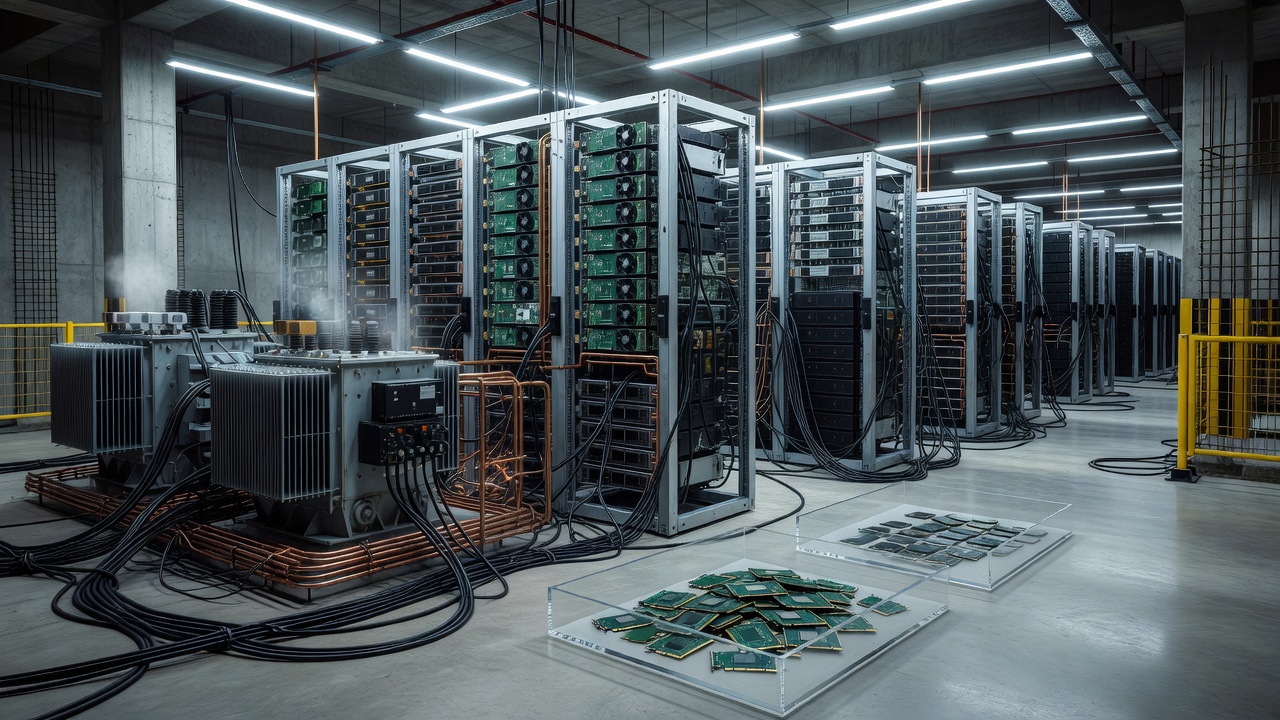
The rapid expansion of artificial intelligence has created an unexpected problem that now commands attention from major investors and technology executives alike. As companies pour billions into developing more powerful models, the infrastructure needed to train and run them faces growing constraints that could slow progress and affect returns on those massive investments. Recent market movements reflect this concern, with shares of companies tied to data center equipment and energy production showing increased volatility as analysts question whether supply can keep pace with demand.
The core issue centers on several interconnected shortages that together form what industry participants describe as an AI bottleneck. Graphics processing units remain in tight supply, with NVIDIA maintaining a dominant position that leaves many organizations waiting months for deliveries. Beyond the chips themselves, the supporting infrastructure presents even larger challenges. Data centers require enormous amounts of electricity, specialized cooling systems, and high-speed networking equipment that cannot be manufactured or installed overnight. According to reporting from Yahoo Finance, these limitations have begun to influence how venture capital firms and public market investors evaluate AI-focused companies.
Power availability stands out as perhaps the most pressing constraint. Training a single large language model can consume electricity equivalent to what hundreds of households use in a year. As models grow larger and more companies attempt to build their own versions, the cumulative demand strains electrical grids already challenged by other trends like electric vehicle adoption and manufacturing reshoring. Utility companies in key technology hubs report waiting lists for new connections that stretch into years rather than months. Some organizations have responded by exploring alternative arrangements, including purchasing existing power plants or signing long-term agreements with renewable energy providers, but these solutions require substantial capital and time.
The physical space for data centers adds another layer of complexity. Prime locations near population centers and fiber optic networks have become scarce, driving up real estate costs and forcing developers to consider less optimal sites. Construction timelines for new facilities often exceed two years when accounting for permitting, environmental reviews, and equipment installation. This lag creates a mismatch between the speed at which software companies can iterate on algorithms and the pace at which physical infrastructure can expand. Investors who initially focused solely on computational performance metrics now examine a broader set of operational factors when assessing AI companies.
Memory bandwidth represents a more technical but equally significant limitation. Even with sufficient processing units, the speed at which data moves between storage and computation determines overall system efficiency. Current architectures face physical constraints on how much information can flow through connections between components. Engineers work on novel approaches including optical interconnects and advanced packaging techniques, yet these innovations remain in early stages and will not address immediate capacity shortfalls. The situation echoes earlier computing eras when different bottlenecks emerged as primary obstacles, though the current combination of factors appears particularly stubborn.
Semiconductor manufacturing capacity adds further pressure to the situation. While foundries have announced expansion plans, bringing new production lines online involves multi-billion dollar investments and years of preparation. The specialized nature of chips designed for AI workloads means standard manufacturing processes often require modification, creating additional delays. Taiwan Semiconductor Manufacturing Company, a key supplier in this space, has indicated that demand continues to outstrip available capacity despite ongoing efforts to increase output. This dynamic affects not only the largest technology firms but also smaller players attempting to compete in the AI sector.
Financial markets have started to price in these realities. Companies positioned to provide solutions to the bottlenecks, such as those involved in electrical equipment, cooling technology, and alternative energy generation, have seen their valuations rise even as some pure AI software plays experience increased scrutiny. Venture capital allocation patterns show greater emphasis on infrastructure and efficiency improvements rather than solely on model development. Public company earnings calls now routinely include discussions about supply chain constraints and power availability, topics that received little attention just two years ago.
The competitive dynamics between major technology companies intensify these challenges. Microsoft, Google, Amazon, and Meta have all committed enormous sums toward building their own AI capabilities, often bidding against each other for the same limited resources. This competition drives up costs and extends lead times across the board. Smaller organizations and research institutions find themselves increasingly squeezed out of access to the most advanced computing resources, potentially concentrating progress among a handful of well-resourced entities. Some experts express concern that this concentration could slow overall innovation by limiting the diversity of approaches and applications.
Energy efficiency improvements offer one pathway toward easing the pressure, though experts caution against expecting rapid breakthroughs. Researchers explore various techniques including model compression, specialized hardware designs, and algorithmic optimizations that reduce computational requirements without sacrificing performance. While these efforts show promise, the historical pattern suggests that efficiency gains tend to be offset by increased demand for more capable systems. Each new generation of models typically requires substantially more resources than previous versions, creating a cycle where efficiency improvements enable larger scales rather than reducing overall consumption.
Geographic factors complicate the picture further. Different regions face distinct constraints based on their energy mix, regulatory environment, and existing infrastructure. Northern European countries with abundant renewable energy and cooler climates attract data center investment, while areas with carbon-intensive power grids face greater environmental pushback. Water usage for cooling systems has emerged as a concern in drought-prone regions, adding another resource constraint to the equation. These variations mean that solutions effective in one location may not translate directly to others, requiring customized approaches that increase complexity and cost.
The investment community has responded with greater sophistication in how it evaluates AI opportunities. Rather than simply counting parameters in large language models, analysts now assess companies based on their access to power contracts, data center capacity, and supply chain relationships. This shift reflects a maturing understanding of what actually determines success in the field. Venture firms report spending more time examining operational details that previously received less attention. Public market investors similarly focus on sustainability metrics and infrastructure partnerships when making allocation decisions.
Looking ahead, several developments could help address these bottlenecks, though none appear likely to resolve them completely in the near term. Advances in chip design may yield more efficient processors that deliver greater performance per watt. New cooling technologies, including liquid immersion and advanced heat exchangers, could reduce energy requirements for temperature control. Grid modernization efforts and increased renewable capacity might ease power constraints over time. However, each of these areas requires sustained investment and faces its own technical and regulatory hurdles.
The situation also drives interest in alternative computing paradigms that might bypass some current limitations. Neuromorphic computing, quantum approaches, and optical processing each receive attention as potential ways to achieve results with different resource profiles. While these technologies remain largely experimental, they represent important areas of research that could eventually complement or partially replace traditional architectures. Government funding initiatives in multiple countries support work in these fields, recognizing both economic and strategic implications.
Industry participants emphasize the need for coordinated action across multiple sectors to address the challenges effectively. Technology companies, utility providers, real estate developers, equipment manufacturers, and policymakers all play essential roles. Some organizations have begun forming partnerships that span these traditionally separate industries, creating integrated approaches to infrastructure development. These collaborations represent a shift from the more siloed operations that characterized earlier phases of digital expansion.
The bottlenecks have also prompted renewed focus on software optimization and algorithmic efficiency. Organizations that can achieve strong results with fewer computational resources gain significant advantages in both cost and availability. This reality has elevated the importance of research into more efficient training methods, inference optimization, and model distillation techniques. Teams that combine strong engineering talent with access to limited hardware often outperform those with greater resources but less optimization expertise.
As the situation continues to develop, market expectations appear to be adjusting to a more measured pace of progress. Rather than assuming unlimited scaling potential, investors increasingly recognize that physical world constraints apply to artificial intelligence just as they do to other domains. This perspective does not diminish the potential value of AI technologies but rather grounds projections in practical realities about infrastructure and resources. Companies that demonstrate clear strategies for managing these constraints may find themselves better positioned than those focused exclusively on computational scale.
The coming years will likely see continued tension between ambitious AI development goals and the practical limitations of supporting infrastructure. Success will depend not only on algorithmic breakthroughs but also on effectively addressing the physical and logistical challenges involved in building and operating the necessary systems. Organizations that can secure reliable access to power, computing resources, and specialized talent while maintaining reasonable costs will hold distinct advantages in this environment. The current bottlenecks, while creating short-term difficulties, may ultimately lead to more sustainable and efficient approaches to artificial intelligence development that deliver greater long-term value.


 WebProNews is an iEntry Publication