
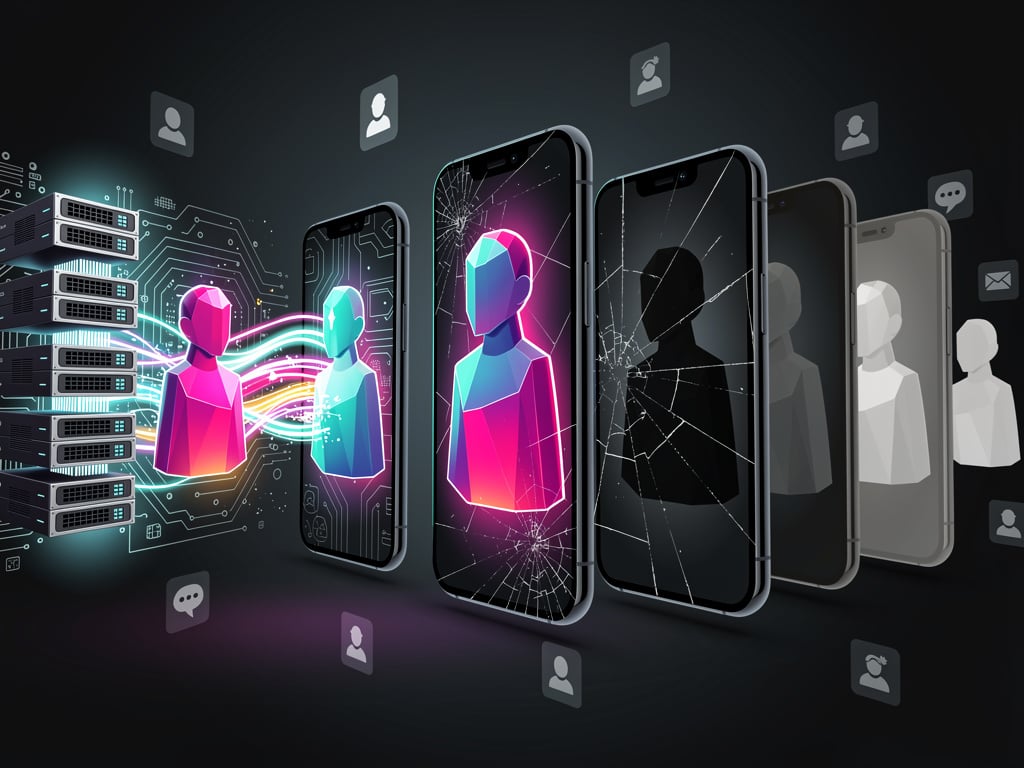
Early virtual stars stood out. Lil Miquela, with her blunt fringe and freckles. Imma and her bubblegum pink bob. Shudu Gram, flawless in every frame. Their launches came with announcements and fanfare. Studios, money, coordination. All that polish made them obviously digital.
Things changed. Fake profiles now slide into feeds looking like any well-traveled acquaintance. They post from upscale restaurants or festivals such as Coachella. They hit Wimbledon. Not quite the girl next door. Still, close enough to professional influencers that casual viewers miss the difference. And the platforms feel it.
The Verge reported this shift in detail last week. AI content creators have grown harder to spot. Social media companies appear baffled by the pace. What began as niche experiments has scaled into a market projected to hit nearly $49 billion by 2030, according to Grand View Research data cited across multiple outlets. Human creators watch their timelines fill with competitors who never tire, never age, and never demand a cut of sponsorship money beyond what their handlers set.
Aitana Lopez offers the clearest case. The pink-haired fitness and fashion figure calls herself a “digital soul.” She maintains three full-time brand partnerships, including work with a Spanish salon chain and an Amazon Black Friday campaign. Revenue estimates run from $75,000 to $100,000 a month through deals, paid posts, and a skincare brand called Vellum that even sells software to improve AI avatar skin. The Clueless, the Barcelona agency behind her, pivoted from hiring human models during the pandemic. Unpredictability and inconsistency drove the move. Creative director Andy García told Business Insider that right now these figures do not threaten real influencers. “It’s like any opportunity, to which real influencers can adapt.”
Yet adaptation carries costs. Gracie Nielson, a fashion and lifestyle creator with more than 600,000 TikTok followers, watched an AI account clone her poses, backdrops, and even her house. “That’s so crazy. This is my house. This is my body, just with somebody else’s face,” she said in a video that drew 2.4 million views. She added that a friend admitted listening to music from another suspected AI personality, Sienna Rose, without realizing the singer was not real. Sienna Rose has 1.5 million monthly Spotify listeners. She has never performed live. Detection tools from Deezer flagged her tracks as AI-generated. Emails to her listed contact went unanswered.
Ally Rooker, who has nearly 190,000 TikTok followers, put the economic pressure bluntly. “When I see influencers promoting generative AI video tools, I’m like, ‘You don’t understand the reason that you have a career.'” She fears brands will choose the cheaper, programmable option. “Why would Maybelline pay a real person if they can just pay an AI person that looks essentially the same?” Cameron Mackintosh, another part-time creator, described the unease after discovering he followed an AI account. “I would never want to read a story written by AI. I would never want to read a book written by AI. I wouldn’t want to consume a painting that was created by a computer.” He expects appreciation for human work to continue. Economics, however, may shrink its share.
Platforms have started to push back. YouTube pledged to reduce low-quality AI content. Neil Mohan, the platform’s chief product officer, made the commitment earlier this year. Shortly after, 16 of the top 100 most-subscribed “slop” channels disappeared, according to reporting by Kapwing and covered in Digiday. The site also tests deepfake detection tools aimed at both Hollywood and everyday creators. But enforcement lags behind generation speed. New tools let anyone spin up realistic avatars with minimal effort. Professor EP, the pseudonym for the operator behind Emily Pellegrini, once managed OnlyFans talent. He now sells courses on building AI influencers. His characters post lifestyle content that blends into the scroll. The Verge noted that people are doing exactly what his courses teach.
Numbers tell part of the adoption story. Later’s 2025 study found 87 percent of creators believe AI improved their content quality. Seventy-six percent use it for ideation. Seventy-seven percent of brands reported stronger results from AI-assisted campaigns. Digiday cited Wondercraft research showing 80 percent of creators now incorporate generative tools into their workflows. Some rely on AI for 90 percent of output. RHEI’s Made platform offers AI agents named Milo, Remy, Zara, and Lila to support creative tasks. POP.STORE’s AI ECHO ME tool counts 20,000 creators as of late April. Konstantinos Synodinos, one user, said the system replicates his tone accurately and lifts engagement.
Yet risks mount. Khaby Lame, the silent TikTok star, signed a January deal granting a Hong Kong printing firm rights to an AI-generated twin. The pact carried a reported $975 million valuation. The firm’s stock later fell 90 percent. Trading restrictions followed. Lame removed the ticker from his profiles. Digiday described the episode as sketchy. Broader worries involve AI avatars shaping political discourse. The New York Times has documented cases of generated influencers pushing messages that real users cannot easily trace.
Legal questions remain unresolved. Right of publicity laws vary by state. Pursuing clones proves expensive with no certain payoff. Disclosure rules differ. Some AI accounts label themselves clearly. Others do not. Casual viewers on For You pages often cannot tell. Emily Higgins, a North Carolina creator, predicted the response. “If something’s too highly produced or too perfect-seeming, then immediately, it can be dismissed as AI. We’re going to see people trying to create more flaws in their content. We’ll see more human, emotional, raw kinds of elements.” Attorney Allison Fitzpatrick argued audiences still favor genuine experience. “You’re going to take the human influencer’s endorsement far more seriously than an AI influencer who’s done none of what I’ve just described.”
Tools proliferate. Recent coverage highlights ChatGPT for ideation, HeyGen for video avatars, Descript for editing, and Midjourney for images. A YouTube analysis from late 2025 listed top performers teaching viewers how to combine these into daily output without cameras or crews. One operator claimed $20,000 to $35,000 monthly from YouTube ads on AI-driven channels. Another hit $50,000 to $60,000 advertising AI products with AI content. Matt Par, interviewed by the New York Post in December 2024, described the model as using AI to sell AI. Those figures predate the newest model releases. Output quality has only climbed since.
Human creators experiment too. Many treat AI as support staff rather than replacement. Prompting shifts from simple requests to layered analysis of audience gaps, viral hooks, and calendar builds. The best results come when creators direct the technology instead of accepting first drafts. But the temptation to automate further grows as competition intensifies. Short-form video rewards volume. Consistency wins algorithms. AI delivers both at low marginal cost.
So the tension sharpens. Brands gain efficiency and control. Creators lose scarcity. Platforms face moderation headaches that grow harder each quarter. Audiences consume more content yet trust less of it. Aitana Lopez and her peers prove the model works commercially today. Whether that success scales without eroding the entire influencer economy remains the open bet. Early virtual influencers needed studios. Today’s need only servers and clever prompts. Tomorrow’s barrier may disappear entirely. The feed already shows the change. Spotting the difference demands closer looks than most users give.
Recent reporting reinforces the trend. Business Insider examined how AI influencers sell clothes, skincare, and routines while human counterparts fight to stand out. Digiday mapped the broader state of generative tools inside the creator economy, highlighting both adoption rates and platform crackdowns. The Verge captured the visual evolution that makes detection tougher than ever. Each piece draws from real campaigns, earnings reports, and creator interviews. None suggests an easy resolution.


 WebProNews is an iEntry Publication