
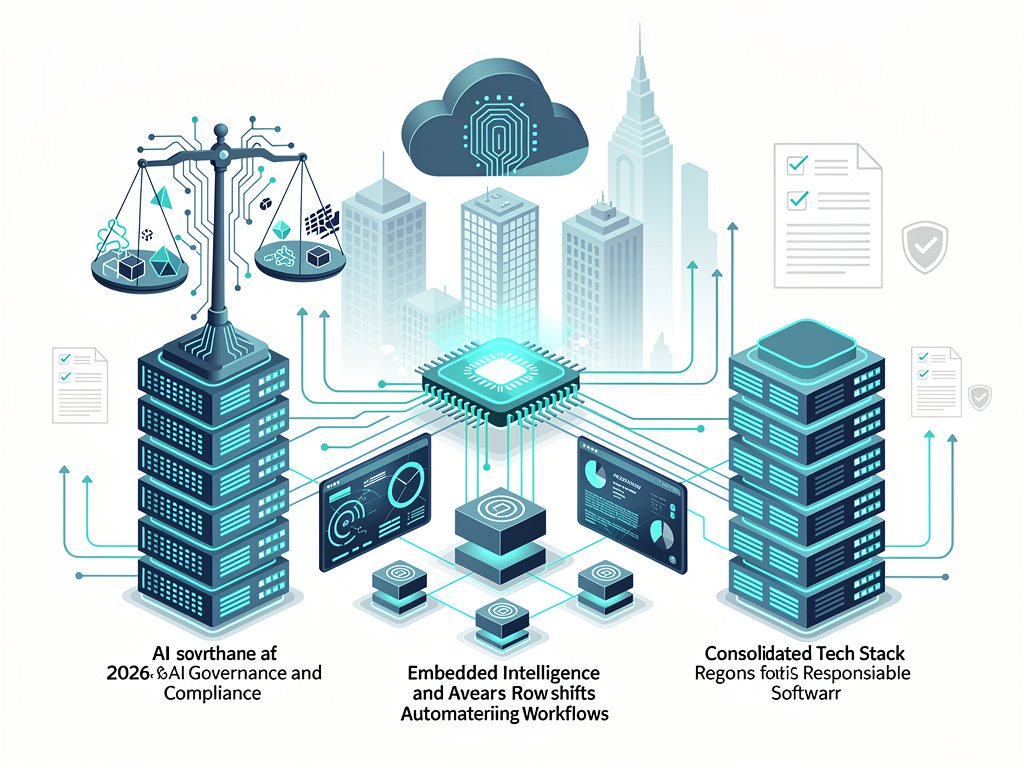
As accounting firms enter 2026, the profession faces a pivotal shift from experimental AI adoption to rigorous governance and streamlined technology stacks. Experts predict a year where measurable returns on tech investments will define success, with overhyped tools facing the axe. “2026 is shaping up to be a reckoning year for the accounting profession’s relationship with technology. Firms will finally stop tolerating tools that no longer deliver measurable value and will subject every piece of software in their stack to audit-level scrutiny,” said Ariege Misherghi, senior vice president and general manager at Bill.
AI governance emerges as the top priority, moving beyond novelty to responsible implementation. Boards demand AI inventories, model risk frameworks, and guardrails for high-risk uses, paralleling cybersecurity scrutiny. “The question is no longer whether to use AI, it’s how to use it responsibly and defensibly,” noted Avani Desai, CEO of Schellman, in the same Accounting Today report.
Will Bible, audit and assurance partner at Deloitte, envisions accountants shifting from routine tasks to overseeing AI outputs. “In 2026, I envision that the staff accountant’s role could start to shift from executing accounting processes to orchestrating technology, leveraging their judgment to review exceptions,” he stated.
AI’s Pivot to Proven Value
Dan Priest, chief AI officer at PwC, emphasizes new governance techniques like automated red teaming and deepfake detection to manage risks while scaling AI. Executives are forming cross-functional AI councils, embedding oversight into risk management. This focus aligns with broader demands for ROI, as CFOs treat AI as core capital expenditure rather than experiments.
Alex Cedro, vice president of finance at Tipalti, urges alignment on AI strategies linked to operating models. “CFOs must stop funding AI as fragmented experiments and start treating it as a core capital expenditure for a new operating system,” he advised in Accounting Today.
Josh Schauer, CFO at Insightsoftware, highlights AI’s role in strategic advising. “More CFOs are starting to see… AI is more than automation, it’s a tool to become a more effective strategic advisor,” he said, noting tools for real-time scenario planning amid tariffs and market shifts.
Embedded AI Reshapes Workflows
Craig Sullivan, group vice president at Oracle NetSuite, predicts AI agents embedded in workflows via standards like Model Context Protocol, ensuring secure, contextual insights. Jeremy Ung, chief technology officer at BlackLine, foresees “ambient AI” integrated into daily tools, driving down costs and boosting adoption amid budget constraints.
In a related Accounting Today analysis, Tammy Coley of BlackLine stressed governance for AI ambitions, signaling a decline in standalone solutions for embedded, invisible AI. Davis Bell, CEO of Canopy, termed this “ambient AI,” where platforms consolidate data for AI value.
Michele Shepard, chief revenue officer at Emburse, sees AI as infrastructure for revenue teams, anticipating risks and accelerating processes. “In 2026, AI won’t be something revenue teams ‘adopt’ — it will be the infrastructure they’re built on,” she predicted.
Integration Drives Competitive Edge
Erik Asgeirsson of CPA.com forecasts connected, agentic AI systems reinventing practice areas. Adam Orentlicher, senior vice president at Wolters Kluwer, anticipates full integration as the norm, with high-growth firms 53% more likely to have deeply integrated systems per the 2025 Future Ready Accountant report.
Matt Fargo of Kurtz Fargo LLP notes major providers integrating AI into core platforms, shifting focus to judgment and strategy. Glenn Friedman of Prager Metis highlights real-time workflows from e-invoicing and unified systems for tax and ESG.
Christopher McPhee, chief information officer at PKF O’Connor Davies, describes tech as the central nervous system for client experiences. In CPA Practice Advisor, integrated tech correlates with 80% revenue growth.
Tech Stack Rationalization Accelerates
Justin Pulgrano of Crunchafi predicts consolidation to reduce complexity, favoring multi-use platforms. Eva Mrazikova of IRIS Accountancy calls unified systems essential, eliminating silos amid compliance demands.
Davis Bell details AI-augmented workflows and unified search evolving platforms into command centers. Jarrod Randall of Xero anticipates more solo firms empowered by AI, plus virtual communities for collaboration, as per Accounting Today‘s 16 predictions.
Cloud dominance grows, with CPA Practice Advisor expecting RPA and cloud platforms to streamline tasks, reduce errors, and manage deadlines. Robotic Process Automation bots pull data, monitor compliance, and flag issues.
Regulatory and Emerging Pressures
The AICPA notes states eyeing AI, digital assets, and ESG frameworks in its advocacy report. FASB updates require expense disaggregation by 2026, per NetSuite.
Blockchain gains for audits, alongside predictive analytics and ESG tools, as outlined in StartUs Insights. Firms prioritizing tech-savvy talent and upskilling will lead, with 75% boosting tech skills in recruitment.


 WebProNews is an iEntry Publication