
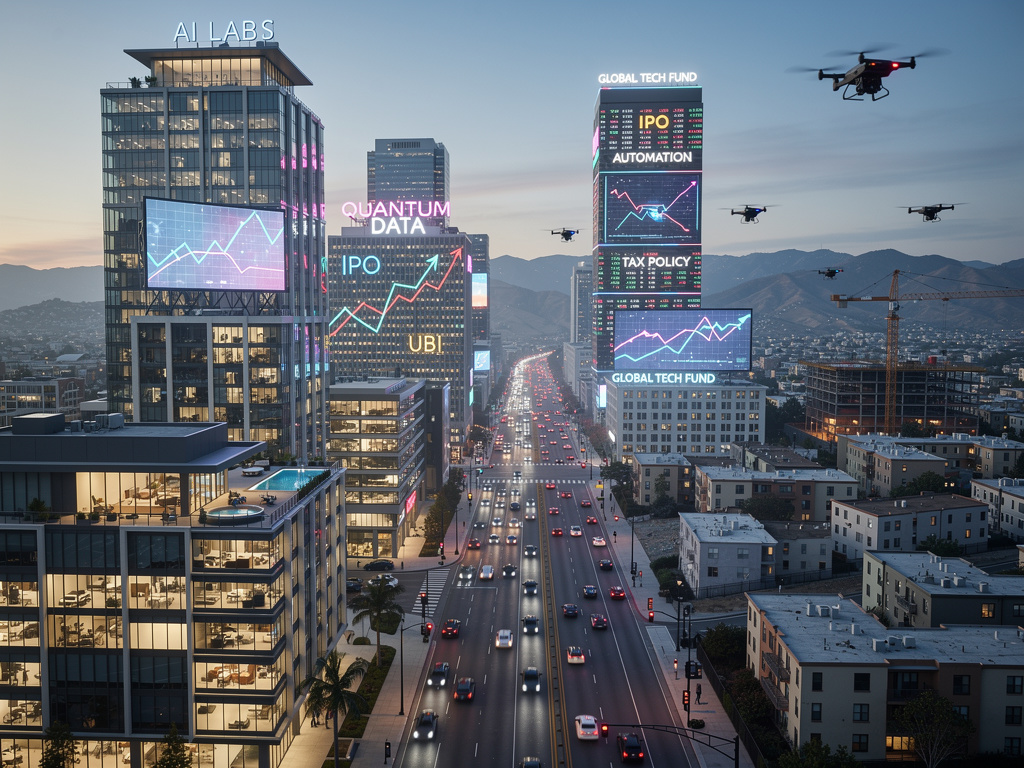
Silicon Valley’s elite are gripped by a stark conviction: the ongoing artificial intelligence surge might represent the final frontier for building enduring fortunes. Leaders like Elon Musk, Sam Altman of OpenAI, and Dario Amodei of Anthropic warn that advanced AI could render traditional income streams obsolete, thrusting society into an era of abundance where money loses its primacy. This fear fuels a high-stakes rush among entrepreneurs, investors, and workers to capitalize now, amid whispers of universal basic income and profound economic shifts.
The notion gained traction through viral discussions and statements from tech titans. Musk, in a recent podcast, described the transition as ‘bumpy,’ foreseeing ‘radical change, social unrest and immense prosperity.’ Such pronouncements echo across hacker forums and social media, where young professionals voice urgency akin to Sheridan Clayborne’s lament in the San Francisco Standard: ‘This is the last chance to build generational wealth. You need to make money now, before you become a part of the permanent underclass.’
Debates intensify as AI firms eye blockbuster initial public offerings. A New York Times report highlights 2026 as a pivotal year for mega IPOs from OpenAI, Anthropic, and SpaceX, poised to flood the region with cash for insiders and Wall Street. Real estate agent Rohin Dhar urged on X to ‘buy your house in San Francisco before this,’ anticipating a housing surge from newfound riches.
Tech Leaders’ Stark Warnings on Job Displacement
Anthropic’s Amodei has spotlighted risks of Great Depression-scale unemployment, while Musk envisions robots managing physical labor and AI dominating cognition, potentially leading to ‘universal high income.’ Yet he cautions that without resource scarcity, ‘it’s not clear what purpose money has,’ as noted at a prior conference. Altman, once a UBI proponent, now stresses human agency: ‘If you just say, ‘OK, AI is going to do everything and then everybody gets…a dividend from that,’ it’s not going to feel good,’ he told a podcaster last year, per the Wall Street Journal.
Nvidia CEO Jensen Huang offers a counterpoint, dismissing doomsday scenarios. In a Business Insider piece, Huang aligns with optimists, predicting AI will amplify human capabilities rather than erase them. Posts on X falsely attributed similar urgency to him, claiming 2025-2030 as the ‘last major chance’ for wealth-building, but his actual remarks to Joe Rogan emphasize equalization: ‘We’re going to have a wealth of resources…because it’s automated.’
These divergent views underscore Silicon Valley’s tension. A New Yorker analysis explores AI’s paradox: abundance for few, inequality for many, drawing on Musk, Amodei, and economists like Keynes. Meanwhile, California’s proposed wealth tax on founders’ voting shares, as covered by TechCrunch, stokes fears of exodus, amplifying the ‘get rich now’ ethos.
IPO Mania and the Housing Frenzy
Expectations of OpenAI and Anthropic listings dominate chatter. The New York Times details how the AI frenzy has minted paper billionaires from startups, mirroring past booms but with unprecedented scale. A Fortune report warns that Silicon Valley’s dismissal of public AI anxieties—over jobs and costs—could erupt by 2026.
San Francisco’s property market braces for impact. Dhar’s X post ties IPO windfalls to a boom, echoing predictions of ‘the mother of all tech booms.’ Recent data shows AI-driven ‘hard tech’ shifting focus from apps to infrastructure, per another New York Times feature, bolstering real estate bets amid shortages.
OpenAI’s talent wars add fuel. Times of India reports Altman poaching from Mira Murati’s Thinking Machines Lab, signaling fierce competition. Anthropic’s Claude advances in code generation, as per The Telegraph, position it for IPO glory.
Universal Basic Income Enters the Debate
UBI resurfaces as a hedge against displacement. Musk predicts AI eliminating poverty via ‘universal high income,’ per Business Insider. Altman concurs on job abundance but prioritizes purpose. Posts on X from Altman affirm: ‘agree with lots of what jensen has been saying about ai and jobs; there is a ton of stuff to do in the world.’
Critics highlight UBI’s clash with American ideals of self-reliance. A CNBC dispatch charts Big Tech’s data center expansion, incurring billions in debt to scale AI, raising questions on who funds any safety net.
Social media amplifies sentiment. Musk’s X posts decry California’s spending, warning of ‘cooked golden geese,’ while stressing low birth rates and immigration strains on resources. Huang’s views, debated by ex-Tesla AI head Andrej Karpathy in Times of India, urge engineers to adapt, not pivot entirely to AI oversight.
Wealth Redistribution Pressures Mount
California’s billionaire tax proposal targets equity stakes, per TechCrunch, prompting relocation talks. Musk’s feud with Altman over OpenAI control, recalled in Altman’s X post citing Musk’s $80 billion Mars city demand, underscores personal stakes.
The New York Times op-ed frames AI firms’ influence as imperial. Yet Huang, in X-aligned sentiments, sees productivity surges from Anthropic’s breakthroughs fixing global slumps.
Asset shifts loom: Musk touts art or scarcity amid abundance. As data centers reshape America—with OpenAI, Musk, and Zuckerberg’s billions in debt, per CNBC—insiders scramble, blending optimism with dread in this defining tech epoch.


 WebProNews is an iEntry Publication