
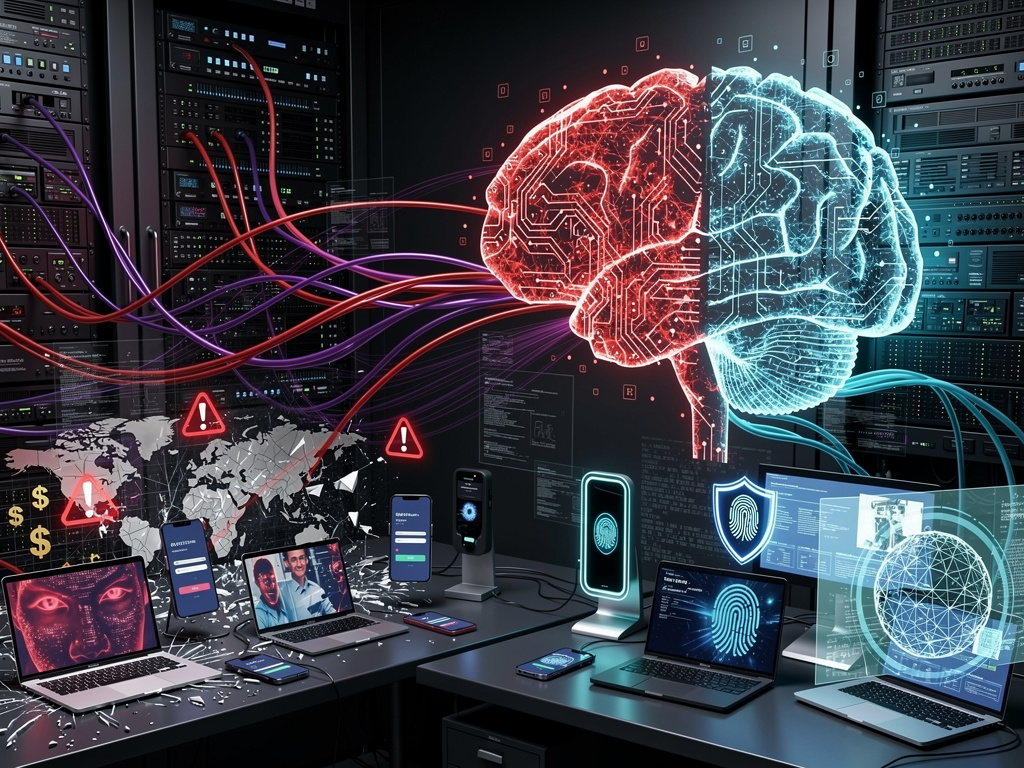
The AI Arsenal: Empowering Cyber Scams to New Heights
In an era where digital threats evolve at breakneck speed, artificial intelligence has emerged as a double-edged sword. While it bolsters defenses for many organizations, it simultaneously arms cybercriminals with tools that make scams more efficient, affordable, and elusive. Recent reports highlight how AI is transforming the realm of cybercrime, enabling fraudsters to launch sophisticated attacks with minimal resources. This shift is not just theoretical; it’s already reshaping how scams operate, from deepfake videos to automated phishing campaigns.
The core of this transformation lies in AI’s ability to automate and personalize deceit. Scammers no longer need advanced coding skills or large teams. Generative AI models can create convincing fake identities, craft tailored messages, and even simulate human voices or faces in real time. This democratization of cyber tools means that even small-time operators can execute schemes that rival those of organized crime syndicates. As a result, the volume and variety of scams are exploding, catching both individuals and businesses off guard.
Experts warn that the financial toll is staggering. Projections indicate that global cybercrime costs could reach trillions annually, with AI playing a pivotal role in amplifying these figures. For instance, AI-driven fraud is surging, making it harder for traditional detection methods to keep pace. This isn’t merely about more scams; it’s about smarter ones that exploit human psychology with unprecedented precision.
AI’s Role in Scaling Deception
One prominent example comes from deepfake technology, where AI generates realistic audio and video to impersonate trusted figures. Fraudsters use these to trick victims into transferring funds or revealing sensitive information. According to a report by Forbes, scammers are exploiting trust through deepfake video calls and fake tax bills, draining accounts with alarming accuracy. This tactic has become cheaper to deploy, as AI tools reduce the time and cost involved in creating convincing fakes.
Beyond deepfakes, AI enhances phishing and smishing attacks by generating context-aware messages. These aren’t generic spam; they’re customized based on scraped data from social media or public records. A piece from Axios Seattle notes that cheap deepfakes and automated hacks empower small groups to target large systems, potentially disrupting entire regions like Washington state’s infrastructure. The ease of access to AI means these threats are proliferating faster than ever.
The economic impact is profound. Cybercrime, supercharged by AI, is projected to cost the world economy $10.5 trillion yearly by the end of 2025, as highlighted in posts on X from cybersecurity analysts. These figures stem from a surge in phishing incidents, up over 1,200% in some categories, thanks to AI’s automation capabilities. Ransomware, too, has evolved, with AI helping attackers identify vulnerabilities and adapt malware on the fly.
Defenses Struggling to Catch Up
Organizations are racing to adapt, but the asymmetry favors attackers. AI allows cybercriminals to test and refine their methods rapidly, often outpacing security updates. For example, adaptive malware can mutate to evade antivirus software, as detailed in an analysis by Integrity360. This report explains how AI-powered phishing and malware are becoming more evasive, urging businesses to bolster their defenses with proactive measures.
On the defensive side, AI is also being harnessed to detect anomalies earlier. A year-in-review from Mastercard points out that advancements in AI help organizations spot threats sooner, while collaborations aim to curb text-based scams. Yet, the same technology that aids detection is weaponized by attackers, creating a cat-and-mouse game where innovation is constant.
Consumer risks are particularly acute. Recent news from gHacks Tech News emphasizes that AI-driven scams in 2026 will prioritize manipulation over direct hacking, using deepfakes to pressure individuals into compliance. This shift means everyday users face threats that feel personal and urgent, like fabricated emergencies from “family members” via AI-generated voices.
Emerging Trends in AI-Fueled Fraud
Looking ahead, experts predict a rise in synthetic identities and subscription traps. A story on KVIA outlines four key trends for 2026, including AI deepfakes and smart home hijacking, advising vigilance as these methods become more sophisticated. Synthetic identities, created by AI to mimic real people, are used for fraudulent loans or accounts, evading traditional verification.
Posts on X from industry figures like Dr. Khulood Almani underscore the top cybersecurity predictions for 2025, including AI-powered attacks and quantum threats. These social media insights reveal a consensus that AI is shifting focus from hype to practical, weaponized applications in cybercrime. One post notes a 180% surge in advanced fraud attacks this year, driven by generative AI producing flawless deepfakes and bots.
Moreover, the integration of AI with other technologies amplifies risks. For instance, prompt injection attacks allow hackers to manipulate AI systems themselves, as explored in a piece from ESET. This method turns defensive AI tools against their users, creating breaches that are harder to trace and mitigate.
Global Responses and Collaborative Efforts
International bodies are stepping up. The World Economic Forum discusses how AI-driven fraud challenges economies, advocating for digital identity wallets and biometrics as countermeasures. These solutions aim to verify identities more robustly, reducing the effectiveness of AI-generated fakes.
In the U.S., collaborations between tech firms and regulators are chipping away at scam proliferation. Mastercard’s review mentions partnerships targeting text scams, which have seen a decline due to AI-enhanced monitoring. However, the global nature of cybercrime means no single entity can tackle it alone; cross-border initiatives are essential.
Small businesses, often the most vulnerable, face unique challenges. A blog from Fuse Technology Group warns that AI makes scams faster and harder to detect, especially during peak seasons like summer when vigilance might wane. Cybercriminals leverage this, using AI to ramp up attacks when defenses are down.
The Human Element in an AI-Driven World
Amid technological arms races, the human factor remains crucial. Scams succeed by exploiting trust and emotion, areas where AI excels in simulation. Posts on X highlight how social engineering, powered by AI, has led to billions in crypto losses this year, with mental “firewalls” recommended as a first line of defense.
Education plays a vital role. Initiatives to raise awareness about AI scams are gaining traction, teaching users to verify suspicious communications. For instance, recognizing signs of deepfakes—like unnatural blinking or audio glitches—can prevent falling victim.
Yet, as AI evolves, so must training. Experts from TechInformed, in their predictions for 2026 available at TechInformed, warn that AI will arm attackers with autonomous threats, urging leaders to prepare for identity-centric attacks.
Innovations Countering the Tide
Defensive innovations are emerging. Biometric authentication, resistant to many AI manipulations, is being integrated into more systems. The World Economic Forum’s piece emphasizes this as a path to a secure digital future.
AI itself is key to countermeasures. Advanced models can analyze patterns in real time, flagging anomalies before damage occurs. Integrity360’s analysis suggests investing in AI-driven defenses to stay ahead of evolving risks.
Collaborative platforms are also vital. Sharing threat intelligence across industries helps preempt attacks. As noted in X posts, the convergence of AI in both attack and defense signals a new era where rapid adaptation is non-negotiable.
Looking Toward a Resilient Future
The proliferation of AI in cybercrime demands multifaceted strategies. Regulatory frameworks are tightening, with calls for AI governance to limit misuse. For example, policies mandating transparency in AI-generated content could curb deepfakes.
Businesses are advised to adopt zero-trust models, verifying every access attempt. This approach, combined with employee training, forms a robust barrier.
Ultimately, while AI supercharges scams, it also empowers solutions. Balancing innovation with security will define the next phase of digital resilience, ensuring that technology serves protection rather than predation. As 2025 closes, the imperative is clear: adapt swiftly or risk being outmaneuvered in this high-stakes digital arena.


 WebProNews is an iEntry Publication