
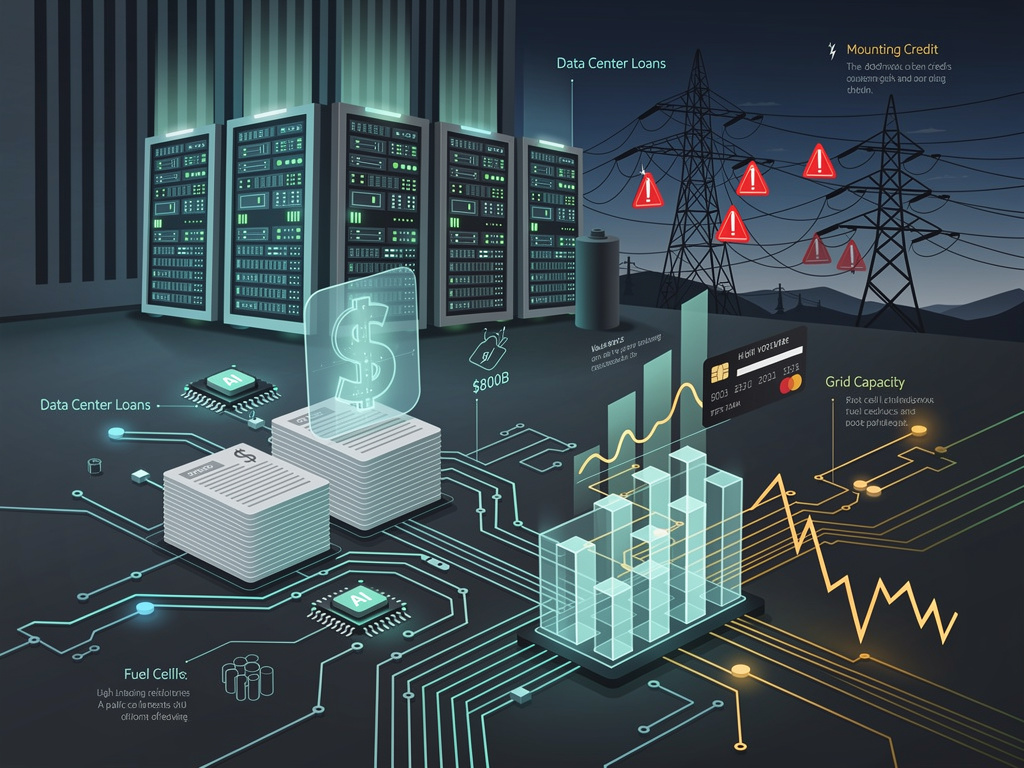
Greed has long spurred capitalist ingenuity, much like water cannons in the California gold rush or securitization machines in the early 2000s mortgage surge. Today, energy and credit bottlenecks throttle the artificial-intelligence boom, prompting a wave of innovations that ease grid pressures and balance-sheet strains while pumping more air into the AI bubble, as detailed in a January 15 article from The Economist.
Power suppliers reel from electricity demands to fuel AI chips in sprawling data centers. Operators bypass grid delays by building their own generators, embracing ‘bring your own power’ models with fuel cells, batteries, and natural-gas turbines. These carry higher costs and equipment risks compared to reliable grid access, yet they propel expansion.
In finance, banks shy from massive AI loans due to capital rules, creating openings for private-credit firms funded by life insurers. These entities originate data-center loans or snap up tailored tranches from bank portfolios. Morgan Stanley projects private-credit involvement in data-center financing hitting $800 billion through 2030, half the anticipated borrowing total.
Grid Pressures Ignite Onsite Power Rush
Bloom Energy exemplifies the shift, partnering with Brookfield Asset Management in a fuel-cell venture. Evercore analysts note this confirms Bloom’s role in AI energy buildouts, expecting sales growth and margin gains. Bloom’s CEO K.R. Sridhar forecasts prolonged AI infrastructure spending, with production ramping to 2 gigawatts by December 2026, per a CNBC report from January 11.
U.S. electricity demand surges, with data centers poised to consume 6.7% to 12% of national power by 2028, according to the Department of Energy. Goldman Sachs anticipates AI driving up to 165% growth in global data-center power needs by 2030. Utilities face transmission buildouts costing billions, passing expenses to residential bills—up to $18 monthly in parts of Maryland and Ohio, as flagged by the Institute for Energy Economics and Financial Analysis.
BlackRock’s investor survey reveals preference for energy and infrastructure plays over big tech for 2026 AI exposure, with only 7% viewing it as a bubble, according to a Reuters piece on January 13. Data-center power demand could hit 106 gigawatts by 2035, a 36% jump from prior forecasts, per BloombergNEF.
Private Credit Steps Into AI Funding Void
Debt piles up rapidly, with hyperscalers eyeing $120 billion in borrowings almost overnight, as noted in X discussions. Bank of America warns of an ‘air pocket’ from data-center debt mountains, predicting sluggish returns from interest burdens and overbuilding rather than a dot-com crash. JPMorgan argues AI differs from past bubbles, funded by cash-rich firms with 20% free-cash-flow margins double late-1990s levels.
Oracle’s $18 billion bond sale preceded a 37% stock plunge, highlighting risks. Meta, Alphabet, and Oracle face $86 billion in combined 2026 needs, per Societe Generale. Morgan Stanley sees debt for data centers exceeding $1 trillion by 2028. Yet profitability concentrates: top AI mega-caps generated over $300 billion in trailing free cash flow.
A Guardian analysis from January 4 warns AI shapes 2026 macro outcomes, with Deutsche Bank poll showing 57% of 440 investors citing tech valuation plunges as top market risk. Hyperscalers plan $490 billion in 2026 AI infrastructure, up from $300 billion in 2025.
Power Innovation Races Against Demand Surge
AI racks demand 30-100+ kilowatts versus 7-10 for traditional servers; a ChatGPT query uses 2.9 watt-hours, tenfold a Google search. PJM capacity prices soared to $329.17 per megawatt for 2026-2027 from $28.92 prior year, driven by data centers. Utilities like National Grid invest $100 million in AI startups for grid efficiency.
Onsite solutions proliferate: Meta and xAI deploy gas turbines off-grid, per Tom’s Hardware. A Duke study shows data-center flexibility for 22 hours yearly accommodates 76 gigawatts sans new plants. Software turns centers into grid stabilizers, curbing peaks without performance hits, as tested on 256 Phoenix GPUs in a Nature Energy study.
BloombergNEF tracks 150 new projects, a quarter over 500 megawatts. Amazon Web Services commits $50 billion for 1.3 gigawatts starting 2026. China meets demand via renewables and nuclear, generating over 10,000 terawatt-hours annually.
Debt Risks Loom Amid Profit Pressures
Only a few firms profit reliably from AI, risking credit meltdowns if unchanged, per The Economist. MIT’s report notes 95% of generative AI investments yield zero returns despite $30-40 billion spent. U.S. mega-cap spending hits $1.1 trillion from 2026-2029, total AI over $1.6 trillion, Wikipedia summarizes.
Ray Dalio likens AI investments to dot-com; Bridgewater’s co-CIO flags similarities. Goldman Sachs dismisses bubble fears, citing demand exceeding supply. Nvidia’s Joseph Colello tells The New York Times no bubble through 2026, with hyperscalers hiking capex.
X users like @thexcapitalist highlight debt-driven sluggishness; @Macrobysunil predicts bigger-than-2008 bust from leverage. BlackRock’s Larry Fink eyes utilities and infrastructure for AI power demands.
Global Repercussions and Investor Shifts
Investors pivot: BlackRock favors providers over big tech. Fortune notes AI bubble in grid forecasts, with PPL facing scrutiny. EIA projects 17.7 cents per kilowatt-hour by 2026, up 36% since 2021. States like Oregon mandate data centers cover grid strains.
Innovations promise spillovers: new energy approaches and credit for non-self-funded AI. Yet dangers persist—BYO power risks failures, private credit experiments unproven. As The Economist cautions, these advances inflate the bubble, potentially rocking finance if profits lag.


 WebProNews is an iEntry Publication