
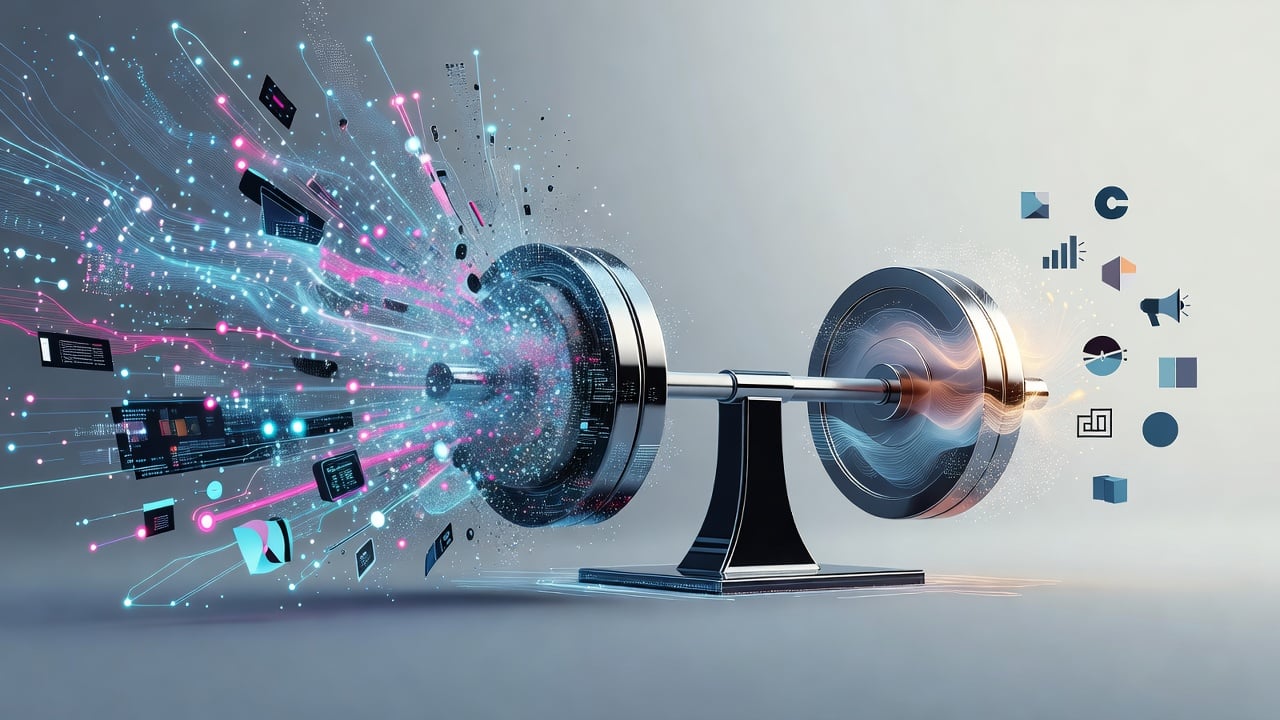
AI output has exploded. Content floods every channel. Brands face a supply shock that changes how they pursue attention.
Kaylen McNamara, chief business officer at VaynerX, laid out the framework in Ad Age today. The piece, published June 26, 2026, describes a “Barbell of Relevance.” One end pulls toward hyper-personalized, AI-driven experiences. The other demands raw, human, offline moments that stand apart from the machine-generated noise. Ad Age
Every major technological shift creates a corresponding counterforce, McNamara notes. AI’s abundance makes scarcity valuable again. Generic AI content becomes invisible. Brands that lean only into scale risk blending into the feed.
Attention splits into extremes. Consumers crave connection while adjusting to being chronically offline. On the far side, AI, answer engines, and live shopping accelerate. Playing it safe in the middle makes a brand invisible.
McNamara’s team has tracked this at Vayner for months. Marketers feel stuck. Last year the question was whether AI would stick. This year it is full acceptance beyond pilots and into scaling. Fear of losing brand humanity and AI slop has grown. The experiential layer solves both: it grabs attention and restores the humanity people seek.
Recent industry reports echo the tension. StackAdapt’s State of Personalization report from February 2026 found 93 percent of brands and 94 percent of agencies agree AI improves personalization. Yet only one in five have fully integrated it across channels. StackAdapt
McKinsey’s analysis released this week on the future of marketing highlights five AI capabilities: insights, creativity, personalization, agentic commerce, and optimization. The report stresses continuous growth over campaigns. McKinsey
Brands test both poles. One side uses AI for real-time creative variation and one-to-one messaging at massive scale. The other invests in live events, physical activations, and unscripted creator moments that feel human by design.
Data unification remains a hurdle. Nearly half of agencies in the StackAdapt study point to data unification, AI-powered creative optimization, and cross-channel orchestration as the biggest upcoming drivers. Eighty-seven percent of brands plan to increase personalization spend this year. Few activate high-intent tactics beyond owned channels.
Brands that master both ends win the middle.
Hyper-personalization at scale now serves as default expectation rather than differentiator. AI generates content variations instantly. Assistants surface options before intent forms. Yet the report from Onclusive on 2026 marketing trends notes success requires supervising AI systems instead of creating every piece. Onclusive
VaynerX has taken the barbell concept on the road. A fireside chat at Cannes Lions this month drew marketers eager for the framework. Attendees described the two extremes: algorithmic scale on one side, analog human connection on the other.
Consumer behavior supports the split. Some audiences seek the unplugged now. Others move deeper into AI-mediated discovery. Brands ignoring either side lose relevance fast.
McNamara’s view aligns with broader signals. Generative AI reduces demand for routine content production while opening doors for agencies that orchestrate strategy and experience. ScienceDirect published research this year on the topic. ScienceDirect
The supply shock does not end personalization. It raises the bar. AI handles volume. Brands must supply meaning at the edges.
Execution demands clarity on where to apply each approach. Heavy AI investment without human anchors produces polished irrelevance. Pure experiential play without scale limits reach. The barbell rewards deliberate tension between the two.


 WebProNews is an iEntry Publication