
The demand for office space among artificial intelligence companies has surged in recent years, reshaping commercial real estate patterns across major American cities. A recent analysis from VTS, a prominent commercial real estate technology firm, highlights how AI-focused businesses now account for a growing share of leasing activity, particularly in technology hubs like San Francisco. According to the report covered by The Next Web, these companies have driven notable increases in occupancy rates and rental commitments, signaling a shift in how innovation sectors interact with physical workspaces.
San Francisco stands out in this trend, with AI enterprises concentrating their operations in the city’s downtown and South of Market districts. Data from the VTS study shows that AI-related tenants represented nearly 15 percent of all new office leases signed in the Bay Area during the first half of the year, a significant jump from previous periods when such activity hovered below 5 percent. This concentration reflects both the rapid expansion of established players like OpenAI and Anthropic and the arrival of numerous startups seeking proximity to talent pools and collaborative environments. Real estate professionals observe that these firms often prioritize locations with high-speed fiber connectivity, access to public transit, and proximity to universities that supply skilled graduates in machine learning and data science.
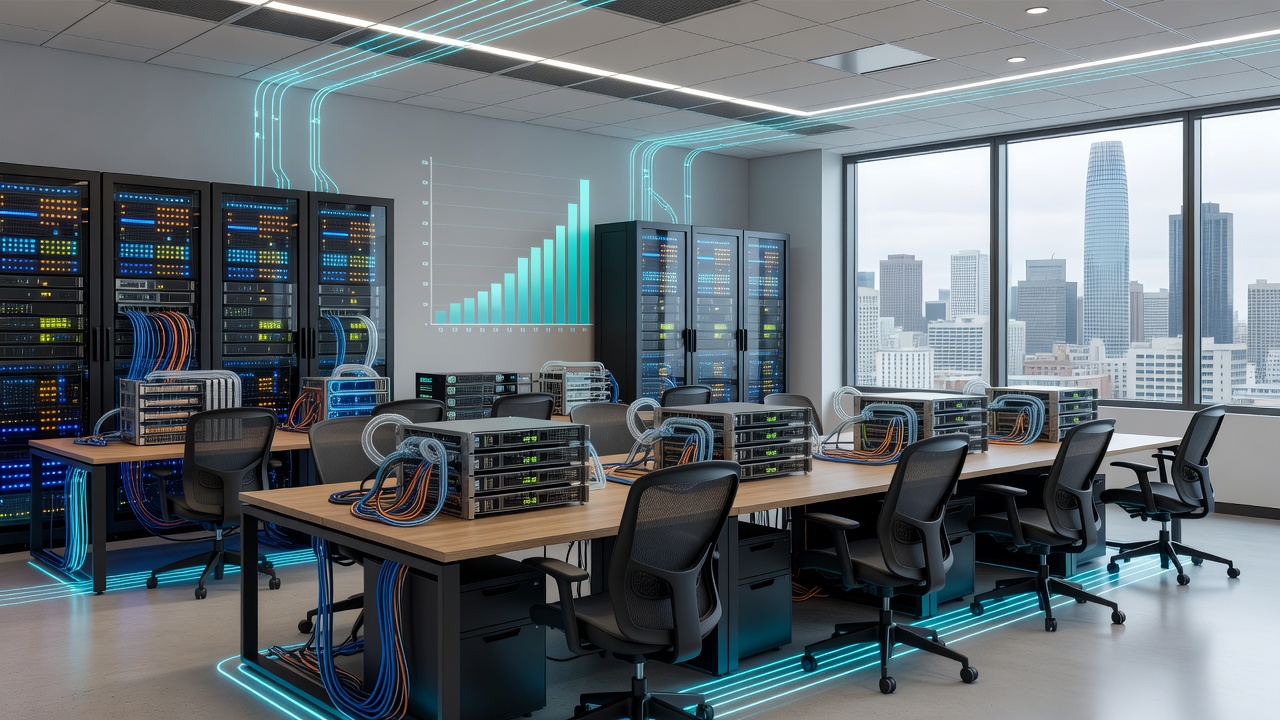
The preference for San Francisco among AI companies stems from several practical factors. First, the city maintains one of the highest densities of machine learning researchers and engineers in the country. Companies report that face-to-face collaboration accelerates problem-solving on complex models that require constant iteration between teams. While remote work remains common for many roles, core research and product development groups tend to cluster together, leading to higher square footage requirements per employee than in traditional software firms. VTS data indicates that AI tenants are leasing an average of 180 square feet per worker compared to 120 square feet for general technology companies, largely to accommodate specialized computing hardware and testing laboratories.
This demand arrives at a time when overall office occupancy in San Francisco has struggled to recover from pandemic-era declines. Vacancy rates that peaked above 30 percent have begun to moderate in select submarkets where AI activity is strongest. Buildings that have successfully attracted AI tenants often feature modern infrastructure capable of supporting dense server installations and advanced cooling systems. Landlords have responded by investing in upgrades such as reinforced flooring for heavy equipment, dedicated electrical substations, and enhanced backup power supplies. These modifications, while expensive, have allowed certain properties to command premium rents that exceed market averages by 25 to 40 percent.
Beyond San Francisco, the VTS report identifies similar patterns emerging in other technology centers, though on a smaller scale. In New York, AI companies have gravitated toward Manhattan’s Flatiron and Hudson Yards neighborhoods, drawn by access to financial sector partners who increasingly incorporate machine learning into trading algorithms and risk assessment tools. Boston’s Seaport district has also seen an uptick in AI leasing, fueled by connections to academic institutions like MIT and Harvard. However, the report notes that none of these markets match the intensity of activity found in the Bay Area, where venture capital funding for AI ventures has continued to flow at record levels despite broader economic uncertainty.
The influx of AI companies carries both opportunities and challenges for commercial real estate markets. On the positive side, these tenants tend to sign longer leases, often committing to five to ten years rather than the three-year terms common among other startups. Their financial backing from major investors provides stability that reassures property owners concerned about credit risk. Additionally, the presence of prominent AI firms can create a halo effect that attracts supporting businesses, including specialized legal practices, data annotation services, and hardware suppliers. This clustering effect has helped stabilize assessed property values in previously underperforming buildings.
Yet the concentration of AI activity also raises questions about market balance. Traditional industries such as finance, law, and professional services continue to reduce their office footprints through hybrid work arrangements. As a result, buildings that fail to attract technology tenants face prolonged vacancies and pressure to lower rents. Some property owners have begun converting older structures into laboratory space or mixed-use developments that combine offices with residential units to broaden their appeal. Others are exploring partnerships with AI companies to co-develop properties specifically designed for high-performance computing needs.
Energy consumption presents another significant consideration. Training and running large language models requires substantial electricity, and many AI firms now factor power availability into their site selection decisions. In San Francisco, where the grid already faces capacity constraints during peak summer months, this demand has prompted discussions about infrastructure investments. Some companies have explored locating secondary facilities in regions with abundant renewable energy sources, such as the Pacific Northwest or parts of Texas, while maintaining primary research operations in the Bay Area. The VTS analysis suggests this dual-location strategy may become more common as AI computation scales.
Talent attraction remains central to location decisions. AI researchers often prefer living in vibrant urban environments with access to cultural amenities, excellent restaurants, and outdoor recreation. San Francisco offers these lifestyle benefits alongside competitive compensation packages that have become standard in the industry. Companies like Anthropic and xAI have expanded their local presence partly to compete for the limited pool of qualified candidates. This competition has driven up salaries and benefits, further increasing the financial commitment these organizations make to their physical workspaces.
The report from VTS also examines how AI companies approach office design differently from previous generations of technology firms. Rather than open floor plans with ping-pong tables and free snacks, many AI organizations prioritize quiet zones for focused work, secure areas for handling sensitive data, and flexible meeting spaces that support both in-person and hybrid collaboration. Some have incorporated specialized facilities for hardware prototyping and model evaluation that require soundproofing and climate control. These customized requirements have led to more negotiated lease terms, with tenants seeking greater input on building systems and future expansion options.
Looking ahead, the sustained growth of AI adoption across industries suggests that demand for suitable office space will persist. Sectors ranging from healthcare to manufacturing are integrating machine learning capabilities, creating opportunities for specialized AI consultancies and product developers. As these applications mature, companies may require larger footprints to accommodate growing teams and demonstration centers where potential clients can interact with the technology. Property developers who anticipate these needs by preparing buildings with adequate power capacity and networking infrastructure may gain competitive advantages in leasing markets.
Challenges remain, particularly around public perception and regulatory scrutiny. Some San Francisco residents have expressed concerns about the rapid expansion of technology companies contributing to housing costs and displacement in surrounding neighborhoods. City officials have responded with proposals for impact fees on large leases and requirements for community benefit agreements. How these policy discussions resolve could influence the pace of AI-related leasing activity in the coming years.
The VTS findings underscore a broader truth about commercial real estate: specific industry waves create distinct geographic patterns of demand. Just as social media companies transformed certain San Francisco districts in the early 2010s, AI enterprises are now leaving their mark on the city’s built environment. Their preference for particular building characteristics and neighborhood attributes provides clear signals for investors and developers seeking to align their strategies with emerging economic forces.
Property technology platforms like VTS play an increasingly valuable role in tracking these shifts through comprehensive leasing databases and market analytics. By aggregating transaction data across thousands of buildings, such platforms enable more accurate forecasting and help stakeholders understand which factors drive tenant decisions in different market cycles. The granularity of their AI-specific analysis offers insights that extend beyond simple vacancy statistics to reveal preferences around building age, amenities, and location attributes.
As artificial intelligence continues advancing, its physical presence in American cities will likely expand. The current concentration in San Francisco may moderate over time as secondary markets develop stronger talent pipelines and supporting infrastructure. Companies might establish satellite offices in emerging technology centers like Austin, Denver, or Raleigh to tap into different labor markets while maintaining core operations in the Bay Area. This dispersion could help distribute economic benefits more broadly while easing pressure on San Francisco’s commercial real estate market.
For now, the data clearly shows AI companies as a primary driver of new office absorption in key markets. Their leasing activity has provided a much-needed boost to downtown areas still recovering from reduced demand in other sectors. Building owners who successfully adapt their properties to meet the technical and collaborative requirements of these innovative firms stand to benefit from stable, long-term tenancies and enhanced asset values. The coming years will reveal how this dynamic evolves as artificial intelligence moves from research laboratories into widespread commercial applications across the economy.


 WebProNews is an iEntry Publication