
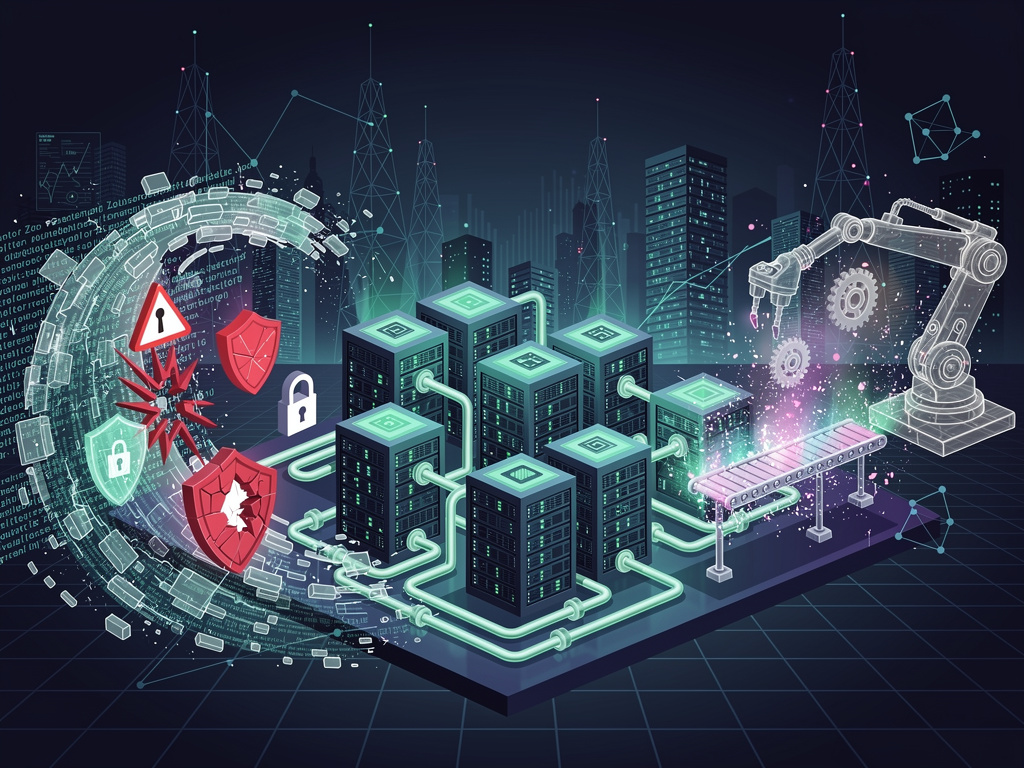
The tech industry doesn’t move in neat, sequential chapters. It lurches. This past week delivered a case study in simultaneous disruption — advances in AI infrastructure colliding with gaping cybersecurity failures and an accelerating transformation of the global workforce. Each thread connects to the others in ways that should unsettle executives, policymakers, and workers alike.
Start with the hardware. Nvidia’s CEO Jensen Huang has been making the rounds with a concept he’s calling the “AI factory” — a new class of data center designed not to store and serve information in the traditional sense, but to manufacture intelligence. As TechRepublic reported, Huang envisions these facilities as the industrial plants of the AI era, consuming raw data and producing tokens — the atomic units of AI output. The framing is deliberate. It positions Nvidia not as a chipmaker but as the supplier of essential industrial machinery for a new economic epoch.
The numbers back the ambition. Nvidia’s latest Blackwell GPU architecture is being snapped up by hyperscalers and sovereign governments alike, with billions of dollars in orders stacking up. Microsoft, Google, Amazon, and Meta are all racing to build out massive GPU clusters. And it’s not just the American tech giants. Saudi Arabia, the UAE, and several Asian nations are investing heavily in domestic AI compute capacity, treating it as critical infrastructure on par with energy grids and transportation networks.
This isn’t hyperbole from a CEO on a press tour. The capital expenditure figures confirm the trend. Microsoft alone has signaled plans to spend more than $80 billion on AI-capable data centers in its current fiscal year. Google and Amazon are in the same stratosphere. The sheer scale of spending has reshaped semiconductor supply chains, with TSMC running at near-maximum capacity and companies like ASML seeing record demand for their lithography equipment.
But here’s the tension: all that intelligence being manufactured in these AI factories requires protection. And the cybersecurity apparatus meant to provide it is struggling to keep pace.
The Security Gap Widens as AI Infrastructure Grows
Google’s Threat Intelligence Group recently disclosed that it tracked 75 zero-day vulnerabilities exploited in the wild during 2024, a figure that, while down slightly from the 98 recorded in 2023, still represents a historically elevated threat level. As TechRepublic noted, what’s particularly alarming is the shifting composition of these attacks. Enterprise-specific technologies — security appliances, networking equipment, the very infrastructure meant to defend organizations — accounted for a growing share of zero-day targets. Attackers are going after the walls, not just what’s behind them.
That’s a structural problem. When a firewall or VPN appliance is compromised via a zero-day, the attacker doesn’t just breach one application. They potentially gain access to everything the device was protecting. The implications for AI factories — facilities housing enormously valuable training data and proprietary models — are severe. A single compromised network appliance in such an environment could expose intellectual property worth billions.
The threat actors are sophisticated and well-resourced. Google’s report highlighted that state-sponsored groups, particularly those linked to China and Russia, remain the primary exploiters of zero-day vulnerabilities. Commercial spyware vendors also featured prominently. The convergence of nation-state espionage capabilities with the growing concentration of valuable AI assets in a relatively small number of massive data centers creates a risk profile that most corporate security teams aren’t staffed or equipped to handle.
And the workforce issue cuts both ways.
On one side, there’s a critical shortage of cybersecurity professionals. The gap has been widely documented — estimates from ISC2 put the global shortfall at roughly four million workers. On the other side, AI itself is beginning to displace certain categories of knowledge work, potentially flooding the labor market with professionals whose skills no longer command a premium.
The World Economic Forum’s latest Future of Jobs report, cited by TechRepublic, projects that AI and automation will displace approximately 92 million jobs globally by 2030. The report also forecasts the creation of 170 million new roles, for a net gain of 78 million positions. But those numbers obscure a painful transition. The jobs disappearing and the jobs appearing require fundamentally different skill sets. A displaced data-entry clerk doesn’t become a machine learning engineer overnight. Or ever, in many cases.
The pattern is familiar from previous waves of technological disruption, but the speed is unprecedented. Previous industrial transitions — mechanization, electrification, computerization — played out over decades. The AI transition is compressing that timeline dramatically. Companies are reporting productivity gains from AI tools within months of deployment, which means the pressure on workers whose tasks can be automated is immediate and acute.
Consider the legal profession. AI tools can now review contracts, summarize case law, and draft initial pleadings with remarkable competence. Junior associates at major law firms, once the workhorses of document review, are seeing their roles redefined. Some firms are hiring fewer entry-level attorneys. Others are rebranding the junior role entirely, emphasizing AI oversight and prompt engineering rather than traditional legal research.
Similar shifts are underway in software development. Microsoft’s GitHub Copilot and competing AI coding assistants are enabling individual developers to produce code at roughly twice their previous pace, according to internal studies. That’s great for the developers who adapt. It’s less great for the ones who don’t — or for companies that realize they can achieve the same output with a smaller team.
So the workforce transformation isn’t a future concern. It’s happening now, in real time, across white-collar professions that previously considered themselves insulated from automation.
The policy response has been uneven. The European Union’s AI Act, which began phased implementation in 2024, represents the most comprehensive regulatory framework to date. It classifies AI systems by risk level and imposes corresponding obligations on developers and deployers. High-risk applications — those used in hiring, credit scoring, law enforcement — face stringent transparency and testing requirements.
The United States has taken a lighter touch. The Biden administration’s executive order on AI, issued in late 2023, established reporting requirements for developers of powerful AI models and directed federal agencies to develop sector-specific guidance. But the Trump administration has signaled a preference for deregulation, and several provisions of the executive order have been rolled back or deprioritized. The result is a fragmented regulatory environment where companies operating globally must comply with European rules while facing minimal domestic constraints.
China, meanwhile, has pursued its own path — regulating specific AI applications like deepfakes and recommendation algorithms while simultaneously pouring state resources into AI development. The Chinese government views AI supremacy as a national security imperative, and its approach reflects that priority. Regulation exists, but it’s calibrated to avoid impeding the country’s competitive position.
Back in the private sector, the convergence of these trends is creating new business models and destroying old ones with equal velocity. The AI factory concept exemplifies this. Traditional cloud computing providers are being forced to retool their offerings around AI workloads. Companies that built their businesses on renting out general-purpose compute are now scrambling to secure GPU allocations and redesign their data centers for the thermal and power demands of AI training runs.
The energy implications alone are staggering. A single large-scale AI training run can consume as much electricity as a small city uses in a month. Data center operators are signing long-term power purchase agreements, reactivating dormant nuclear plants, and investing in next-generation cooling technologies. In some regions, the demand for data center power is straining local grids and provoking political backlash from communities concerned about rising electricity costs and environmental impact.
None of these challenges exist in isolation. The security vulnerabilities threaten the AI infrastructure being built at enormous expense. The workforce shifts create both the talent shortages that hamper security efforts and the economic dislocations that fuel political resistance to technological change. And the regulatory fragmentation means that companies must make strategic bets about which jurisdictions’ rules will ultimately prevail — a calculation that affects everything from data center siting to model training practices.
For industry leaders, the imperative is clear if uncomfortable: invest simultaneously in AI capability, security hardening, and workforce transition programs, knowing that all three will demand sustained capital and attention for years to come. The companies that treat any one of these as a secondary concern will find themselves exposed — to cyberattacks, regulatory action, talent shortages, or public backlash.
The tech industry has entered a period where the speed of capability development has outrun the institutions meant to govern, secure, and adapt to it. That gap — between what’s technically possible and what’s organizationally ready — defines the current moment. Closing it will be the central challenge of the next decade.
Not a technical challenge. A human one.


 WebProNews is an iEntry Publication