
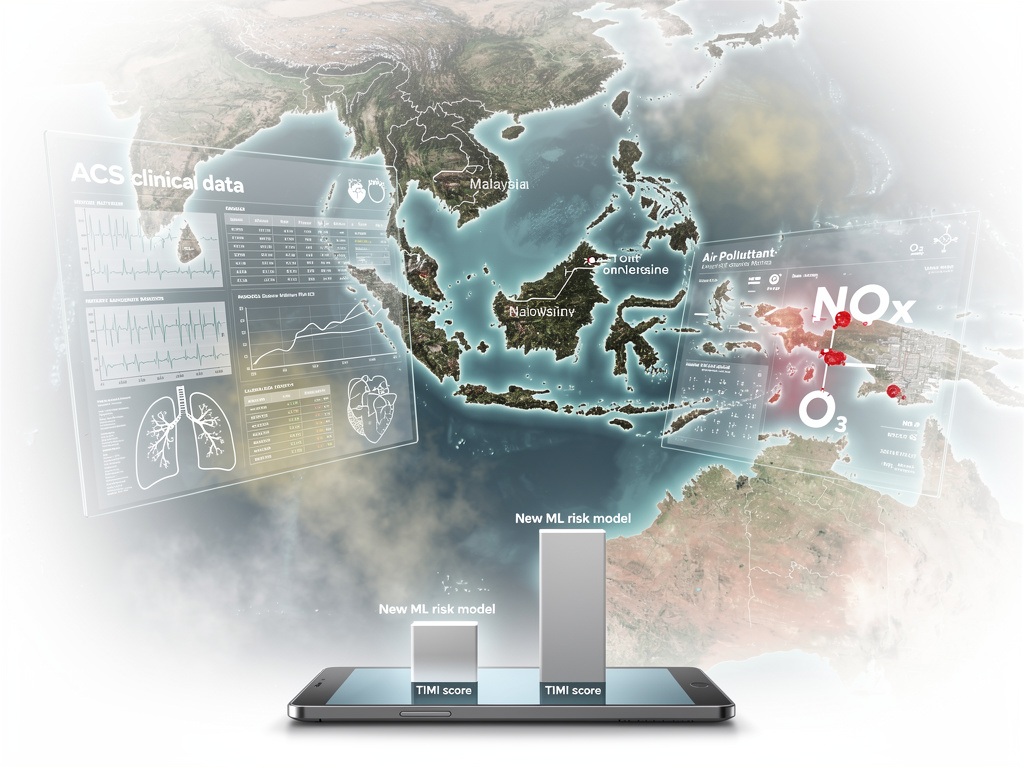
In the smog-choked cities of Southeast Asia, a new machine learning model is revealing how invisible pollutants like nitrogen oxides and ozone are turning acute coronary syndrome into a silent killer. Published this week in Scientific Reports, the study by Sazzli Kasim and colleagues at Universiti Teknologi Mara analyzes 14,145 Malaysian ACS cases from 2006 to 2017, fusing clinical data from the National Cardiovascular Disease Database with daily air quality metrics from the Department of Environment.
“Air pollution is a growing cardiovascular risk in Southeast Asia, particularly in the Western Pacific region where transboundary haze and urban emissions are prevalent,” the authors write. Traditional tools like TIMI risk scores overlook these environmental triggers, but the random forest algorithm here delivers an area under the curve of 0.843—beating TIMI’s 0.791 for STEMI and 0.565 for NSTEMI cases. Net reclassification improvements hit 8.71% for STEMI and a striking 86.94% for NSTEMI, both with p-values under 0.001.
SHAP analysis pins NOx and O₃ as top culprits alongside Killip class and fasting blood glucose, underscoring how haze from Indonesia’s fires and urban exhaust amplify in-hospital deaths.
Revolutionizing Risk in Polluted Skies
This breakthrough arrives amid escalating alarms. The World Heart Federation’s 2024 report warns air pollution drives millions of preventable cardiovascular deaths yearly, with PM2.5 claiming over 60% of pollution-linked heart fatalities globally, as detailed in its analysis. In Asia, where one in three deaths ties to dirty air per State of Global Air data, Southeast Asia bears outsized burdens from household and ambient sources.
Hourly pollutant spikes correlate with ACS onset, a Circulation study of 1.29 million Chinese patients found: PM2.5 interquartile rises (36 μg/m³) link to 1.32% higher risk, NO₂ (29 μg/m³) to 3.89%, as reported in PubMed. JACC’s state-of-the-art review confirms short-term PM2.5 elevations boost acute events by 1-3% within days, hitting those with existing artery disease hardest.
Western Pacific nations face transboundary threats: Malaysia’s haze episodes mirror regional patterns where urban emissions and seasonal fires spike NOx and O₃, directly fueling plaque rupture and inflammation.
ML Models Outpace Legacy Scores
Prior Asian ACS research, like a PLOS One study on Malaysian patients, showed artificial intelligence boosting in-hospital mortality predictions, yet ignored pollution. The new model fills this void, with random forest topping logistic regression, XGBoost, and ensembles. “Integrating environmental and clinical features improves ACS mortality prediction,” Kasim’s team concludes, urging validation across the region.
Global meta-analyses echo superiority: A European Journal of Medical Research review of ML for ACS mortality reports excellent predictive power, while ScienceDirect analyses peg gradient boosting and random forest AUCs at 0.918 and 0.913. In pollution-heavy contexts, these gains matter: Frontiers in Cardiovascular Medicine notes ML spotting weather-pollution interactions for ACS prevalence.
Southeast Asia’s vulnerabilities amplify urgency. A PLOS One study on Thailand’s air quality index tied PM2.5 to surges in ACS emergency visits, while Lancet forecasts ischemic heart disease dominating age-standardized mortality by 2050 across East, South, and Southeast Asia.
Pollutants Penetrate the Heart’s Defenses
NOx and O₃ don’t just irritate lungs—they inflame endothelium, stiffen arteries, and destabilize plaques. SHAP values in the Malaysian study rank them above many clinical markers, aligning with JACC findings that PM2.5 drives atherosclerosis from childhood. In high-exposure zones, long-term buildup correlates with post-ACS survival drops, per a European Heart Journal cohort.
Transboundary haze, a Western Pacific hallmark, crosses borders unchecked: Indonesia’s peat fires blanket Malaysia, spiking PM10 and precursors. Urbanization compounds this—Kuala Lumpur’s emissions mirror Beijing’s, where hourly NO2 triples ACS odds.
Broader data paints grim trends: Global Heart reports PM2.5 fueling ischemic heart disease, stroke, and heart failure, with Asia’s concentrations routinely breaching WHO guidelines. World Bank tallies $8.1 trillion in annual health damages, equivalent to 6.1% of global GDP.
From Data to Policy Imperatives
Malaysia’s NCVD-DOE fusion sets a template: scalable, interpretable ML for resource-strapped systems. External validation looms critical—the authors caution generalization needs testing in Thailand, Vietnam, Philippines. Yet potential shines: reclassifying NSTEMI risks by nearly 87% could slash preventable deaths.
X discussions amplify calls to action. Cardiothoracic surgeon Zain Khalpey tweeted on pairing exposome data with AI for heart failure prediction, while The Lancet highlighted pollution’s 9 million global deaths, many cardiac. India’s crisis mirrors: 1.27 million annual fatalities, half cardiovascular, per clinician Dorairaj Prabhakar.
Public health pivots needed: enforce standards (India’s 40 μg/m³ PM2.5 could cut hypertension 15%), fund registries linking air monitors to hospitals, deploy ML apps for real-time alerts. As Kasim’s framework proves, ignoring pollution dooms traditional scores—AI offers the precision to save lives in Asia’s toxic air.


 WebProNews is an iEntry Publication