
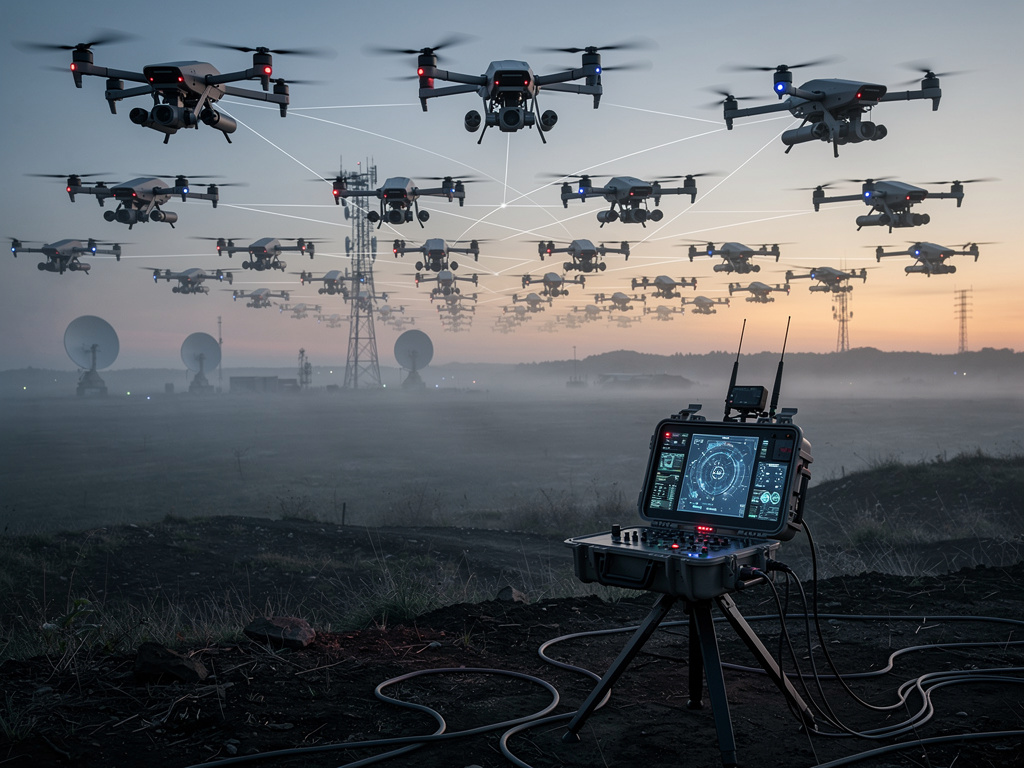
The Dawn of Swarm Command: Revolutionizing Battlefields with Solo Operators and Drone Legions
In the evolving theater of modern conflict, a paradigm shift is underway, driven by lessons from Ukraine’s front lines. Executives in the robotics sector are forecasting a future where a single soldier, augmented by artificial intelligence, orchestrates vast swarms of drones, transforming the dynamics of warfare. This vision, articulated by leaders in Ukrainian defense tech, underscores how technology is reshaping military strategies, making traditional manpower-intensive operations obsolete.
At the heart of this transformation is the push for multi-drone control systems. According to insights from Business Insider, the CEO of Ark Robotics emphasizes that enabling one operator to manage multiple unmanned aerial vehicles (UAVs) is essential for the “total drone warfare” on the horizon. Drawing from real-time experiences in Ukraine, where drones have become ubiquitous, this approach promises to amplify a soldier’s reach without exposing them to direct danger.
The integration of AI plays a pivotal role here. By automating routine tasks and decision-making processes, AI allows a lone operator to oversee dozens, if not hundreds, of drones simultaneously. This isn’t mere speculation; it’s grounded in ongoing developments where swarms can communicate autonomously, adapting to threats in real time and executing complex maneuvers that would overwhelm a human pilot managing them individually.
Elevating Human Oversight in Automated Skies
Ukraine’s conflict has served as a live testing ground for these innovations. Reports from the Center for Strategic and International Studies highlight how AI-enabled autonomy is being woven into unmanned systems, with human oversight retained for critical ethical and strategic decisions. As detailed in their analysis, advancements in machine learning allow drones to identify targets, navigate obstacles, and even coordinate attacks with minimal input, yet the emphasis remains on keeping soldiers in the loop to prevent unintended escalations.
This balance is crucial amid ethical debates surrounding lethal autonomous weapons. Industry insiders note that while full autonomy is technically feasible, the preference is for supervised systems where a single operator acts as a conductor, directing the swarm’s symphony. Such setups not only enhance efficiency but also align with international norms on warfare, ensuring accountability in an era of increasingly detached combat.
Moreover, the economic implications are profound. Producing swarms of inexpensive drones controlled by one person reduces the need for large-scale troop deployments, potentially lowering costs and casualties. Drawing from web sources, publications like CEPA discuss how drone proliferation in Ukraine has democratized high-impact operations, enabling smaller forces to challenge larger adversaries through sheer volume and precision.
Lessons from Ukraine’s Drone-Driven Frontlines
The Russia-Ukraine war has accelerated these trends, with both sides deploying thousands of drones daily. A Hudson Institute report examines the tactical inflection point created by cheap, disposable UAVs equipped with loitering munitions and electromagnetic warfare capabilities. From a French perspective outlined in the piece, the mass use of such tech has shifted battles from artillery duels to electronic and aerial skirmishes, where control over the skies dictates ground outcomes.
In this context, the concept of one soldier managing multiple drones emerges as a force multiplier. Ukrainian arms makers, as reported in various outlets, are pioneering interfaces that allow operators to switch seamlessly between drones, issuing high-level commands while AI handles the minutiae. This mirrors developments in civilian sectors, like autonomous vehicle fleets, but adapted for the high-stakes environment of combat.
Politico Magazine’s coverage further illustrates Ukraine’s innovative edge, noting that by 2025, the nation plans to field over 30,000 autonomous drones, many funded internationally. These systems, capable of long-range strikes with pinpoint accuracy, exemplify how a single operator could oversee missions that once required entire squads, from reconnaissance to direct engagement.
AI’s Role in Scaling Soldier Capabilities
Peering into 2026 and beyond, experts predict even greater integration of AI for swarm management. Posts on X from defense analysts echo this, with discussions around Ukraine’s “Drone Line” initiative, which embeds UAVs into frontline units to create deep kill zones extending up to 15 kilometers. Such setups rely on one operator per swarm, leveraging mesh networks for resilient communication amid jamming attempts.
The Pentagon, too, is taking notes. Foreign Policy articles, referenced via X, argue that Ukraine’s agile, low-cost innovations outpace America’s cumbersome defense procurement. By year’s end, projections suggest 90% of Ukrainian drones will employ AI-based targeting, allowing a solo soldier to command operations that disrupt enemy logistics and fortifications with minimal risk.
However, challenges persist. Reliability remains a concern, as Ark Robotics’ founder told Business Insider in their interview, stressing that defense forces demand near-perfect AI performance, which isn’t fully realized yet. This underscores the need for hybrid models where human intuition complements machine speed.
Global Ramifications for Military Doctrines
Beyond Ukraine, nations are adapting. European militaries, spurred by the conflict’s lessons, are investing in anti-drone tech and swarm countermeasures, as per recent Business Insider pieces on converting machine guns into drone killers. This arms race highlights the dual-edged nature of the technology: while empowering the individual soldier, it also necessitates new defenses against swarms controlled by adversaries.
Russian military thinkers, as shared in X posts about doctrinal shifts, envision “digital warfare” where drones and computing power supplant traditional hardware. Yuri Baluyevsky’s vision, discussed online, points to fiber-optic enhancements from allies like China, enabling resilient swarm operations that a single operator can direct against fortified positions.
In the U.S., the push is toward similar capabilities. Web searches reveal CNN’s exploration of drone evolution, quoting historical parallels to underscore how invention arises from chaos, much like in Ukraine’s improvised workshops turning consumer tech into battlefield assets.
Ethical and Strategic Horizons Ahead
As this technology matures, ethical considerations loom large. The prospect of one soldier wielding the power of an entire air wing raises questions about proportionality and civilian safeguards. International forums, informed by CSIS reports, debate the vitality of human oversight in AI-driven warfare, ensuring that swarms don’t escalate conflicts autonomously.
Strategically, this shift favors agile, tech-savvy forces over sheer numbers. Ukraine’s Deputy PM, as posted on X, forecasts robotic armies by 2025 for tasks like supply delivery and evacuations, all under minimal human control. This not only preserves lives but redefines victory conditions in protracted engagements.
Yet, vulnerabilities exist. Reuters’ imagery of drone nets covering Ukrainian frontlines illustrates countermeasures, where physical barriers and electronic warfare disrupt swarm cohesion, forcing operators to adapt on the fly.
Innovations Propelling Future Conflicts
Looking ahead, the fusion of drones with ground robots amplifies the single-operator model. BBC reports on land drones ferrying supplies to besieged areas like Pokrovsk show how integrated systems allow one soldier to manage aerial and terrestrial assets concurrently, creating multifaceted threats.
Industry forecasts, such as those from Coptrz on military reconnaissance drones, detail tactical applications in 2025, emphasizing ISR capabilities that feed data back to a central operator, enabling informed command over swarms without line-of-sight limitations.
Ultimately, this evolution points to a future where warfare is less about massed forces and more about intelligent, distributed networks. As X users like Mario Nawfal highlight, Ukraine’s sci-fi-like advancements—autonomous UAVs and AI armies—are setting global precedents, proving that asymmetric tools can level playing fields.
Adapting to the Swarm Era’s Demands
For militaries worldwide, adaptation is imperative. The Wall Street Journal’s own analyses, echoed in online discussions, label drone swarms as the pivotal shift for 2025, with Russia countering Ukraine’s edge through mass production and advanced cabling.
Training programs must evolve accordingly, focusing on operators skilled in AI interfaces rather than piloting prowess. This human element, as emphasized in DNYUZ coverage mirroring Business Insider’s insights, ensures that while technology scales capabilities, strategic acumen remains paramount.
In regions like Europe, surging interest in defensive tech, as noted in recent articles, prepares forces for swarm confrontations, blending legacy weapons with cutting-edge sensors to neutralize threats before they overwhelm.
Charting the Path Forward in Drone Dominance
As 2025 unfolds, the trajectory is clear: one soldier, empowered by AI, controlling drone legions will define operational success. Ukraine’s innovations, from DeepStrike UAVs to integrated kill zones, provide blueprints for this future, as shared across platforms like Politico and X.
Yet, the journey involves balancing innovation with caution. Overhyping autonomy, as critiqued by Ukrainian robotics firms in AOL reports, reminds us that while the tech is irreversible, perfection demands ongoing refinement.
In this new era, the lone warrior stands not isolated but amplified, commanding forces that blur the lines between man and machine, reshaping how nations wage and win wars.


 WebProNews is an iEntry Publication