
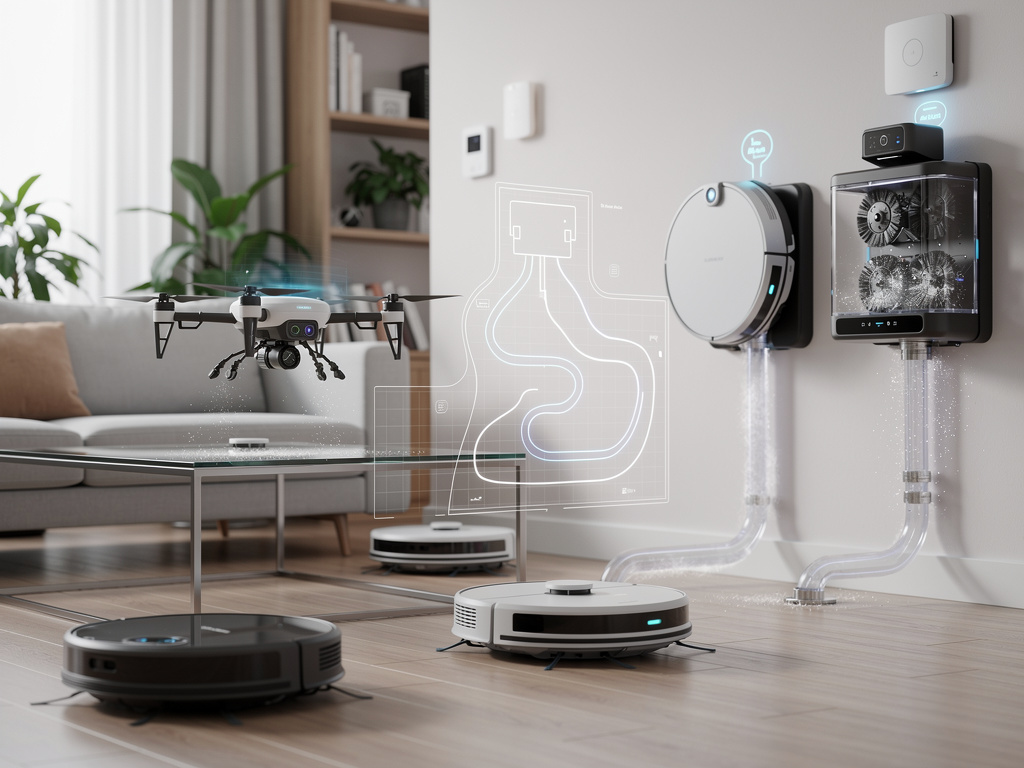
The Dawn of Hands-Free Floors: When Robot Vacuums Finally Cut the Cord from Human Oversight
In the evolving world of smart home devices, robot vacuums have long promised a future where household chores vanish into the background. Yet, for all their mapping prowess and scheduling smarts, these machines still demand a surprising amount of human babysitting—emptying dustbins, untangling cords, or rescuing them from stair edges. But recent innovations suggest that era might be ending sooner than expected. As CNET reports in a forward-looking piece, advancements in artificial intelligence and mechanical design are pushing these devices toward true independence, potentially transforming them into seamless home companions that operate without constant intervention.
Engineers and product developers are tackling longstanding pain points, such as self-maintenance and adaptive navigation, with a flurry of prototypes and market-ready models. For instance, the integration of AI-driven object manipulation allows robots to handle obstacles proactively rather than just avoiding them. This shift is evident in products like Roborock’s Saros Z70, which features a mechanical arm capable of lifting items up to 300 grams, as highlighted in posts on X from users like Ritwik Pavan. Such capabilities mark a departure from passive cleaning to active environmental interaction, where the vacuum doesn’t just dodge toys or socks but relocates them temporarily to complete its task.
Beyond hardware, software enhancements are enabling these robots to learn from their surroundings in real time. Machine learning algorithms now allow devices to optimize paths based on dirt patterns and room layouts, reducing the need for manual zone settings. According to insights from JONR, future models will leverage AI to identify high-traffic areas and adjust suction power accordingly, making cleaning more efficient and less disruptive.
Mechanical Arms and AI Brains: Redefining Robot Capabilities
The mechanical arm trend isn’t isolated; it’s part of a broader push toward multifunctionality. DJI, known for its drone technology, has entered the fray with the ROMO Series, which incorporates advanced sensing inspired by aerial navigation systems. As detailed in a recent X post from DJI Global, these vacuums use cutting-edge perception to map spaces with drone-like precision, avoiding collisions and even climbing small thresholds. This crossover from aviation tech to floor cleaning underscores how interdisciplinary innovations are accelerating progress in autonomous home appliances.
Self-maintenance features are another critical frontier. Imagine a robot that not only empties its own bin but also washes its mops and refills water tanks without prompting. Narwal Robotics explores this in their blog on the future of robot vacuum technology, noting that AI will soon enable fully autonomous upkeep, including docking stations that handle waste disposal and part cleaning. Narwal Robotics predicts models that perform their own diagnostics, alerting users only when human intervention is truly necessary, like for major repairs.
Industry insiders point to the role of enhanced sensors in this evolution. Lidar, cameras, and ultrasonic detectors are becoming more sophisticated, allowing robots to differentiate between types of debris and surfaces. A ScienceDirect study from 2018 on vacuum robot development laid early groundwork, but today’s iterations build on that with real-time adaptability. For example, the ability to detect and respond to pet hair versus liquid spills represents a leap in contextual awareness, reducing errors that once required owner fixes.
Market Forces Driving Innovation
The competitive arena is heating up, with established players and newcomers vying for dominance. According to a market analysis from Market.us, the robotic vacuum sector is projected to reach $12 billion by 2033, growing at a 10.3% CAGR from 2023’s $4.5 billion. This growth is fueled by consumer demand for smarter, more reliable devices, pushing companies to innovate rapidly. Brands like iRobot and Ecovacs are responding with models that integrate voice assistants and app controls, but the real game-changer is autonomy that minimizes app interactions altogether.
Challenges remain, particularly in complex home environments. Stairs, thresholds, and cluttered spaces have historically stumped robots, but emerging solutions like stair-climbing mechanisms are on the horizon. TechRadar outlines desired upgrades for 2026, including better edge cleaning and quieter operation, based on a decade of testing. These insights reveal that while current models excel in open areas, true autonomy demands versatility across varied terrains, from shag carpets to hardwood floors.
Integration with broader smart home ecosystems is amplifying these capabilities. As Arm Newsroom discusses in its CES 2026 trends preview, edge AI in devices like robot vacuums will enable seamless coordination with lights, thermostats, and security systems. A vacuum could dim lights in a room it’s cleaning or pause if it detects human activity, all without user input. This interconnectedness, drawn from posts on X about Loki Robotics’ observational learning bots, suggests robots that adapt by watching household routines.
From Residential to Commercial: Expanding Horizons
The ripple effects extend beyond homes into commercial spaces. SMO Works highlights how robotics are revolutionizing industrial cleaning, with autonomous scrubbers handling large facilities like malls and hospitals. Advancements in AI allow these machines to operate 24/7, learning from environments to optimize routes and reduce labor costs. X posts from users like Massimo echo this, describing Loki’s robots that observe and adapt, potentially halving manual workloads in maintenance.
However, scaling autonomy isn’t without hurdles. Data privacy concerns arise as these devices collect home mapping data, and ensuring secure connections is paramount. Additionally, initial costs can deter adoption, though falling prices—driven by competition—are making high-end features more accessible. NextMSC lists top innovators like Roborock and Dyson, whose connectivity and AI integrations are lowering barriers, with models now offering voice control and auto-docking.
Sustainability is emerging as a key differentiator. Future designs emphasize energy efficiency and recyclable materials, aligning with consumer preferences for eco-friendly tech. As per Vacuum Wars, the rise of online marketplaces is accelerating innovation, allowing niche brands to introduce green features like low-power modes and biodegradable filters, responding swiftly to feedback.
Regulatory and Ethical Considerations in Autonomy
As robots gain independence, regulatory frameworks are catching up. Governments are eyeing standards for AI safety in home devices, ensuring they don’t pose risks like hacking vulnerabilities. Insights from another ScienceDirect article on robots in home ecosystems stress the importance of user trust, learned from early adopters’ experiences. Ethical design must prioritize transparency, such as clear data usage policies, to build confidence.
Job displacement in cleaning sectors is a hot topic, particularly in commercial applications. While automation promises efficiency, it raises questions about workforce transitions. TechTongbo notes 2025 innovations like improved obstacle avoidance could automate more tasks, but experts advocate for reskilling programs to mitigate impacts.
Looking ahead, events like CES 2026 will showcase prototypes that embody these trends. Vacuum Wars’ CES preview anticipates debuts from major brands, including AI-powered models with predictive cleaning based on weather or occupancy data. X sentiment, as seen in recent posts from Global News Report, buzzes with excitement over near-term full autonomy, suggesting consumer readiness for this shift.
The Path to Invisible Chore Management
Prototypes like Tesla’s conceptual sanitation systems for vehicles, mentioned in X posts from SETI Park, hint at broader applications where robots maintain spaces proactively. By detecting conditions and executing disinfection routines, they exemplify multi-modal autonomy that could translate to homes.
Consumer testing is refining these technologies. CNET’s December 2025 roundup of top robot vacuums praises models with superior navigation and low noise, based on revamped evaluations. These winners, including hybrids with mopping, demonstrate how incremental improvements accumulate into significant leaps.
Ultimately, the trajectory points to a home where cleaning happens invisibly. As innovations converge—mechanical dexterity, AI learning, and ecosystem integration—the need for human oversight diminishes. Industry observers, drawing from X discussions and web analyses, foresee a market where robot vacuums evolve into indispensable, self-sufficient aides, reshaping daily life in profound ways. With ongoing refinements, that hands-free future isn’t just imaginable—it’s imminent.


 WebProNews is an iEntry Publication