
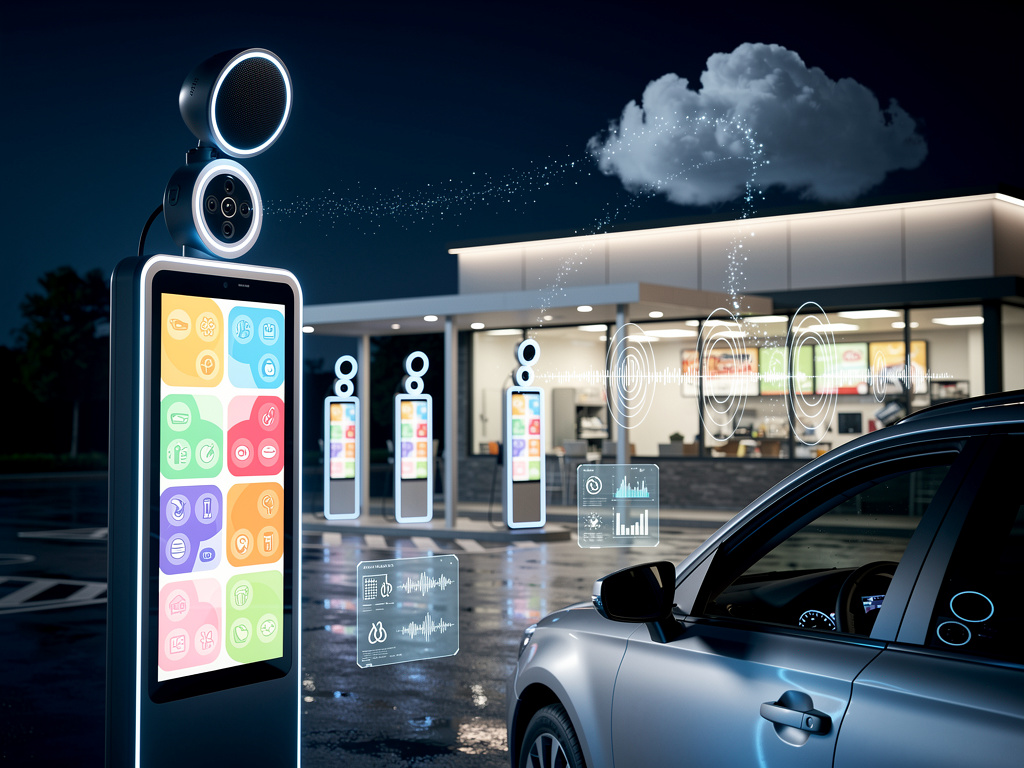
In the high-stakes world of quick-service restaurants, artificial intelligence is rewriting the rules of customer interaction. Major chains like McDonald’s, Papa Johns, and Taco Bell are deploying AI-powered voice systems at drive-thrus and kiosks, aiming to slash order errors, accelerate service times, and free staff for higher-value tasks. This shift, accelerating into 2026, promises operational efficiencies but raises questions about customer experience and workforce impacts.
Recent deployments highlight the momentum. Fox News reports that fast-food giants including McDonald’s and Papa Johns are racing to implement these systems to reduce errors and speed up service. Papa Johns, partnering with Google Cloud, launched an AI ordering assistant that personalizes orders in real time for its 150 million global customers, as detailed by QSR Magazine.
McDonald’s, after ending a prior test with IBM, is doubling down on AI for 2026. Yahoo Finance notes the chain’s focus on fixing drive-thru bottlenecks, where long lines and miscommunications plague peak hours.
From Experiments to Widespread Rollouts
The transition from pilot programs to full-scale adoption has been rapid. Taco Bell’s voice AI now processes millions of orders across hundreds of locations, allowing staff to prioritize food prep, according to posts found on X. Wendy’s FreshAI, developed with Google and tested in Ohio since 2023, continues to expand, handling drive-thru orders with improved accuracy.
Industry analysts predict dominance by 2026. QSR Web forecasts AI evolving from novelty to necessity, with back-of-house automation and personalized tools combating labor shortages. Precedence Research projects the restaurant AI market to grow from $129.2 million in 2024 to $1.32 billion by 2030 at a 47.8% CAGR, underscoring the financial stakes.
Voice technology’s appeal lies in its seamlessness. Systems like those from Valyant AI integrate with point-of-sale hardware, recognizing accents and noisy environments while upselling based on past orders.
Precision Gains and Error Reductions
Accuracy improvements are quantifiable. White Castle reported a 20% drop in order mistakes and 90-second service times using AI, per PYMNTS. Wendy’s FreshAI achieves over 85% hands-free order completion rates, enabling crew to focus on assembly.
These systems parse complex requests—’extra pickles, no onions’—with machine learning trained on vast datasets. GlobalEdge highlights how AI manages inventory in real time, predicting demand to minimize waste.
Customer data fuels personalization. Papa Johns’ Google-powered agent suggests add-ons like dipping sauces based on order history, boosting average ticket sizes.
Overcoming Early Stumbles
Not all launches were smooth. McDonald’s IBM partnership ended in 2025 amid accuracy issues, as covered by Restaurant Business. Yet, lessons learned propelled refinements, with newer models handling diverse accents and interruptions better.
Posts on X reveal mixed user reactions: some praise speed, others decry the loss of human touch, likening it to surveillance. Chains counter with hybrid models, where AI hands off to humans if needed.
Regulatory scrutiny emerges too. Instacart paused AI dynamic pricing amid FTC probes, per recent reports, signaling broader oversight on algorithmic decisions in food service.
Workforce Shifts and Economic Pressures
AI promises relief from labor woes. With U.S. restaurant turnover at 70%, systems reduce frontline staffing needs by 30-50%, allowing focus on hospitality. Tasting Table outlines 2026 changes, including AI to counter rising wages.
Training adapts quickly. Crews monitor AI via tablets, intervening seamlessly. This upskilling positions workers for oversight roles, potentially increasing job satisfaction.
Economic models show returns: payback in 3-6 months via higher throughput and upsells, with ROI exceeding 300% annually for leaders like Checkers and Rally’s.
Personalization at Scale
Hyper-personalization drives revenue. AI analyzes loyalty data for tailored offers—’your usual Big Mac with fries?’—lifting sales 15-20%. Domino’s and Starbucks pioneered voice commerce, now standard.
Integration with apps and delivery platforms amplifies reach. The Takeout details streamlined operations reducing waste through predictive ordering.
Future iterations promise multimodal AI, blending voice, vision for menu boards, and gesture recognition.
Competitive Edges and Global Expansion
Early adopters gain ground. Taco Bell’s nationwide push processes orders 8 seconds faster on average. Internationally, adaptations handle multilingual orders in Europe and Asia.
Competition intensifies with startups like Presto Voice offering plug-and-play solutions. Incumbents like SoundHound AI partner with White Castle for custom models.
Challenges persist: data privacy under GDPR and CCPA demands robust compliance, with anonymized processing key.
Looking to Full Integration
By late 2026, 50% of U.S. drive-thru orders could be AI-handled, per industry projections. Chains like Burger King and Popeyes already deploy in select markets.
Hybrid human-AI teams optimize peaks, with AI managing routine orders. This evolution positions fast food for sustained profitability amid inflation and talent wars.
Stakeholders watch closely as AI redefines service speed and precision, setting new benchmarks for the $400 billion industry.


 WebProNews is an iEntry Publication