
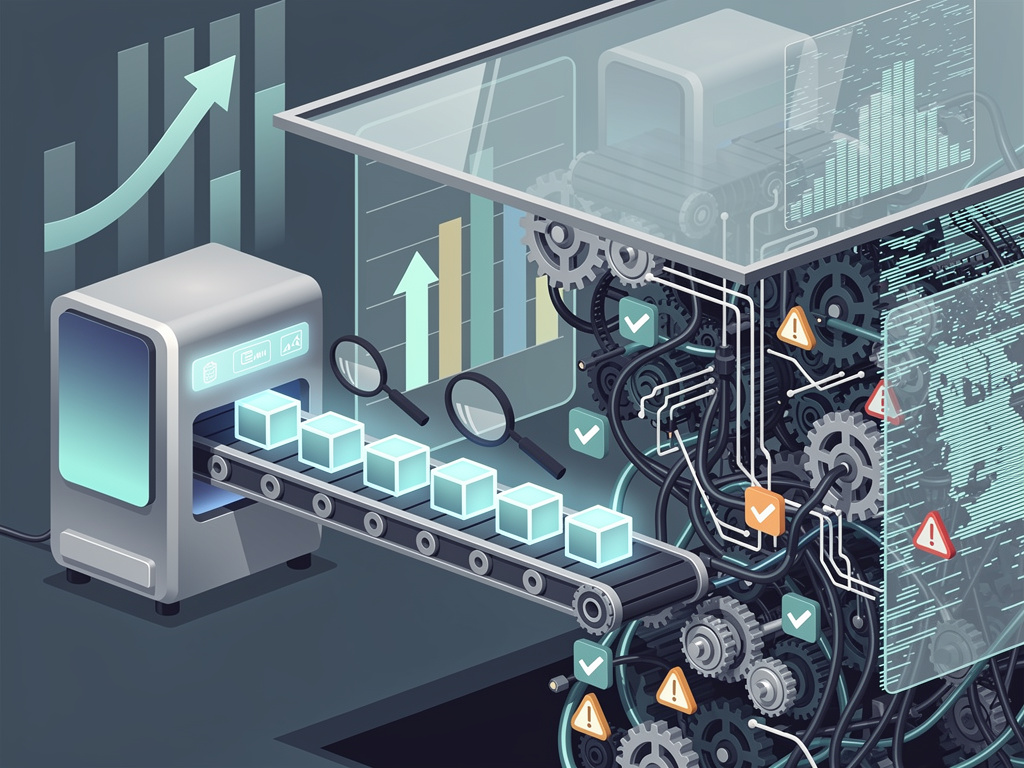
The pitch is simple: deploy AI, do more with less. But a growing body of practitioner testimony and emerging research suggests that generative AI doesn’t eliminate work so much as it reshapes it — often into forms that are harder to see, harder to measure, and no less time-consuming.
A March 2025 blog post by software developer Aman Y. Agarwal, published on his site Marble, crystallized what many engineers and knowledge workers have been saying quietly for months. The thesis is blunt: AI tools don’t replace work. They displace it. The labor shifts from producing the output to reviewing, verifying, editing, and debugging the output. And that displaced work is frequently invisible to the people making purchasing decisions.
Agarwal isn’t a Luddite. He uses AI tools daily. His argument isn’t that these tools are useless — it’s that the productivity narrative built around them is fundamentally misleading. “The work isn’t gone,” he writes. “It’s just different work.”
Different. And often worse.
The Verification Tax Nobody’s Counting
Here’s the core problem. When a developer uses an AI coding assistant to generate a function, they don’t just hit accept and move on. They read every line. They test edge cases. They check for subtle errors that the model confidently produces without warning. The generation took seconds. The review takes minutes — sometimes longer than writing the code from scratch would have.
Agarwal describes this as a fundamental asymmetry. Producing text is cheap for LLMs. Verifying text is expensive for humans. And verification can’t be automated away, because the whole reason you need a human in the loop is that the AI’s output is unreliable in ways that are difficult to predict.
This isn’t a fringe observation. A September 2024 study from Upwork Research Institute found that 77% of employees said AI tools had actually increased their workload. Not decreased it. Increased it. The survey covered 2,500 workers across the U.S., U.K., Australia, and Canada. Among the findings: employees were spending more time reviewing AI-generated content, more time learning to use the tools, and more time attending meetings about AI strategy. Only 42% of C-suite executives reported regularly using AI themselves.
That last number matters. The people mandating AI adoption are frequently not the people bearing the cost of it.
A January 2025 study published in Nature Human Behaviour examined AI-assisted writing tasks and found that while AI helped participants produce drafts faster, the total time savings were modest because editing and fact-checking consumed a disproportionate share of the workflow. The researchers noted that “the cognitive effort of evaluating machine-generated text may offset the speed gains from automated drafting.”
So the time saved on generation gets eaten by verification. Net gain: marginal at best.
There’s a deeper issue Agarwal raises that deserves attention. When you write something yourself, you build a mental model of the code or text as you go. You understand its structure because you constructed it. When an AI generates it, you’re reverse-engineering someone else’s work — except that someone else is a stochastic process with no actual understanding of what it produced. The cognitive load of reviewing AI output is qualitatively different from the cognitive load of producing your own. It’s not just proofreading. It’s forensic analysis.
And the stakes are real. GitHub’s own research, published in a 2022 GitHub Blog post, showed that developers using Copilot completed tasks 55% faster in a controlled study. But that study measured task completion time, not code quality, bug rates, or time spent on subsequent debugging. Faster isn’t better if the downstream cost is higher.
The Management Blind Spot
Enterprise AI adoption is being driven by executives who see the demo, read the McKinsey report projecting $4.4 trillion in annual economic value from generative AI, and conclude that headcount can come down. But the McKinsey projection, published in a widely cited June 2023 report, is built on theoretical potential — not observed outcomes. The report explicitly states that realizing these gains depends on worker retraining, process redesign, and technology maturation that hasn’t happened yet.
Meanwhile, companies are laying people off and expecting the remaining workers to absorb the difference with AI tools. The result, predictable to anyone who’s actually used these tools at scale, is burnout and quality degradation.
A February 2025 survey by Resume Builder found that 37% of companies had replaced workers with AI in 2024. But among those same companies, 44% reported that remaining employees were working longer hours. The math doesn’t add up if AI is actually replacing the work.
Agarwal’s framing is useful here. The work wasn’t replaced. It was displaced onto fewer people, repackaged as “AI-augmented productivity,” and made invisible in the metrics that matter to leadership. Tickets closed per sprint might look the same. But the person closing them is spending half their time wrestling with hallucinated code suggestions instead of thinking about architecture.
This is a measurement problem as much as a technology problem. Most organizations track output metrics. They don’t track verification time, cognitive overhead, or the quality cost of AI-assisted work. So the displaced labor never shows up in the dashboard.
There’s also a skills issue nobody wants to talk about. Reviewing AI output effectively requires as much expertise as producing the output manually — sometimes more. Junior developers can’t spot the subtle bug in an AI-generated function because they haven’t built the pattern-recognition that comes from years of writing code by hand. So AI tools are most useful to the people who need them least, and most dangerous in the hands of the people companies are hoping will use them to skip the learning curve.
This isn’t speculation. A 2024 study from researchers at Stanford and MIT, covered by Wired, found that experienced developers benefited significantly from AI coding assistants while novice developers showed minimal gains and in some cases produced lower-quality code. The tool amplified existing competence. It didn’t substitute for it.
Where This Leaves Enterprise Buyers
None of this means AI tools are worthless. They’re genuinely useful for specific, bounded tasks: boilerplate generation, search augmentation, first-draft creation, pattern completion. Agarwal acknowledges this. The problem is the gap between what the tools actually do and what’s being sold.
Vendors are selling labor replacement. What they’re delivering is labor transformation — and not always in a direction that benefits the buyer. When Salesforce CEO Marc Benioff told investors in late 2024 that the company would hire no more software engineers in 2025 because of AI productivity gains, as reported by Business Insider, that’s a signal to the market. But it’s a signal based on projected savings, not demonstrated ones.
The honest assessment is this: generative AI in its current form is a tool of modest, uneven productivity improvement that creates new categories of work while partially automating old ones. The net effect depends entirely on the task, the user’s expertise, and whether the organization has realistic expectations.
Most don’t.
The companies that will get actual value from these tools are the ones willing to measure what AI really costs — not just the license fee, but the verification time, the quality overhead, the retraining burden, and the cognitive tax on their best people. The companies that will waste money are the ones that believe the pitch deck.
Agarwal’s post resonated because it named something that millions of knowledge workers already know from daily experience. AI doesn’t make the work disappear. It makes it shapeless, harder to quantify, and easy to ignore — until the bugs ship, the reports are wrong, and the people who were supposed to be freed up are more exhausted than before.
The work is still there. It’s just hiding.


 WebProNews is an iEntry Publication