
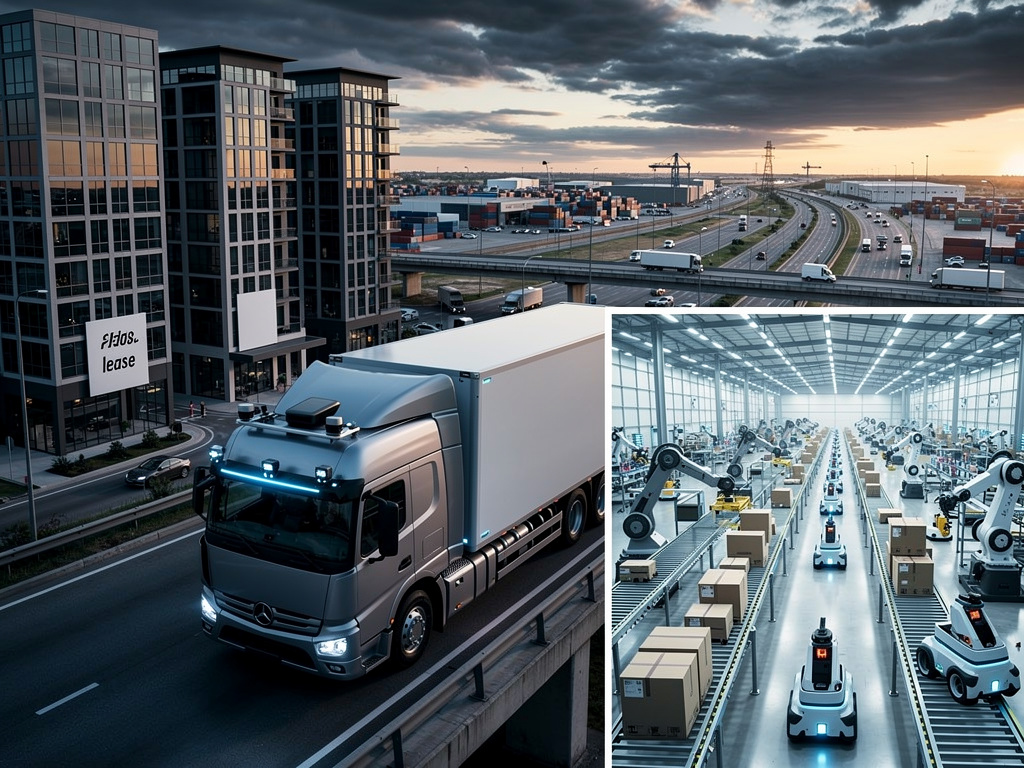
For months, the artificial intelligence revolution was largely a story about Silicon Valley — about chipmakers, cloud providers, and the software companies racing to build the next generation of large language models. But in February 2026, the tremors of AI-driven disruption have reached sectors that once seemed insulated from the technology’s most destabilizing effects. Real estate, trucking, and logistics — industries that collectively employ millions of Americans and underpin the physical economy — are now grappling with a growing wave of AI fear that is rattling investors, reshaping corporate strategies, and raising urgent questions about the future of work in some of the nation’s most essential industries.
As CNBC reported, the anxiety is no longer theoretical. Stock prices in these sectors have come under pressure as analysts and investors recalibrate their expectations, factoring in the possibility that AI-powered automation could fundamentally alter demand for commercial real estate, reshape supply chain operations, and reduce the need for human labor in freight transportation. The sell-off reflects a broader market phenomenon: as AI capabilities accelerate, the circle of industries considered vulnerable to disruption keeps expanding.
From Silicon Valley to the Loading Dock: How AI Fear Went Mainstream
The current wave of AI anxiety in traditional industries can be traced to several converging developments. Advances in autonomous trucking technology have accelerated dramatically, with companies like Aurora Innovation, Kodiak Robotics, and Waymo Via expanding their driverless freight operations across key corridors in the Sun Belt. Meanwhile, AI-powered logistics platforms are demonstrating the ability to optimize routing, warehouse management, and last-mile delivery with a level of efficiency that threatens to make significant portions of the existing workforce redundant. In commercial real estate, the fear is more indirect but no less potent: if AI enables more companies to operate with fewer employees, demand for office space — already weakened by the remote work revolution — could face another structural decline.
The market reaction has been swift. Shares of major trucking firms, logistics providers, and real estate investment trusts with heavy office exposure have underperformed the broader indices in recent weeks. According to CNBC’s Daily Open analysis, the pattern mirrors what happened to media, advertising, and customer service companies in 2024 and 2025, when investors began pricing in the disruptive potential of generative AI. The difference now is that the industries in question are far larger by employment and far more deeply embedded in the physical economy.
Trucking’s Existential Reckoning with Autonomous Technology
The trucking industry, which employs roughly 3.5 million drivers in the United States, has long been identified as one of the sectors most vulnerable to automation. But for years, the timeline for widespread autonomous trucking remained comfortably distant — a problem for the next decade, not the current one. That calculus is shifting rapidly. Aurora Innovation has been running driverless trucks on a commercial basis along Interstate 45 between Dallas and Houston, and the company has signaled plans to expand to additional routes in 2026. Kodiak Robotics has similarly scaled its operations, partnering with major freight carriers to integrate autonomous trucks into existing networks.
The implications for the labor market are profound. While industry advocates argue that autonomous trucks will initially supplement rather than replace human drivers — handling long-haul routes while humans manage more complex urban deliveries — the long-term trajectory is clear. A 2025 report from the McKinsey Global Institute estimated that autonomous trucking could displace between 800,000 and 1.2 million driving jobs in the United States by 2035, depending on the pace of regulatory approval and technology deployment. For investors, the question is not whether disruption will come, but how quickly it will arrive and which companies are best positioned to survive the transition.
Logistics Giants Navigate the Automation Arms Race
In the logistics sector, AI is already transforming operations at a pace that has caught some incumbents off guard. Amazon, which has long been at the forefront of warehouse automation, continues to deploy AI-driven robotics systems that can pick, pack, and sort packages with minimal human intervention. But the technology is no longer confined to the e-commerce giant. Companies like Locus Robotics, Symbotic, and Ocado Group are selling AI-powered automation solutions to a broad range of retailers and third-party logistics providers, democratizing access to technology that was once the exclusive province of the largest players.
The result is a growing sense of unease among mid-sized logistics firms that lack the capital to invest heavily in automation. As CNBC noted, the fear is that AI will create a winner-take-most dynamic in logistics, where companies that successfully integrate automation can offer lower prices and faster delivery times, squeezing competitors that rely on traditional labor-intensive models. This concern is reflected in the stock market, where shares of smaller logistics firms have lagged behind those of larger, more technologically advanced rivals. The competitive pressure is intensifying at a moment when the industry is still absorbing the aftershocks of the pandemic-era boom-and-bust cycle in freight demand.
Commercial Real Estate Faces a Second Wave of Disruption
If the first wave of disruption to commercial real estate came from remote work, the second wave may come from artificial intelligence. The logic is straightforward: if AI enables companies to automate tasks currently performed by knowledge workers, fewer employees will be needed, and less office space will be required. This concern has been building for over a year, but it gained new urgency in early 2026 as several major corporations announced plans to reduce headcount in departments where AI tools have demonstrably improved productivity — including finance, legal, human resources, and customer support functions.
The impact on office-heavy REITs has been notable. Firms with significant exposure to Class B and Class C office properties — the kind of space most vulnerable to reduced demand — have seen their valuations compress. Even Class A properties in gateway cities are not immune; while trophy towers in Manhattan and San Francisco continue to attract tenants, the overall trajectory of office demand remains uncertain. The National Association of Realtors and commercial real estate analytics firms have begun incorporating AI adoption rates into their forecasting models, a sign that the industry recognizes the technology as a material factor in future demand projections.
Wall Street Recalibrates: Pricing in the AI Discount
For investors, the challenge is distinguishing between legitimate long-term disruption risks and short-term market overreaction. History suggests that markets tend to overestimate the speed of technological disruption while underestimating its ultimate magnitude. The introduction of e-commerce, for example, took decades to fully reshape retail, but its eventual impact was far greater than most early forecasts predicted. A similar dynamic may be playing out with AI and the physical economy sectors now in the crosshairs.
Analysts at major Wall Street firms have begun issuing research notes that attempt to quantify the “AI discount” — the amount by which stock prices in vulnerable sectors should be marked down to reflect automation risk. Goldman Sachs and Morgan Stanley have both published frameworks for assessing AI exposure across industries, with trucking, logistics, and commercial real estate ranking among the most affected. The difficulty, as several analysts have acknowledged, is that the pace of AI advancement remains highly uncertain, making precise valuation adjustments more art than science.
The Human Cost and the Policy Response
Beyond the market implications, the spread of AI fear into these sectors carries significant social and political consequences. Trucking, warehousing, and logistics jobs have historically provided middle-class wages and benefits to workers without college degrees. If AI-driven automation erodes these employment opportunities, the effects will be felt disproportionately in rural communities and smaller metropolitan areas that depend heavily on freight and distribution industries. Policymakers in Washington and in state capitals are beginning to take notice, with several congressional committees scheduling hearings on the workforce implications of autonomous trucking and warehouse automation.
The Biden administration’s successor has signaled interest in developing a national strategy for AI-driven workforce transitions, though concrete policy proposals remain scarce. Labor unions, including the International Brotherhood of Teamsters, have stepped up their advocacy efforts, calling for federal regulations that would slow the deployment of autonomous trucks and require companies to provide retraining and transition assistance for displaced workers. Whether these efforts will succeed in shaping the pace of adoption remains to be seen, but the political salience of AI disruption is growing in tandem with its economic impact.
What Comes Next for Industries in the AI Crosshairs
The spread of AI anxiety into real estate, trucking, and logistics marks a new phase in the technology’s disruption cycle — one in which the consequences are measured not just in stock prices and quarterly earnings, but in the livelihoods of millions of workers and the economic vitality of communities across the country. As AI capabilities continue to advance, the list of industries forced to confront this reckoning will only grow longer. For corporate leaders, investors, and policymakers alike, the imperative is clear: the time to prepare for AI-driven transformation is not next year or next decade, but now.


 WebProNews is an iEntry Publication