
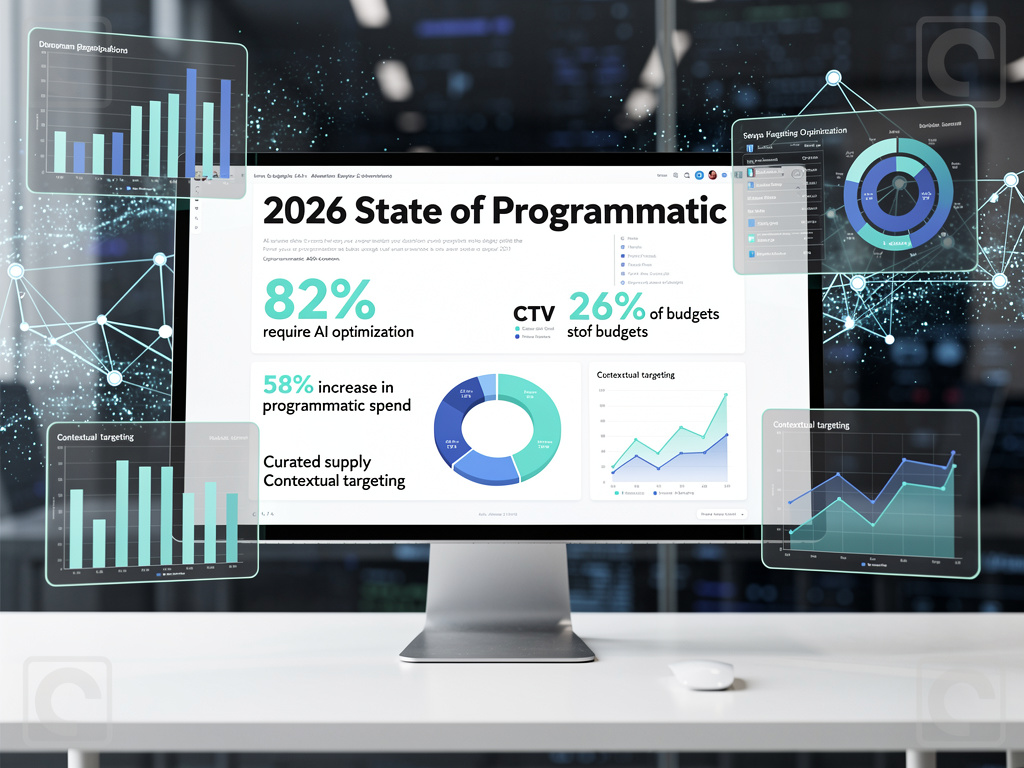
Proximic by Comscore’s third annual State of Programmatic Report, released January 20, 2026, marks programmatic advertising’s entry into a mature growth phase where buyers demand precision over raw scale. Surveying more than 200 decision-makers from brands, agencies and publishers between November 4 and 25, 2025, the report shows 58% of marketers plan to boost programmatic spending this year, down from 72% in 2025 but signaling sustained commitment amid heightened selectivity. Fully 82% now deem AI-powered optimization essential when choosing partners, upending vendor evaluations.
“Programmatic is entering its mature growth phase, where buyers are moving budget with purpose and demanding transparency, quality, and outcomes across every screen,” said Rachel Gantz, Managing Director of Proximic by Comscore. The findings frame programmatic through a three-layer stack—Growth, Control and Performance—mirroring how teams now plan, activate and measure campaigns. This structure underscores a shift from experimentation to disciplined execution, with AI as the connective tissue.
CTV’s Relentless Budget Pull
Connected TV stands as programmatic’s breakout channel, poised to claim 26% of media budgets on average in 2026, up three percentage points year-over-year, according to the PPC Land analysis of the report. Some 45% of marketers reallocating to programmatic CTV draw from linear TV, consistent with 46% last year, while digital display supplies 24%, social 16% and audio 10%. Only 16% of CTV growth stems from unallocated funds, confirming strategic reshuffling over expansion.
Over half—51%—expect more than 60% of CTV budgets to flow programmatically, with nearly a quarter forecasting over 80%. This default status reflects CTV’s maturation from niche to core, fueled by addressable inventory and cross-device measurement. Linear TV’s steady role as the top donor highlights advertisers’ pivot to streaming without net-new outlays.
Audio’s Quiet Surge
Programmatic audio trails CTV as the sole other channel with year-over-year growth, capturing 10% of budgets, up from 9%. Linear TV funds 21% of increases, net-new budgets 18% and digital display 17%, per the report detailed in Yahoo Finance. One-third of respondents see no audio uptick, emphasizing methodological shifts over broad adoption.
Traditional radio feeds this migration, as platforms integrate omnichannel identity solutions. Audio’s rise parallels CTV’s, leveraging data-driven automation to eclipse legacy buys while maintaining modest scale.
Curation’s Rise to Control
Buyers favor curated paths, with 76% rating private marketplaces, deal IDs or curated exchanges as important or very important for 2026. Agency trading desks rank at 70%, publisher-direct at 60%. Quality access drives 75% of choices, exclusivity 70% and protections against made-for-advertising sites or brand risks 61% each, as outlined in the StockTitan coverage.
Nearly half—49%—still allocate over 40% to open exchanges, blending scale with safeguards. This layered curation evolves from open auctions to intentional supply chains prioritizing transparency.
Contextual’s Steady Anchor
Contextual targeting stabilizes as baseline, with 74% maintaining or expanding use for the second year. Increases dip to 43% from 54%, signaling normalization over hype. In regulated sectors like healthcare and finance, 50% name it primary, surpassing ID-based at 34% and ID-free at 16%.
Paired with first-party data, contextual builds resilient frameworks amid privacy shifts, per Advanced Television.
AI’s Non-Negotiable Edge
AI transitions to table stakes, topping partner criteria at 82%. Priorities cluster around audience modeling (88%), pacing and bidding (77%), attribution (71%) and fraud safety (70%), while creative lags at 40%. Three-quarters blend manual and AI audience selection; none go fully automated. Over two-thirds limit AI creative to under 20%, a third to zero.
This hybrid model preserves human strategy amid AI efficiency, as noted in Comscore’s full report.
Performance Upstream
Pre-campaign forecasts dominate: over 80% value predicted reach and conversions for audience picks, engagement at 68%. Cross-channel metrics rate critical or valuable for 87% within platforms. Conversion tops measures at 62%, ROAS 47% and reach-frequency 46%.
These demands reflect unified views linking TV exposure to digital actions.
Budget Discipline Sets In
Growth moderates to 58% planning increases, with 24% holding steady—82% total sustaining or growing. CTV and audio concentrate gains, while others plateau. Nearly half expect over 40% programmatic share, balancing automation with direct ties.
The report, echoed across outlets like Markets Insider, signals programmatic’s pivot to accountable, quality-driven execution amid CTV and AI dominance.


 WebProNews is an iEntry Publication