
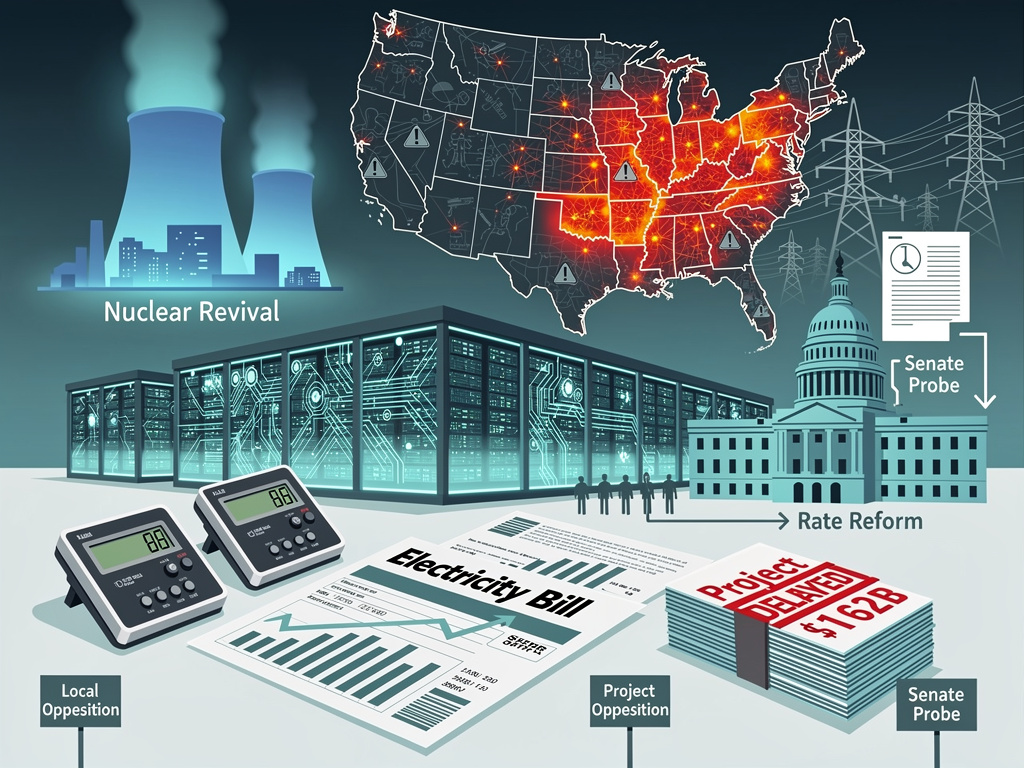
In the rush to power artificial intelligence, hyperscalers like Amazon, Microsoft, Alphabet’s Google, Meta Platforms and Oracle are pouring hundreds of billions into data centers across the U.S. Yet this frenzy is igniting fierce local resistance over surging electricity bills, threatening to derail projects and inflate capital spending. Since 2023, $162 billion in data center developments have been blocked or delayed amid bipartisan outcry, according to Investor’s Business Daily.
The tension boils down to power: Data centers could triple their U.S. electricity consumption to 12% by decade’s end, per a study by Carnegie Mellon and North Carolina State universities cited in the same report. In regions like PJM Interconnection’s grid—spanning 13 states—capacity prices have hit records for two years running, passing costs to households. Recent Senate probes by Democrats including Elizabeth Warren target Big Tech’s role in these hikes, demanding answers from Amazon, Google and others, as reported by The New York Times.
Third-quarter earnings underscored the capex surge: Google’s spending leaped 83% to $24 billion, Microsoft’s rose 74% to $35 billion, and Meta’s more than doubled to $19.4 billion. Amazon eyes $125 billion for 2025. Meta CEO Mark Zuckerberg defended the outlays, telling a podcast he’d rather “misspend a couple of hundred billion dollars” than lag in AI.
Populist Fires Spread Across Red and Blue Districts
Opposition transcends party lines, uniting 142 activist groups in 24 states, per Data Center Watch by 10a Labs. Virginia’s data center density fueled Gov.-elect Abigail Spanberger’s win, pledging accountability for big power users. “We have to be clear-eyed about the fact that we will have an energy crisis headed into the future,” she warned in an interview cited by Investor’s Business Daily.
In Pennsylvania, a $110 billion data center wave—including Amazon’s $20 billion pledge—clashes with 12% bill hikes, double the national average, per U.S. Energy Information Administration data. Luzerne County’s John Zola, founder of The Alliance To Stop The Line, rails against a proposed 500kV transmission line: “They’re putting people in a really bad position.” Residents fear subsidizing out-of-state power flows from their net-exporter state.
Hampden Township blocked office-park data centers; Lackawanna County saw plans scrapped; Hazel Township rejected a 1,280-acre campus. Similar rebuffs hit Arizona (Amazon’s Tucson project), Indiana (Google’s last-minute pullout) and beyond, delaying grid upgrades essential for AI scale.
PJM Grid Strains Under Hyperscaler Demand
PJM, serving over 65 million, faces backlash as data centers drive bill spikes, per CNBC. Federal Energy Regulatory Commission last week ordered PJM to craft rules for AI data center hookups adjacent to plants, aiming to curb grid risks amid unprecedented load growth, as noted by Reuters.
Senators Warren, Blumenthal and Van Hollen fired off letters to hyperscalers and operators like CoreWeave, Equinix and Digital Realty, probing consumer impacts, according to The Guardian and The Verge. Carnegie Mellon’s Paulina Jaramillo calls the demand surge “unprecedented,” projecting national bills up 8% and regional hits to 25% by 2030.
Posts on X echo the fury: Users highlight hyperscalers’ $800 billion 2025 commitments amid 35% price jumps since 2022, with one noting data centers could claim nearly all H1 2025 GDP growth. Electricity, not GPUs, emerges as AI’s choke point.
Utilities and States Reshape Rate Structures
Dominion Energy proposed high-load rates for Virginia data centers; Texas law shifted costs to big users. PJM’s market monitor urged FERC to bar non-reliable connections. Moody’s Ryan Wobbrock warns of overbuilding risks, stranding assets if demand falters.
Enverus Intelligence’s Adam Robinson praises targeted tariffs for weeding speculative builds. Florida’s Ron DeSantis pushes an AI Bill of Rights barring resident surcharges; 20 states eye utility curbs. Trump’s December 11 executive order deploys Justice Department muscle against state AI laws, tying broadband funds to compliance.
Hyperscalers counter: Microsoft builds substations to shield neighbors; Amazon avoids ratepayer pass-throughs. Data Center Coalition’s Aaron Tinjum affirms full cost coverage.
Nuclear Revival Powers AI Ambitions
Nuclear leads solutions: Constellation Energy’s Three Mile Island restart powers Microsoft via 20-year deal, bolstered by a $1 billion Trump loan. Talen Energy supplies Amazon from Susquehanna, plotting small modular reactors. Oklo targets 2027-2028 commercialization.
Bitcoin miners like Iren, TeraWulf and Core Scientific pivot to AI, leveraging existing grid ties—boosting shares 244%, over 100% and recovering from deal breaks. Natural gas from GE Vernova faces seven-year backlogs; renewables snag on cancellations, per Cleanview’s tally of 2,000 axed projects.
Bain’s Aaron Denman stresses speed: Self-generation or miner pacts yield edges. “Power availability…is directly linked to our economic interest.”
Site Wars Erupt as Demand Outruns Permissions
States lure with tax breaks: Pennsylvania expedites; Georgia draws Amazon’s $11 billion and Google’s 950 acres. “Demand is so big…they go everywhere,” says B Strategic’s Brad Viator. Hyperscalers hedge multiple sites, knowing delays abound.
Moody’s John Medina notes robust cash flows buffer hyperscalers versus dot-com busts—save debt-laden Oracle. Yet activists like Annie Vinatieri unite factions: “Everyone, saying, ‘Hold on, we smell a rat.'” Zola urges: “If you don’t fight now…it will be too late.”
As capex accelerates—projected $7 trillion by 2030 per McKinsey—U.S. risks ceding AI dominance if grids lag. Denman warns of national security stakes: “If we can’t build the power, we lose the economic impact.”


 WebProNews is an iEntry Publication