
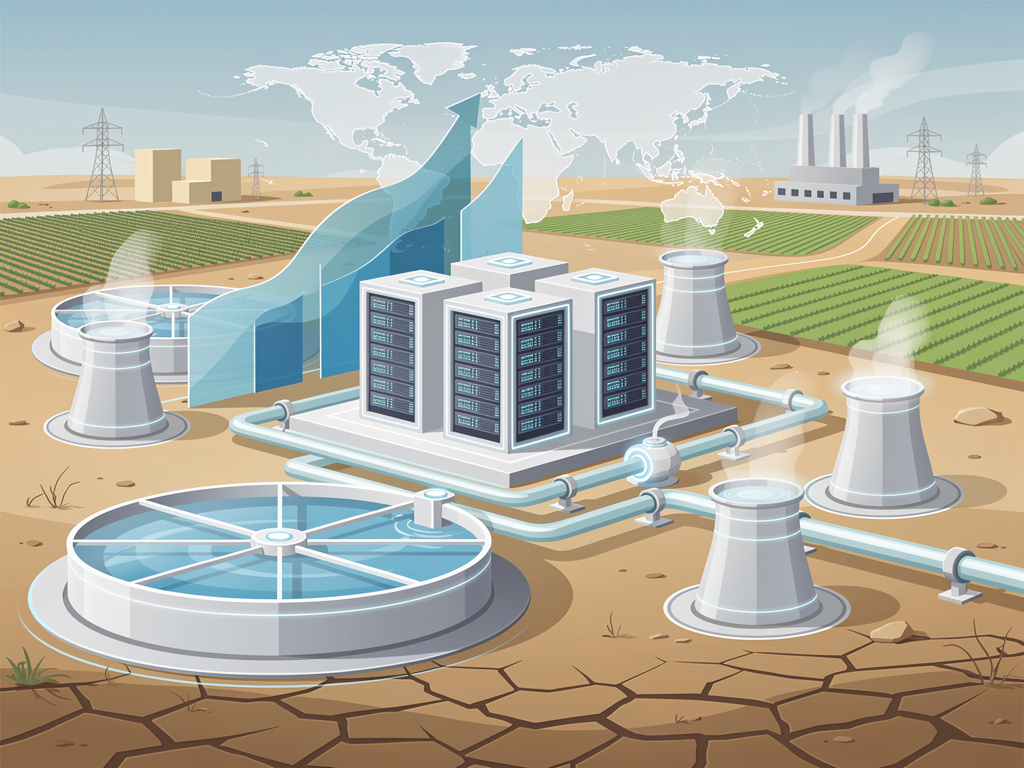
Numbers tell two stories about artificial intelligence and water. One set paints data centers as thirsty monsters. The other puts their direct consumption in perspective against the vast flows that irrigate crops and fill taps across the United States.
Direct water use by U.S. data centers reached roughly 17.4 billion gallons in 2023. Projections show that figure climbing to between 38 billion and 73 billion gallons annually by 2028. Yet those volumes represent a sliver of total American freshwater withdrawals. Ars Technica laid out the math clearly. Agriculture still claims the overwhelming share. Power plants come next. Data centers trail far behind.
But the picture sharpens when the lens narrows to specific communities. A single large facility can pull up to 5 million gallons a day for evaporative cooling. That matches the daily demand of a town of 50,000 people. And many new AI-focused projects now target regions already facing drought stress.
The Guardian reported this month that a majority of new U.S. AI data centers are slated for high water-stress zones. In Arizona, Meta plans a project that could draw as much as 1 billion gallons per year from an aquifer used for farming. Company officials insist the water won’t come from municipal supplies. Local residents remain skeptical. Similar tensions play out in Utah, where proposals near the shrinking Great Salt Lake have sparked lawsuits and calls for referendums.
Google’s own disclosures show its data center water consumption rose from 4.3 billion gallons in 2021 to 6.1 billion in 2024. The company withdrew 7.8 billion gallons total that year and consumed 78 percent of it. Microsoft and Meta report comparable growth tied to expanding AI workloads. These figures capture on-site evaporative cooling. They exclude the far larger indirect water footprint embedded in the electricity that powers the racks.
Here the numbers balloon. A Reuters story from June 3 detailed findings from UN University researchers. Global data centers consumed 4.5 trillion liters of water in 2025 when power-generation impacts are included. That volume could double by 2030. AI accounted for one-fifth of the total. The associated water footprint by decade’s end could match the basic annual domestic needs of 1.3 billion people in Sub-Saharan Africa.
Yet even these larger estimates still position data centers as minor players in the global water budget. The Missouri Science & Technology Policy Initiative noted in April that U.S. data centers directly consumed water equivalent to about 160,000 American households in 2023. Projections to 2028 remain well below one percent of public water supply. Compare that with the 70 percent of freshwater claimed by agriculture nationwide.
Each ChatGPT-style query carries a tiny water cost. Researchers once calculated that a 100-word AI prompt consumes roughly half a liter through cooling demands. Scale that across billions of daily interactions and the totals add up. Still, the per-query impact stays orders of magnitude smaller than the water embedded in a single serving of beef or a cotton T-shirt.
Operators have responded with efficiency gains. Water usage effectiveness has improved 39 percent industry-wide since 2021. Some facilities now deploy closed-loop systems that slash evaporation. Others tap reclaimed wastewater instead of freshwater. Microsoft has built sites that use zero water for cooling. Google has committed to water replenishment projects that returned 4.5 billion gallons in 2024. These steps matter. They don’t erase the growth curve driven by exploding AI demand.
Power remains the bigger variable. Training and running large models drive massive electricity loads. That power, whether generated by coal, gas, nuclear or renewables, carries its own water intensity. Coal and natural gas plants can consume one to nine liters per kilowatt-hour. Even some renewable sources require water for manufacturing and maintenance. When those upstream costs enter the ledger, data centers look less like isolated facilities and more like extensions of the energy system.
Recent UN analysis projects data center electricity demand could hit 945 terawatt-hours globally by 2030. That rivals Japan’s current annual consumption. Carbon emissions tied to the sector could reach 399 million tons. Water tied to power generation would hit 9.3 trillion liters. These forecasts assume continued rapid AI adoption. They also assume no radical breakthroughs in chip efficiency or cooling technology.
Local pushback has grown intense. Polling cited by the Guardian shows 70 percent of Americans oppose having a data center nearby. Lawmakers in California, New York, Michigan and Iowa have introduced bills requiring detailed water reporting or mandating closed-loop systems. One California city voted overwhelmingly to ban data centers outright. In Phoenix, planned facilities could push annual direct water use from 385 million gallons today to 3.7 billion gallons. That increase equals nearly twice the supply for a city the size of Flagstaff.
Industry insiders argue the focus on data centers distracts from larger consumers. HyperFRAME Research and others point out that direct on-site use accounts for perhaps 20 percent of the total attributed water footprint. The rest traces back to power plants. Blaming the server farm for the cooling tower at the coal plant feels incomplete. Yet communities near proposed sites experience real pressure on aquifers, rivers and treatment infrastructure regardless of upstream accounting.
Tech giants increasingly tout water-positive goals. Amazon, Meta and others pledge to return more water to local basins than they withdraw by 2030. Some invest in watershed restoration hundreds of miles away. These offsets help balance spreadsheets. They rarely satisfy neighbors who watch construction crews lay pipe to massive new buildings.
And the trajectory points higher. AI inference now dominates energy and water demand, far outpacing one-time training runs. A single large language model in continuous deployment can process billions of tokens daily. Each interaction adds heat that must be removed. Hyperscale facilities packing tens of thousands of high-power GPUs intensify that load. Rack densities have climbed from 36 kilowatts in 2023 toward 50 kilowatts and beyond.
Alternative cooling methods offer partial relief. Immersion cooling submerges servers in dielectric fluids that transfer heat without evaporation. Free-air cooling works in colder climates but struggles during heat waves. Hybrid systems blend approaches. None has yet scaled cheaply enough to displace evaporative towers across the entire fleet.
So the debate continues. Data centers do consume meaningful water. In certain counties they rank among the largest single users. Nationally and globally they remain a modest slice of total demand. The Ars Technica analysis reminds readers that context counts. A drop in the bucket can still feel like a flood when the bucket sits in your backyard.
Engineers keep refining designs. Policymakers weigh new rules. Companies negotiate with utilities and water districts. The AI boom shows no signs of slowing. Neither does the scrutiny over its physical costs. How those tensions resolve will shape where the next wave of facilities gets built and how much water they ultimately pull from local sources.


 WebProNews is an iEntry Publication