
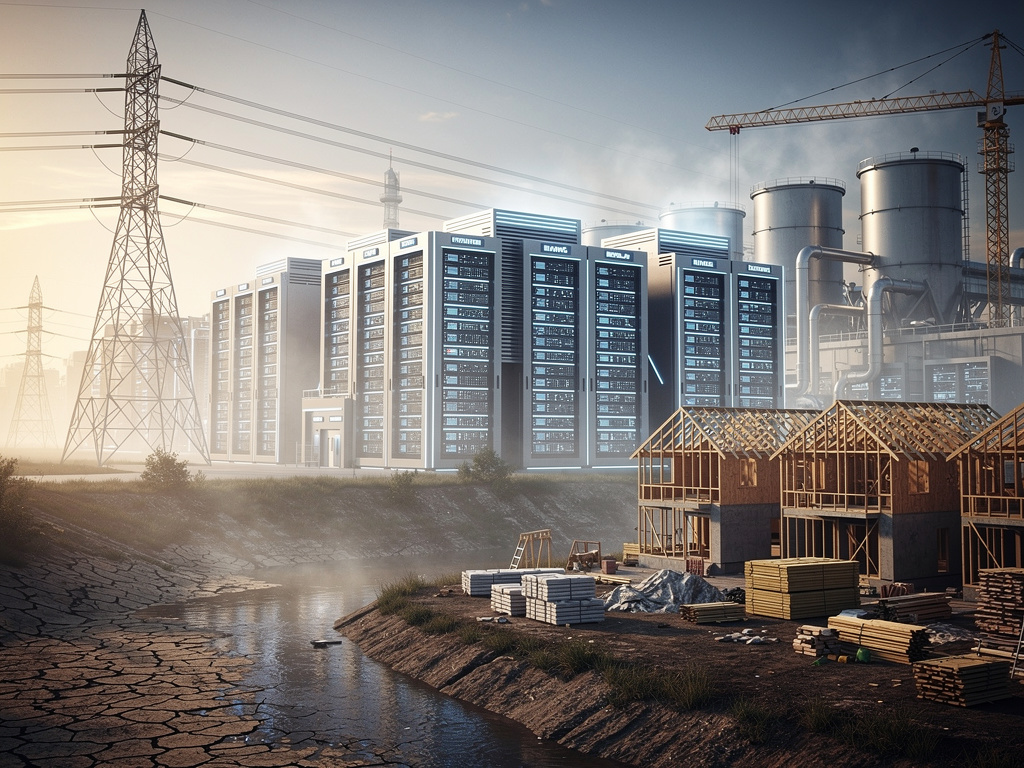
The AI Juggernaut: When Data Centers Derail Dreams of New Homes
In the race to fuel artificial intelligence’s insatiable appetite for computing power, a quiet crisis is unfolding in cities and suburbs worldwide. Data centers, those vast warehouses of servers humming with the algorithms that power everything from chatbots to complex simulations, are gobbling up electricity and water at unprecedented rates. This surge is not just straining utility grids; it’s directly impeding the construction of new homes, as developers find themselves competing for the same limited infrastructure resources. Recent reports highlight how this tension is manifesting in places like London, where housing projects are being delayed or scaled back because power supplies are prioritized for tech giants’ facilities.
The issue stems from the explosive growth of AI technologies, which require massive computational resources. Companies like Microsoft, Google, and Meta are investing billions to build or expand data centers, often in areas with existing infrastructure that can’t keep pace. In West London, for instance, the electrical grid is stretched thin, forcing local authorities to ration capacity. Housing developments that once seemed straightforward are now mired in bureaucratic hurdles, as utilities warn that adding more residential load could overload the system already burdened by data centers’ demands.
This isn’t an isolated problem. Across the Atlantic, similar stories are emerging in U.S. states like Virginia and Georgia, where data centers have proliferated due to tax incentives and available land. But the environmental and social costs are mounting, with local communities facing higher utility bills and water shortages as these facilities draw on shared resources. The irony is stark: while AI promises to revolutionize industries, its backend infrastructure is creating barriers to basic human needs like affordable housing.
Strains on Urban Grids and the Housing Pipeline
The mechanics of this conflict are rooted in the sheer scale of data centers’ needs. A single hyperscale facility can consume as much electricity as tens of thousands of homes, and with AI models growing more complex, that demand is projected to double by 2030, according to a report from Pew Research Center. In practical terms, this means utilities must choose between approving new residential projects or allocating power to data centers that promise economic boosts through jobs and investments.
Take the case in London, detailed in a recent article from TechRadar, where three major housing developments have been put on hold. Developers aiming to build thousands of homes in areas like Hillingdon and Ealing are told that the grid lacks capacity, largely because nearby data centers are drawing massive amounts of power for AI operations. This has led to a backlog, exacerbating the UK’s ongoing housing shortage and driving up property prices in already strained markets.
Beyond electricity, water usage is another flashpoint. Data centers rely on enormous volumes of water for cooling, often pulling from municipal supplies. In arid regions like the American Southwest, this has led to depleted aquifers and restrictions on new construction. A blog post from the UAB Institute for Human Rights notes that communities in Georgia are reporting dry wells, forcing residents to truck in water while tech firms expand their footprints.
Economic Ripples and Policy Dilemmas
The economic implications are profound, as data centers bring short-term gains but long-term challenges. Tech companies argue that their investments create high-paying jobs and stimulate local economies, yet critics point out that the jobs are often temporary, tied to construction phases, and the facilities themselves employ relatively few people once operational. Meanwhile, the strain on infrastructure could lead to higher electricity rates for everyone, as utilities invest in upgrades that ratepayers ultimately fund.
In the U.S., this dynamic is playing out amid a broader AI boom that’s warping economic priorities. According to WIRED, Microsoft, Alphabet, Meta, and Amazon are pouring tens of billions into data centers, making AI infrastructure a key driver of growth. However, this has sparked debates over whether the benefits outweigh the costs, especially when housing affordability is at stake. Some locales are pushing back, with zoning laws and moratoriums on new data center builds to preserve resources for residential needs.
Policy makers are caught in a bind. On one hand, fostering AI development is seen as essential for national competitiveness; on the other, ignoring housing crises risks public backlash. Recent discussions at think tanks like Brookings emphasize the need for balanced approaches, including incentives for sustainable data center designs that minimize energy and water use.
Global Echoes and Emerging Solutions
The problem extends far beyond the U.S. and UK. In Ireland, a hub for European data centers due to its cool climate and tax advantages, similar grid constraints have delayed housing projects in Dublin suburbs. Reports indicate that power demands from facilities operated by global tech firms are outstripping supply, leading to blackouts and development halts. This global pattern underscores how AI’s growth is testing infrastructure limits everywhere from Asia to Europe.
Innovative solutions are beginning to emerge, though they’re in early stages. Some companies are exploring off-grid data centers powered by renewable sources like solar or wind, reducing reliance on public utilities. For example, initiatives in Nevada, as covered by The Guardian, are transforming desert lands into AI hubs with dedicated power plants, potentially alleviating pressure on urban grids.
Yet, these fixes come with their own hurdles. Building dedicated infrastructure requires massive upfront capital and can take years, during which housing needs continue to mount. Analysts from Deloitte warn that without rapid scaling of grid capacity and supply chains, the AI age could exacerbate inequalities, leaving communities behind.
Voices from the Ground and Future Projections
Local residents and developers are increasingly vocal about the disruptions. In online discussions on platforms like X, users lament how AI’s power hunger is sidelining everyday needs, with posts highlighting delays in home building due to data center expansions. One sentiment echoes a broader frustration: the tech industry’s priorities are reshaping communities without adequate input from those affected.
Looking ahead, projections paint a daunting picture. McKinsey estimates that the race to scale data centers could cost up to $7 trillion, as detailed in their analysis at McKinsey, driven by AI’s compute demands. If current trends hold, by 2030, data centers could account for 8% of global electricity use, per various industry forecasts, further intensifying competition for resources.
This escalation raises questions about sustainability. Environmental groups are calling for stricter regulations on data center placements, advocating for sites in less populated areas with abundant renewable energy. A Wired piece suggests optimal locations based on emissions data, available at WIRED, emphasizing the need to build in regions like the Midwest where grids are cleaner and less strained.
Industry Warnings and the Path Forward
Even tech leaders are sounding alarms. IBM’s CEO has warned that the current pace of AI data center expansions is unsustainable, potentially leading to catastrophic losses if hardware cycles don’t slow, as reported by TechRadar in a separate article. The hyperscale buildouts are consuming electricity at national levels, prompting calls for more efficient AI models that require less power.
Communities are adapting in creative ways. Some U.S. states are implementing “data center impact fees” to fund infrastructure upgrades, ensuring that tech profits contribute to grid enhancements. In Europe, EU directives are pushing for greener data centers, mandating energy efficiency standards that could ease the burden on housing developments.
Ultimately, resolving this tension will require collaboration between tech firms, governments, and utilities. Pilot programs integrating AI facilities with community benefits, like shared renewable energy projects, show promise. For instance, in areas where data centers have caused water shortages, companies are investing in desalination plants to offset their usage, as noted in reports from NPR at NPR.
Balancing Innovation with Livability
As AI continues to evolve, the challenge is to harness its potential without sacrificing societal basics. Housing advocates argue that unchecked data center growth perpetuates inequality, prioritizing corporate needs over public welfare. In London, campaigns are gaining traction to reform grid allocation policies, ensuring equitable access.
The Federalist has highlighted how these facilities are driving up utility costs for residents, in an article at The Federalist, painting a picture of communities bearing the brunt of the AI boom. Similarly, CNBC warns of potential higher electric bills if the boom busts, with infrastructure investments left stranded, as discussed at CNBC.
Fast Company notes an unexpected upside: the data center surge is spurring infrastructure booms in related sectors, like construction materials and engineering, per their coverage at Fast Company. This could lead to broader economic revitalization if managed well.
Navigating the High-Stakes Trade-Offs
The interplay between AI advancement and housing development reveals deeper trade-offs in our digital era. While data centers enable breakthroughs in medicine, climate modeling, and more, their footprint demands careful stewardship. Industry insiders suggest modular data centers that can be scaled dynamically, reducing permanent infrastructure strains.
Posts on X reflect growing public awareness, with users discussing how power constraints are pushing data center development into riskier areas like flood-prone zones, echoing concerns from real estate advisors. This shift could introduce new vulnerabilities, from natural disasters to supply chain disruptions.
In the end, the path to harmony lies in proactive planning. Governments must update zoning and energy policies to anticipate AI’s demands, while tech companies invest in efficient technologies. By addressing these challenges head-on, we can ensure that the AI revolution builds up communities rather than tearing them down.


 WebProNews is an iEntry Publication