
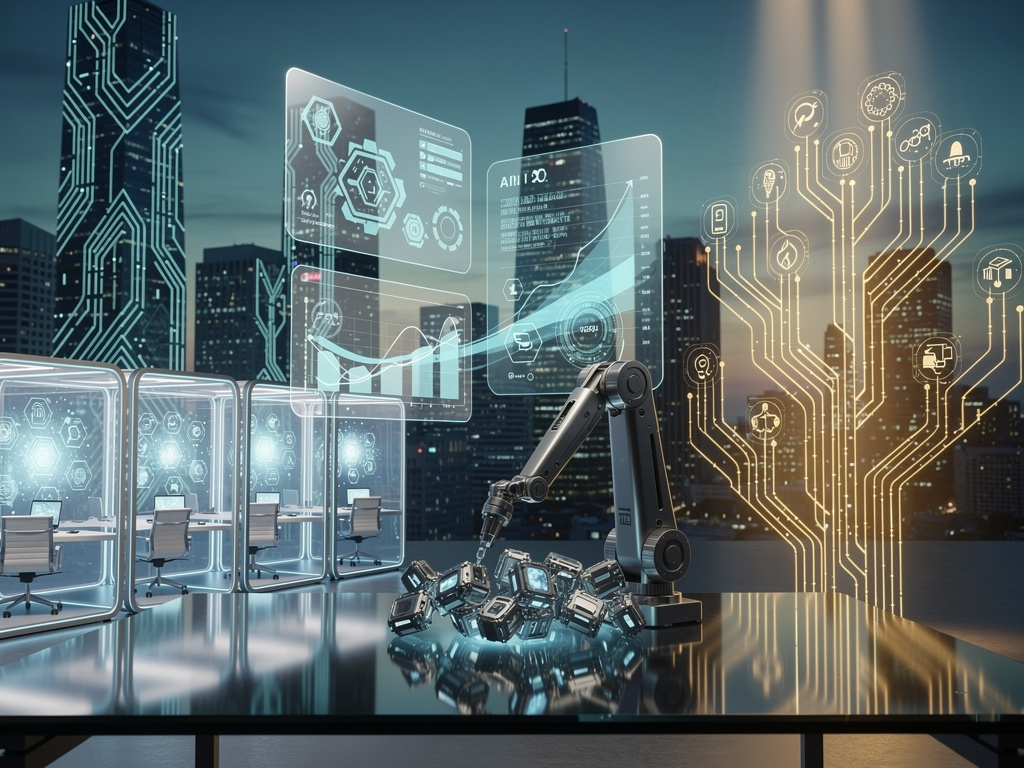
Beyond the Doom: AI’s Quiet Revolution in Birthing Novel Careers
As artificial intelligence continues to permeate various sectors, fears of widespread job displacement have dominated headlines. Yet, emerging data paints a more nuanced picture: AI isn’t just automating tasks—it’s spawning entirely new professions that demand uniquely human skills blended with technological savvy. Recent studies and industry reports suggest that while some roles may evolve or diminish, the net effect could be an expansion of opportunities in unexpected areas. For instance, positions like AI ethics officers and prompt engineers are already appearing in job listings, signaling a shift toward roles that oversee and optimize AI systems rather than compete with them.
This transformation is particularly evident in tech-heavy industries, where companies are racing to integrate AI without losing the human touch. Executives at firms like Walmart and Salesforce have begun creating titles such as “AI integration specialists” to manage the deployment of generative tools. These roles require not only technical knowledge but also an understanding of business processes, ensuring that AI enhances rather than disrupts workflows. As one industry observer noted, the key lies in augmentation—using AI to amplify human capabilities, much like how spreadsheets revolutionized accounting without eliminating accountants.
Moreover, the pace of this change is accelerating. With advancements in large language models and machine learning, new job categories are emerging faster than anticipated. Data from various analyses indicates that occupations most exposed to AI are actually experiencing wage growth and increased demand, countering the narrative of inevitable obsolescence. This resilience stems from the need for humans to interpret AI outputs, refine algorithms, and address ethical concerns that machines can’t fully grasp.
The Surge of AI-Driven Vocations
In the realm of creative industries, AI is birthing roles that blend artistry with algorithm. Take, for example, the rise of “vibe coders,” professionals who design applications that capture specific emotional tones or user experiences through AI interfaces. According to a post on X from tech enthusiast Bindu Reddy, such positions could command salaries rivaling those of traditional software engineers by mid-2025. This evolution reflects a broader trend where AI tools handle routine coding, freeing humans to focus on innovative, high-level design.
Similarly, the demand for AI trainers—experts who curate datasets to teach models nuanced decision-making—has spiked. Companies are investing heavily in these roles to ensure their AI systems are accurate and unbiased. A recent article in The Washington Post highlighted how firms like KPMG are debuting such titles, emphasizing the need for domain-specific knowledge that goes beyond basic programming. These trainers often come from fields like healthcare or finance, bringing real-world expertise to refine AI’s understanding of complex scenarios.
The educational sector is also adapting, with new curricula emerging to prepare workers for these shifts. Online platforms are offering courses in prompt engineering, where individuals learn to craft precise inputs for AI models to yield optimal results. This skill set is becoming indispensable in marketing and content creation, where tailored AI-generated material can personalize customer experiences at scale.
Navigating the Employment Shift
Contrary to apocalyptic predictions, empirical evidence shows AI-exposed jobs outperforming others in growth metrics. A study by Vanguard, detailed in Fortune, analyzed 100 professions closely intertwined with AI and found they are thriving, with higher job postings and wage increases. This outperformance is attributed to the complementary nature of human-AI collaboration, where machines handle data crunching, and people provide oversight and creativity.
However, this doesn’t mean the transition is seamless. Geoffrey Hinton, often called the “Godfather of AI,” warned in a Business Insider piece that 2026 could see a new wave of displacements as AI capabilities expand. He points to roles in customer service and data entry as particularly vulnerable, urging proactive retraining. Yet, even Hinton acknowledges the potential for net job creation, echoing sentiments from the World Economic Forum’s reports on future employment.
On social platforms like X, discussions reveal a mix of optimism and caution. Users are sharing lists of emerging jobs, from “red teamers” who test AI vulnerabilities to “decision oversight analysts” who vet machine recommendations in critical fields like medicine and law. These grassroots insights complement formal studies, highlighting how AI is reshaping entry-level positions to demand higher-order thinking, as explored in an IEEE Spectrum article.
Industry Case Studies and Emerging Trends
Looking at specific sectors, the finance industry exemplifies AI’s dual impact. Banks are hiring “AI council members”—advisors who deliberate on ethical deployments and regulatory compliance. This role, as described in various X threads, involves interdisciplinary expertise, blending tech with policy knowledge. Meanwhile, a Axios analysis confirms that wages in AI-exposed financial occupations have risen, driven by the need for skilled interpreters of algorithmic insights.
In manufacturing, AI is creating demand for robotics integrators who design and maintain physical AI systems. Posts on X emphasize fields touching “atoms and bodies,” such as mechatronics, where professionals build sensors and actuators for autonomous machines. This hands-on work contrasts with pure knowledge-based roles, which may face more automation, as noted by user Mustafa in a widely viewed thread.
Healthcare provides another vivid example. AI is automating diagnostic tasks, but it’s also generating jobs for bio-AI ethicists who ensure algorithms don’t perpetuate biases in patient care. According to Nexford University‘s insights, such positions are among those poised for growth through 2030, requiring a fusion of medical knowledge and AI literacy.
Policy Implications and Workforce Preparation
Governments and organizations are responding to these shifts with targeted initiatives. Opinion pieces, like Sal Khan’s in The New York Times, advocate for companies to fund retraining programs, proposing that a percentage of AI profits be allocated to upskill displaced workers. This approach could mitigate disruptions while fostering a more adaptable workforce.
Educational institutions are pivoting accordingly. Coursera’s list of top AI jobs for 2026, available at Coursera, includes roles like machine learning engineers and data scientists, but also novel ones such as AI product managers who bridge tech development and market needs. These programs emphasize lifelong learning, preparing individuals for a job market where adaptability is key.
X conversations further illuminate public sentiment, with users like Chris Madden listing in-demand roles such as “forward-deployed engineers” who embed AI into operations. This real-time buzz underscores the excitement around AI’s potential to create rather than destroy opportunities, even as debates rage about equitable distribution.
Economic Forecasts and Global Perspectives
Economically, the outlook is cautiously positive. An Economist article, echoed in Slashdot discussions at Slashdot, argues that AI is far from triggering a job apocalypse, instead birthing brand-new occupations. Projections from PwC’s Global AI Jobs Barometer, referenced in X threads by Ani Bisaria, show job growth across continents, with minimal evidence of mass replacement.
Globally, variations emerge. In developing economies, AI could accelerate job creation in tech services, while mature markets focus on high-skill integrations. A post from SA News Channel on X cites estimates of 97 to 170 million new roles by 2030, offsetting displacements and potentially yielding a net gain of up to 78 million positions.
Challenges remain, particularly in ensuring inclusive growth. As AI advances toward agentic systems—autonomous planners and executors—the need for oversight roles will intensify. Bisaria’s threaded analysis on X warns of potential disruptions from such technologies, yet stresses that current data doesn’t support doomsday scenarios.
Forward-Looking Strategies for Professionals
For industry insiders, the message is clear: embrace AI as a collaborator. Professionals should seek certifications in emerging fields, like those offered by platforms highlighting AI trainer roles. Networking on platforms like X can reveal hidden opportunities, from vibe coding to ethical hacking of LLMs.
Companies, too, must strategize. Investing in internal upskilling, as suggested in Fortune’s Vanguard study, can retain talent and boost productivity. By viewing AI as a tool for augmentation, businesses can foster innovation without alienating their workforce.
Ultimately, the narrative of AI’s impact on jobs is one of evolution, not extinction. As new occupations continue to emerge, the focus shifts to harnessing this technology to create value, ensuring that human ingenuity remains at the forefront of progress. With proactive measures, the future could see a richer tapestry of careers, where AI empowers rather than replaces.


 WebProNews is an iEntry Publication