
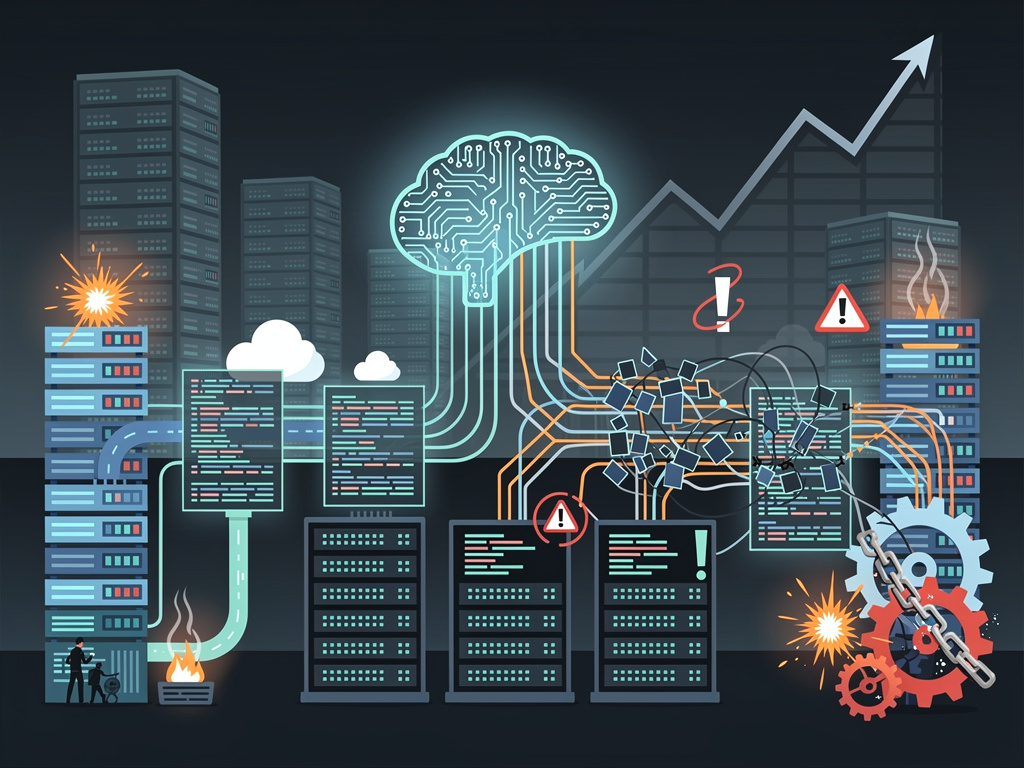
Enterprise teams pushed AI coding tools hard. Output soared. Then production systems started to crack.
The Verification Gap Widens
Eighty-one percent of enterprise technology leaders reported more production issues tied to AI-generated code. The finding comes from a CloudBees survey of more than 200 leaders released this week. (The Register)
Yet 92 percent of those same leaders said they felt confident the code was ready for production. The disconnect runs deep. AI now accounts for 61 percent of code in these organizations. Sixty-four percent call AI widely or fully integrated into workflows. More than half saw software development output rise.
Sunil Gottumukkala is CEO of Averlon. He told The Register that the problems surface after deployment. Functionality bugs. Performance hits. Availability drops. Security holes. “These are issues that surface after code has already been deployed to production, which means the code passed every review and deployment gate and still broke things,” he said. The validation process simply cannot keep up.
Jacob Krell serves as senior director of secure AI solutions and cybersecurity at Suzu Labs. He pointed to the same survey data. Sixty-nine percent of respondents cited security vulnerabilities from AI code. Sixty-three percent noted compliance problems. “AI generates code faster than teams can validate it,” Krell explained. Seventy percent now say maintaining test suites burdens them more than writing new code.
But the story does not stop at failures. Costs climb too. Fifty-four percent of organizations saw significant rises in CI/CD infrastructure spending over the past year. Fifty-three percent reported higher expenses for testing, security and deployment. Only 45 percent described those costs as predictable. Thirty-six percent track AI spending with no ROI measurement or none at all. Just 31 percent can tie AI outlays to concrete business results even though 68 percent believe value arrives.
Few controls exist. Twenty-seven percent set token usage quotas. Eighteen percent deployed automated spending limits. Only 12 percent maintain dedicated AI governance teams. When failures hit, blame falls on the CTO or VP of engineering 46 percent of the time. Engineering leads take the hit in 32 percent of cases. Developers absorb it just 7 percent of the time.
Formal review processes cover AI code at 93 percent of organizations. Enforcement happens always in only 56 percent. The gap between speed and scrutiny grows wider by the month.
A separate survey from Lightrun delivered even sharper numbers. Forty-three percent of AI-generated code changes require manual debugging in production. This holds even after the code clears quality assurance and staging. Not one respondent could verify an AI-suggested fix with a single redeploy. Eighty-eight percent needed two or three cycles. Eleven percent required four to six. (VentureBeat)
Developers now devote 38 percent of their week to debugging issues linked to AI code. At 88 percent of companies this reliability tax consumes between 26 and 50 percent of developer capacity. Zero percent of leaders expressed very high confidence that AI-generated code would behave correctly in live environments. The trust wall stands firm.
Real incidents already show the pattern. Amazon faced two major outages in early March 2026. Both traced back to AI-assisted code changes deployed without proper approval. The March 2 event lasted nearly six hours. It caused 120,000 lost orders and 1.6 million website errors. Three days later a worse outage struck. Six hours again. Ninety-nine percent drop in U.S. order volume. Roughly 6.3 million orders lost. The company responded with a 90-day reset on code safety practices.
Financial services firms offer another window. One company adopted the AI coding tool Cursor. Monthly code output jumped from 25,000 lines to 250,000. A one-million-line review backlog formed almost overnight. Joni Klippert, CEO of security startup StackHawk, described the fallout in The New York Times. Vulnerabilities multiplied. Stress spread from engineering to sales, marketing and support teams. “The sheer amount of code being delivered, and the increase in vulnerabilities, is something they can’t keep up with,” she said. (The New York Times)
Gartner forecasts that 40 percent of AI-augmented coding projects will face cancellation by 2027. Reasons include rising costs, unclear business value and weak risk controls. (Codebridge.tech) Maintenance expenses for unmanaged AI code can reach four times traditional levels after the first year as technical debt compounds. First-year costs run 12 percent higher than expected once review overhead, expanded testing and code churn enter the equation.
Security stands out as a particular weak point. Studies show AI-generated code carries 2.74 times more vulnerabilities than human-written equivalents. Forty-five percent of OWASP Top 10 security tests fail on such codebases. Privilege-escalation paths increase by 322 percent. Gartner predicts that by 2028 one-quarter of enterprise data breaches will stem from AI agents. (First Line Software)
And yet adoption continues. Ninety-one percent of software companies now use AI to cut development costs, according to a Goodfirms survey. Sixty-one percent expect budget reductions of 10 to 25 percent. (Yahoo Finance) Productivity claims sound attractive. Teams report 55 percent faster task completion in some studies. Time to market drops 30 percent in others.
The numbers do not lie. Speed arrives. But so does fragility. Technical debt piles up. Security teams drown. Finance departments watch budgets swell without clear returns. Observability tools lag. Seventy-seven percent of organizations express low or no confidence in them for AI-generated systems. Ninety percent keep AI site reliability engineering agents in experimental mode only. No one has moved them confidently into production.
Sixty percent of respondents in the Lightrun report named lack of visibility into live system behavior as the top bottleneck. Ninety-seven percent of AI SRE agents operate without significant runtime visibility. Finance teams fall back on tribal knowledge 74 percent of the time rather than trust automated diagnostics.
Executives face a choice. Double down on volume and accept the rework. Or slow the flood, strengthen governance, enforce reviews every time and invest in observability that actually works at production scale. So far many choose volume. The outages and surprise invoices suggest that strategy carries limits.
CloudBees published its State of Code Abundance report on May 19, 2026. Lightrun released its engineering survey in April. Both captured the same tension. AI writes fast. Production breaks faster. The bill arrives later. Organizations that close the verification gap may capture real gains. Those that do not will spend more to achieve less reliable software.


 WebProNews is an iEntry Publication