
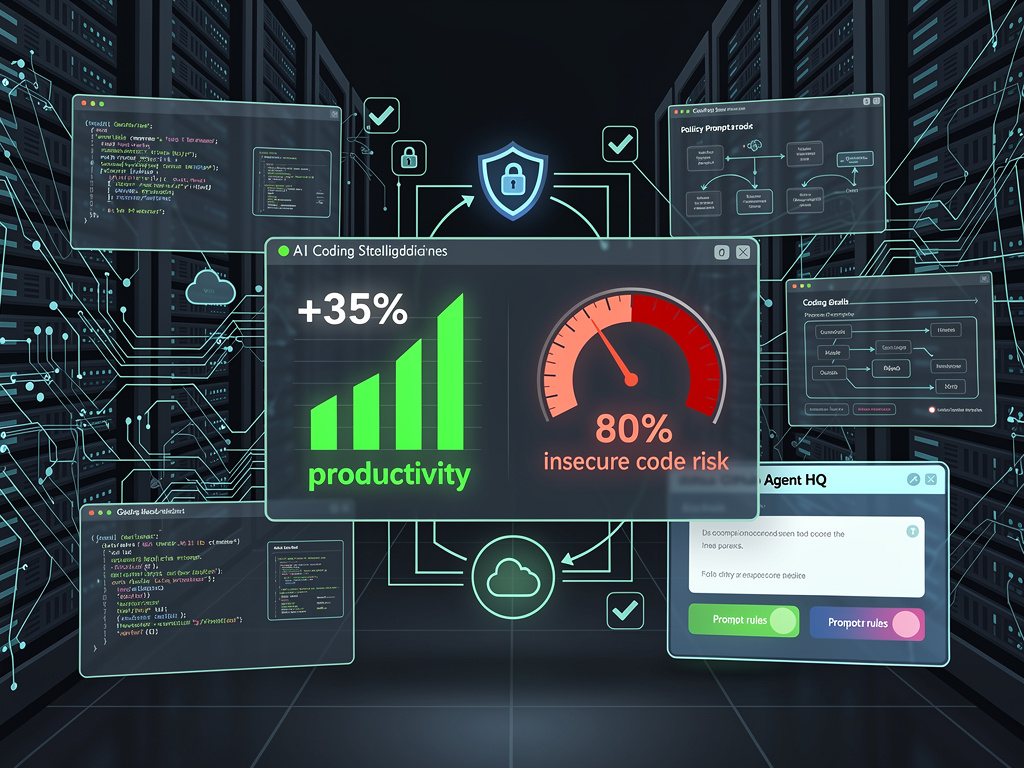
Enterprise chief information officers face a pivotal challenge in 2026: unleashing AI coding assistants to turbocharge developer output while imposing ironclad controls to avert vulnerabilities and compliance breakdowns. IDC research reveals over 60% of organizations now deploy AI coding tools widely, with 89% of developers citing productivity gains averaging 35% higher output, yet fewer than 1 in 50 firms plan cutbacks amid rising risks like insecure code generation.
Rodrigo Madanes, EY’s global next frontier technology and AI leader, warns of the ‘acceleration trap’ in a CIO.com analysis: fast adoption sans safeguards breeds rework, outages, and breaches. EY’s pilots with tools from enterprise vendors and startups delivered tasks in hours rather than days, but only after certifying compliance and security. An EY engineer captured the allure: “once you’ve worked with one of these tools, you don’t want to go back — it’s like having a brilliant junior sitting beside you who never gets tired.”
Studies underscore the perils. One field experiment showed AI-assisted teams finishing tasks 25% faster with 40% better quality within models’ strengths, but performance plunged on unstructured problems. Another found developers produced less secure code in 80% of cases yet felt 3.5 times more confident in its safety, per the CIO.com piece.
Mapping AI’s Uneven Strengths
Large software firms anticipate 30% or more code AI-generated soon, potentially injecting $3 trillion into global GDP via doubled developer productivity. Yet unlike Y Combinator startups where a quarter boast near-fully AI codebases, enterprises grapple with legacy systems and regulations demanding rigorous oversight. Madanes urges CIOs to chart AI’s ‘jagged frontier’—routine tasks where it shines versus novel challenges needing human insight.
Morgan Watts, vice president of IT at 8×8, told CIO.com that AI code accelerates productivity but requires adapted guardrails on model usage, code review, security validation, and data integrity. “CIOs need frameworks that give visibility and control as they scale, especially in industries like finance and healthcare where regulatory pressures are intensifying,” she said.
Barracuda CIO Siroui Mushegian echoed this in the same report: “The biggest challenge I’m preparing for in 2026 is scaling AI enterprise-wide without losing control. AI requests flood in from every department. Without proper governance, organizations risk conflicting data pipelines, inconsistent architectures, and compliance gaps.”
Guardrails as Productivity Boosters
Effective strategies start small. EY embedded governance in pilots: precise prompts via playbooks embedding security checks, data rules mandating encryption and consent, plus upskilling to counter skill atrophy. “You can lose your skills if you use AI too much. You get a bit rusty,” noted another EY developer, adding, “It’s an enabler – you’re no longer stuck. You can ship something yourself instead of waiting for your manager or a senior engineer.”
AI itself enforces rules, such as restricting file access or mandating tests. Madanes views guardrails not as drag but accelerators, evolving engineers into generalists orchestrating AI. WaveMaker executives predict a 2026 reset for AI code tools toward baked-in architecture and governance, per IT Brief Asia: “The winners will be solutions that interpret enterprise context, surface architectural choices and accelerate delivery without creating technical debt,” said Prashant Reddy, head of AI product engineering.
GitHub’s Agent HQ and Copilot SDK address proliferation of agents, offering a control plane with branch-level access, AGENTS.md files for versioned rules, and Mission Control dashboard across VS Code, CLI, and web. VentureBeat reports this unifies rivals like Anthropic and OpenAI under enterprise governance, curbing inconsistent outputs from varied prompts.
2026’s Governance Imperative
Info-Tech Research Group’s CIO Priorities 2026 warns CIOs must prove AI value amid budget scrutiny, prioritizing risk management as threats mount. “CIOs are no longer being judged on whether they can adopt AI, but on whether they can prove its value,” said Brian Jackson, principal research director.
Solutions Review’s 2026 predictions highlight an AI agent governance crisis: “As fleets of autonomous agents proliferate, CTOs and CIOs will realize their biggest bottleneck isn’t model performance—it’s governance,” with traditional access tools failing dynamic agents. OutSystems CEO Woodson Martin, in a blog post, stresses integrity over raw generation: “The ability to ensure correctness at scale becomes more important than the ability to generate software.”
Airia’s platform restores visibility into shadow AI, imposing guardrails enterprise-wide, as detailed in CIO Review. TechRepublic’s 2026 trends foresee escapes from pilot purgatory via integrated deployments with observability to curb hallucinations and leaks.
Real-World Scaling Tactics
Rishi Kaushal, CIO of Entrust, prepares for AI shifts by focusing on cultural readiness: “The CIO role has moved beyond managing applications and infrastructure. It’s now about shaping the future,” per CIO.com. Nicole Coughlin, CIO of Cary, N.C., in InformationWeek, advocates co-creating guardrails across policy, legal, and IT.
Mistral’s Vibe 2.0 challenges GitHub Copilot with team-controlled agents, noted in recent X discussions. GitHub posts on X tout Copilot’s memory across workflows, boosting PR merges 7% via verified citations. Enterprises like EY leverage ‘vibe coding’ pilots, certifying before scaling over 70,000 professionals in software roles.
Forbes warns in an analysis of loose prompts burning costs or drifting quality: “Guardrails matter.” VentureBeat’s pilot autopsy blames unchanged workflows, urging orchestration where AI thrives in defined bounds.
Enduring Enterprise Edge
CIO Dive’s 2026 predictions expect agentic AI maturation with grounded workflows: “AI agents built on proven, deterministic workflows will ensure every action is grounded in predictable, governed logic,” per expert Zilbershot. Info-Tech urges threat modeling for AI biases, with 55% of CIOs expanding cyber budgets.
SiliconANGLE covers agent guardrails like audit trails and rollbacks as deployments surge. Constellation Research foresees agentic licenses normalizing, per its trends.
CIOs succeeding treat AI as a marathon: pilot rigorously, govern proactively, upskill relentlessly. As Madanes concludes, future engineers orchestrate AI, turning raw speed into sustainable advantage amid 2026’s high-stakes push.


 WebProNews is an iEntry Publication