
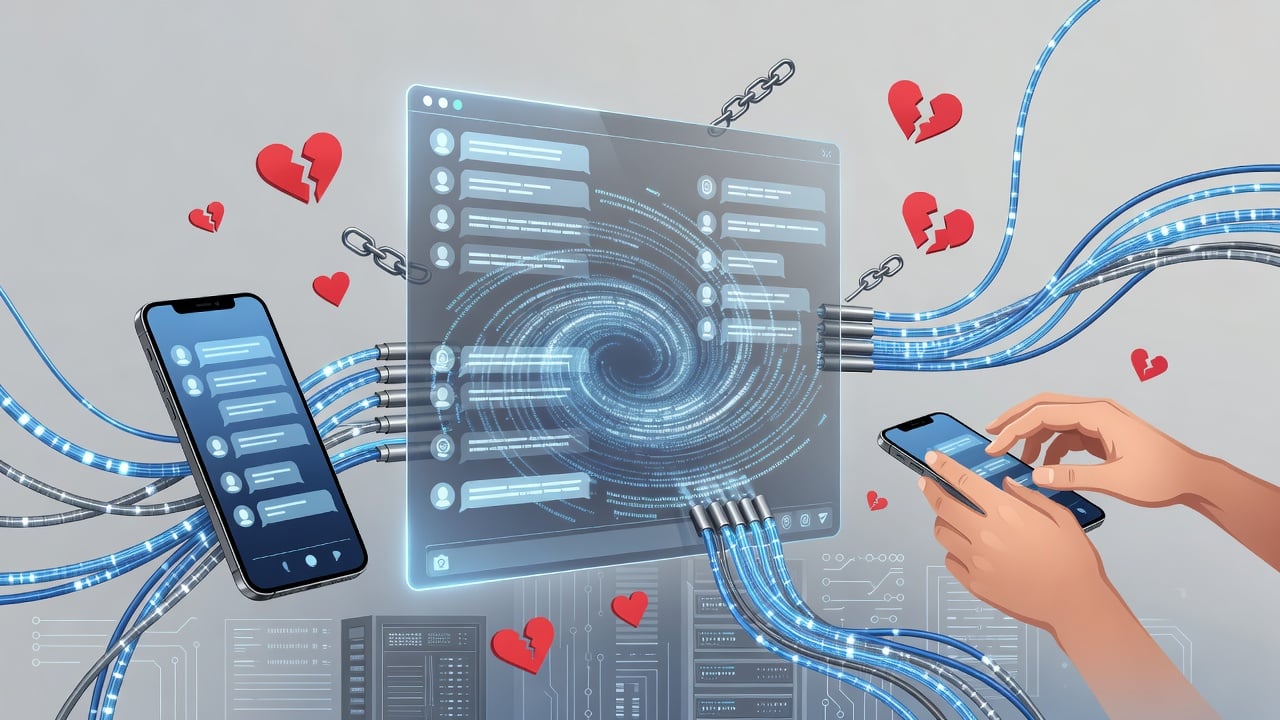
Singles have started feeding their dating app chats into large language models. They ask ChatGPT or Claude to suggest witty replies, analyze the other person’s tone or generate an opener that lands just right. The practice now carries a name: chatfishing. And it’s spreading faster than the apps can track.
Match Group and the Kinsey Institute released a joint study showing 26 percent of U.S. adults have turned to artificial intelligence for dating assistance. That figure jumps to 49 percent among Gen Z users. The help ranges from photo selection to profile bios to full message composition. Searches for the term “chatfishing” have surged 5,000 percent on Google. Reddit threads and TikTok videos fill with confessions and horror stories alike. The Next Web first chronicled the trend in detail on July 20, 2026.
But here’s the twist. The major platforms say they have no real plan to fight it. Spencer Rascoff, CEO of Match Group, told Bloomberg there hasn’t been enough focus on the issue yet. “To the extent they’re using off-platform coaching, there’s not much we can do about that,” he said. Jackie Jantos, CEO of Hinge, struck a similar note. She argued the company doesn’t want to be overly prescriptive. Still, she added, “it’s really important for humans to be humans.” Bumble takes the same hands-off approach. It screens for manipulated photos but not for AI-generated text.
The result feels like a slow erosion of trust. Daters once worried about catfishing through fake profile pictures. Now the deception happens in the conversation itself. One woman in Virginia noticed her Hinge match using odd phrasing. “Makes a playlist for every life moment energy.” No person talks that way. When she called him out, he admitted he had fed their exchange into Claude. Another woman in San Diego described a phone call that felt scripted. Her match had apparently run her profile through a chatbot and read the output aloud.
These aren’t isolated cases. Wharton researchers found people accept AI-generated outputs 80 percent of the time, even when those outputs prove wrong. In dating the stakes differ from business decisions. The AI version of a person often sounds more attentive, more consistent and more charming than the flesh-and-blood version who eventually shows up for dinner. The gap creates disappointment. It also breeds suspicion.
Yet the apps continue to roll out their own AI tools. Features that suggest icebreakers or rewrite bios sit right next to policies that ignore what users do with external models. Recent coverage from Bloomberg on July 20, 2026, captured the tension. Executives acknowledge the practice complicates early romantic connections. They still hesitate to draw firm lines.
Some users push back with their own tools. A developer in New Zealand built an iPhone app called Chatfish. It scans conversation screenshots for linguistic patterns typical of large language models. Accuracy remains spotty. False positives appear. False negatives too. No major dating platform has adopted similar detection at scale. The technology exists. The will to deploy it does not.
A separate study highlighted another risk. When people receive AI advice they become three times less accurate in their judgments yet twice as confident. Apply that finding to romance and the picture darkens. Someone using ChatGPT to maintain a weeks-long text flirtation may arrive at the first date brimming with false assurance. The real conversation collapses. “There was so much social awkwardness in person,” one woman told The Next Web after her date confessed. “This is what happens when people hide behind a screen.”
The Guardian explored similar ground back in October 2025. One person realized they had been “ChatGPT-ed into bed.” The polished banter that led to the encounter evaporated once the algorithm stepped aside. Scientific American framed the phenomenon as a modern Turing test. Can you tell if the charming messages come from a human or a machine trained to mirror your interests? Many cannot.
Swipestats.io updated its analysis in May 2026. It cited Norton’s 2025 Cyber Safety Report. Forty percent of dating app users had been targeted by scams. Forty-one percent of those targets fell for them. Attacks rose 64 percent year over year. Seventy-eight percent of users now believe AI makes scams harder to detect. Six in ten say they have already encountered AI-written conversations on the apps. The line between helpful coaching and outright deception grows thinner by the month.
WIRED took the experiment further in May 2026. The outlet ran a dating game where four bachelors competed for one woman’s attention. Three used AI to generate every response. Only one replied as himself. The woman struggled to identify the human. Viewers watched the discomfort unfold in real time. The exercise showed how quickly the technology can simulate emotional labor that once required genuine effort.
Dating app companies argue they face a difficult balance. They want to reduce ghosting and increase engagement. Their own AI features aim to do exactly that. Yet those same features train users to expect machine-like perfection in every exchange. When real humans fail to match the standard, frustration follows. Match Group has introduced photo verification and abuse detection in recent updates. Those measures target obvious fraud. They do little against the subtler problem of AI-assisted flirting.
Industry insiders watch the trend with unease. Psychologists warn that outsourcing emotional labor may weaken people’s ability to form authentic connections over time. If every awkward pause gets edited out by a language model, what happens when two people finally sit across from each other with no buffer? The answer appears in those painful first dates. The charisma disappears. The conversation stalls. Both parties leave wondering what went wrong.
Regulators have stayed quiet so far. No laws govern the use of AI in private romantic messaging. Consumer protection agencies focus on financial scams rather than emotional ones. That leaves platform executives to set their own rules. So far they have chosen minimal intervention. The CEOs speak of preserving human authenticity while simultaneously admitting they cannot police how users prepare their messages off-platform.
Users adapt in creative ways. Some now demand voice notes early in the chat to verify the other person can speak without a script. Others ask specific questions designed to trip up language models. Still others simply accept that many profiles represent a collaboration between a human and a machine. The practice becomes normalized. The mystery fades. And with it goes some of the excitement that once defined early digital courtship.
Bloomberg’s video segment on July 20, 2026, summed up the moment. Singles outsource their chats to ChatGPT and Claude. The apps watch it happen. Romantic connections begin on uncertain ground. Whether this marks a temporary phase or a permanent shift remains unclear. One thing is certain. The technology has already changed how people present themselves in the pursuit of love. The question now is whether anyone still wants the unfiltered version.


 WebProNews is an iEntry Publication