
Seattle barely registers on most maps of AI power centers. Yet a startup there just walked away from an investment contest with top honors. Its pitch? Give brands the power to correct what chatbots say about them. And make sure those corrections stick.
Optimly launched in October 2025. Founder Apurva Luty, a former product strategist at Microsoft, Meta and Discord, saw marketers lose sleep over AI answers. Models pull from scattered web sources. Company websites often rank low. The result? Inaccurate descriptions, wrong product details, even outdated tone. So Luty built a fix.
The company offers two layers. One is free and public. The other sits behind a paywall and promises verification plus ongoing monitoring. Early traction looks real. Over 100 brands have claimed profiles. The public index fields 11,000 agent requests each week. Scores cover more than 60,000 brands, with 24,000 entries live. But numbers only tell part of the story.
Luty studied policy and economics at the University of Oregon. He helped launch Surface devices at Microsoft. At Meta he worked on rebranding efforts. Discord tapped him for gaming strategy. Those roles exposed him to how perception forms at scale. AI simply accelerated the problem.
In May 2026 Optimly entered the Flywheel Investment Conference in Wenatchee, Washington, as a last-minute addition. Judges handed it the triple crown: $150,000 in investment, a $50,000 relocation offer and a $5,000 audience-choice prize. Months later the startup closed an $800,000 pre-seed round led by Mighty Capital and AI House. Earlier checks totaling $100,000 came from Right Side Capital Management and Forum Ventures. It also joined the WTIA accelerator program.
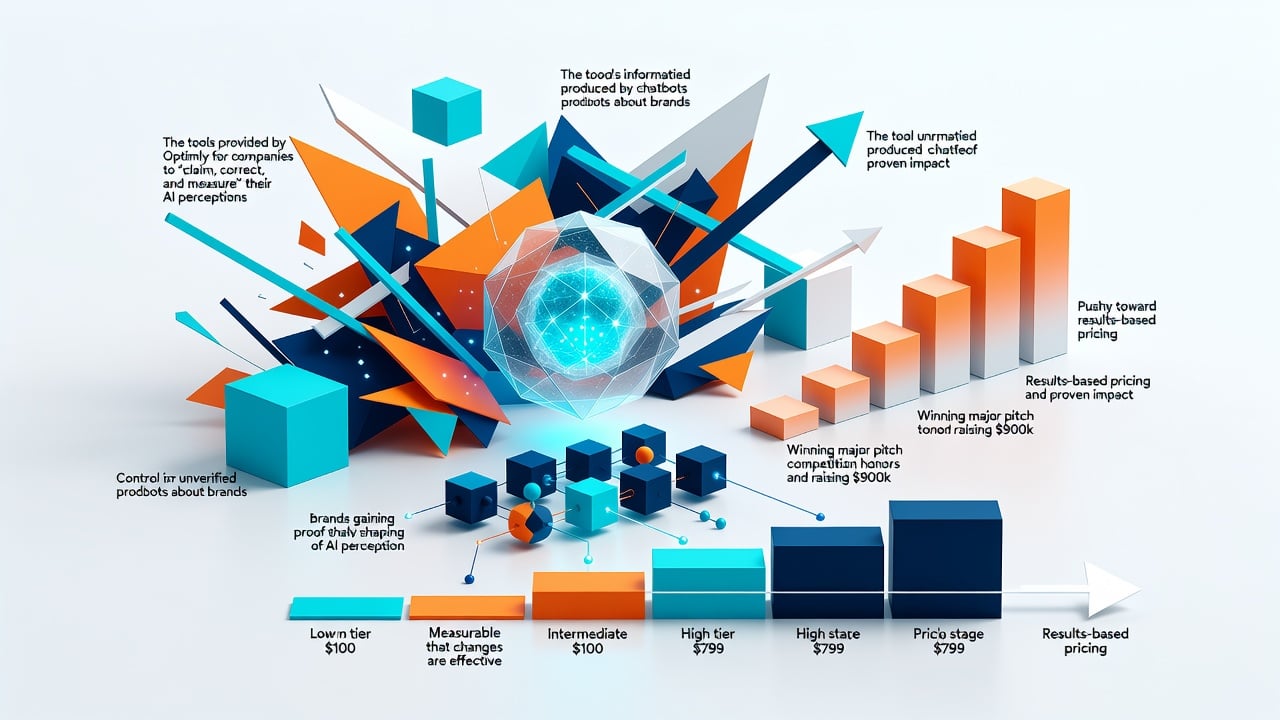
Subscription plans run from $100 to $799 per month. Optimly aims to shift toward results-based pricing. The idea is simple. Brands claim their entry in the AI Brand Index. They submit corrections. Optimly tracks whether major models update their outputs. The public index acts as a directory. The paid BrandVault product adds verified status, rewrite capabilities and continuous checks.
Marketers have watched this shift with growing alarm. A New York Times report from February detailed how companies now court AI systems the way they once courted human influencers. Chatbots don’t just answer questions. They shape consideration sets before shoppers reach a website. Get the description wrong and you vanish from recommendations.
Optimly’s approach differs from most AI optimization shops. Many advise on content creation or structured data. Few measure downstream impact on model responses. Luty’s team built measurement into the core product. Weekly reports show visibility scores, sentiment shifts and specific fixes that moved the needle. Brands see exactly which changes produced results.
But. Success depends on model providers cooperating. OpenAI, Anthropic, Google and others update training data on their own schedules. Some incorporate retrieval mechanisms that could surface Optimly’s index. Others may ignore it. The startup bets that a canonical, machine-readable source will prove too useful to dismiss. It already publishes llms.txt files and API specifications for easy ingestion.
Recent coverage shows the trend accelerating. A Forbes 2026 AI 50 list published today highlights several companies building enterprise AI tools that rely on accurate brand context. EliseAI, for instance, deploys chatbots in property management and healthcare where factual precision matters. Its CEO Minna Song noted in the profile that investors now pitch her on expansion ideas. The pattern repeats across sectors.
Meanwhile, marketers experiment with training their own models on brand voice. Podcasts and workshops from early 2026 describe custom systems that avoid generic output. One session highlighted how 76% of marketers believe properly tuned brand-specific AI content matches or beats human work. The data comes from industry surveys circulating on social platforms this week.
Optimly takes a different route. Instead of asking every company to build its own model, it creates a shared index that any model can reference. Think of it as a Wikipedia for AI agents, except brands control their pages and performance data proves the edits worked. The approach scales. A small team can support thousands of brands. Measurement creates accountability.
Challenges remain. Hallucinations still occur. Sentiment analysis on model outputs can prove noisy. And not every brand wants a public profile. Some prefer to manage perception through traditional PR while monitoring quietly. Optimly offers tools for both. Free audits let any company check its current AI footprint. Paid plans deliver weekly action cards with specific fixes.
Luty’s background in research shapes the product. He treats AI perception as data. Collect it. Score it. Improve it. Repeat. The public index already functions as a living dataset. Researchers and developers query it. Brands correct it. Models, hopefully, learn from it.
Early users include companies tired of seeing competitors rank higher in AI answers despite weaker offerings. One common complaint: models cite old reviews or misattribute product features. Optimly’s system lets brands upload canonical descriptions, product specs and tone guidelines. It then tests prompts against major chatbots and reports back.
The startup’s site, optimly.ai, positions BrandVault as “the verified source AI uses for your brand.” It promises continuous monitoring and machine-readable resources. Founders can be reached at [email protected]. Job postings suggest the team is expanding in Seattle.
This matters beyond marketing departments. As AI agents handle more transactions and recommendations, brand accuracy becomes infrastructure. A wrong fact in a chatbot response can cost sales, damage trust or trigger compliance issues. Optimly sells peace of mind backed by data.
Its timing looks sharp. AI search startups like Profound released tools in early July that track brand citations and sentiment. The market recognizes the problem. Solutions that combine correction with measurement stand out. Optimly does both while keeping the core index open.
So what happens next? More brands will claim their profiles. Models may start citing the index directly. Pricing could evolve toward performance contracts where Optimly gets paid when AI answers improve. The company already hints at that direction.
For now, marketers have a new lever. They can stop hoping models get it right. They can teach them. And the chatbots, it seems, are starting to listen.


 WebProNews is an iEntry Publication