
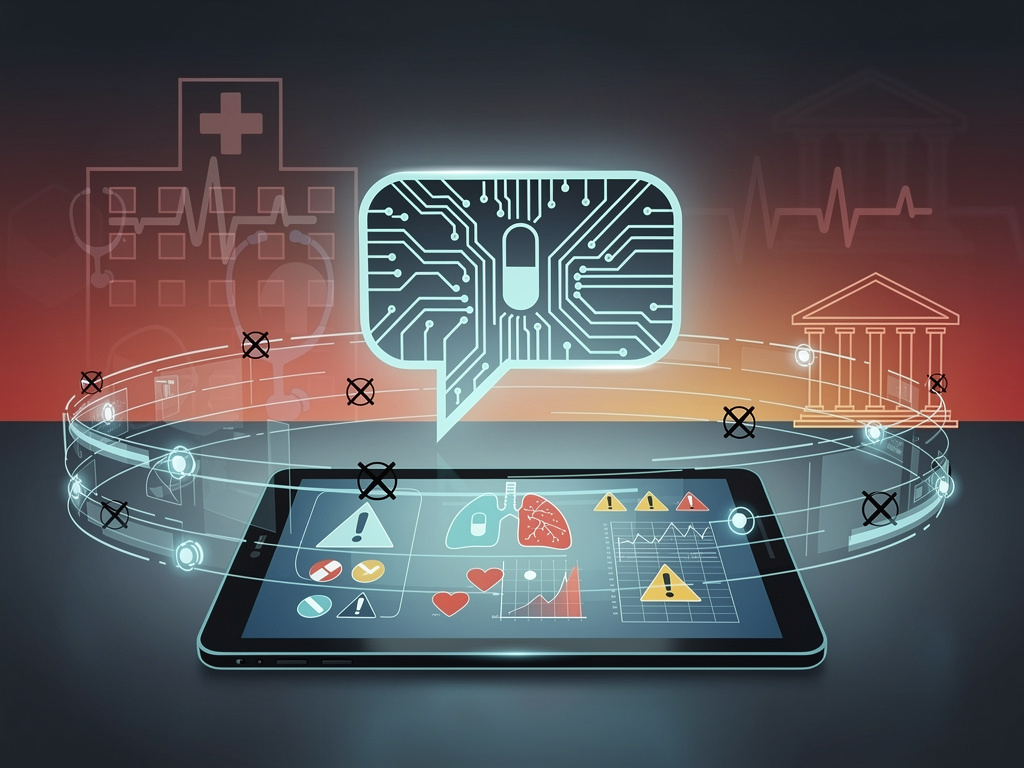
AI chatbots miss medical diagnoses at an alarming rate. That’s the blunt takeaway from a growing body of research now drawing serious attention from clinicians, technologists, and regulators alike. A recent CNET report laid out the problem in stark terms: popular AI tools, including ChatGPT and others marketed for health-related queries, frequently fail to identify conditions correctly when presented with symptom descriptions. Not occasionally. Routinely.
The core issue isn’t that these models sometimes stumble on rare diseases. It’s that they get common conditions wrong — the bread-and-butter diagnoses a first-year medical student would catch. And millions of people are already using these tools as a first stop before seeing a doctor, or worse, instead of seeing one.
A study published in JAMA Network Open earlier this year tested several large language models on clinical vignettes — standardized case descriptions used in medical education. The results were sobering. ChatGPT-4, widely considered the most capable general-purpose LLM available, achieved diagnostic accuracy rates that varied wildly depending on the specialty and complexity of the case. For straightforward presentations, it performed reasonably well. But introduce atypical symptoms, comorbidities, or demographic nuances, and accuracy dropped fast. Other models performed even worse.
This matters because the public doesn’t see the variance. They see a confident, articulate response.
That confidence is precisely the danger. Unlike a search engine that returns a list of possibilities and lets the user sort through them, a chatbot delivers a single narrative answer. It reads like authority. There’s no hedging built into the interface, no visible uncertainty score, no disclaimer that lands with any real weight. Users interpret fluency as expertise. Research from the University of California, San Diego has shown that people rate AI-generated medical advice as more empathetic and often more trustworthy than advice from actual physicians — a finding that should unsettle anyone thinking about downstream effects.
So what exactly goes wrong? Several things. LLMs don’t reason the way clinicians do. A doctor builds a differential diagnosis — a ranked list of possibilities — and then narrows it through targeted questions, physical examination, and testing. Chatbots skip most of that process. They pattern-match against training data, generating the most statistically probable response. When the input is ambiguous or incomplete, which real patient descriptions almost always are, the model fills in gaps with assumptions that may be entirely wrong.
There’s also the problem of training data bias. Models trained predominantly on data from certain populations may systematically underperform on others. Skin conditions that present differently on darker skin tones. Cardiac symptoms that manifest differently in women. Pediatric cases where adult-centric training data leads the model astray. These aren’t edge cases. They’re the everyday reality of clinical medicine.
The industry response has been mixed. OpenAI has added disclaimers to ChatGPT’s medical outputs, but disclaimers don’t change user behavior — decades of research on warning labels confirms this. Google’s Med-PaLM 2, designed specifically for medical applications, showed improved performance on medical licensing exam questions, but exam questions aren’t patients. They’re clean, complete, and unambiguous in ways that real clinical encounters never are.
Some companies are building more specialized tools. Microsoft Research has explored retrieval-augmented generation approaches that ground LLM outputs in verified medical literature, reducing hallucination rates. Startups like Glass Health and Ambience Healthcare are developing clinician-facing AI that assists with differential diagnosis rather than replacing clinical judgment. The distinction matters enormously. A tool that helps a trained physician think through possibilities is fundamentally different from a tool that tells a layperson what they have.
But the horse is already out of the barn. Patients aren’t waiting for purpose-built medical AI. They’re using ChatGPT right now, today, to interpret lab results, assess symptoms, and make decisions about whether to seek care. A 2024 survey from the Pew Research Center found that roughly one in four American adults had used an AI chatbot for health-related questions. Among adults under 30, the number was significantly higher.
Regulators are paying attention, slowly. The FDA regulates software that functions as a medical device, but general-purpose chatbots don’t neatly fit existing categories. The European Union’s AI Act classifies health-related AI as high-risk, which will impose stricter requirements — but enforcement timelines remain unclear. In the U.S., there’s no federal framework specifically addressing consumer-facing AI health tools that don’t make explicit diagnostic claims.
And that’s the loophole. These companies don’t claim their products diagnose disease. They claim to provide information. The legal and regulatory distinction is enormous even if the practical distinction, from the user’s perspective, is nonexistent.
The path forward likely involves multiple interventions. Better model calibration so outputs express genuine uncertainty. Mandatory structured disclaimers integrated into conversational flow, not buried in terms of service. Improved training data diversity. And perhaps most importantly, public education about what these tools actually are — statistical prediction engines, not doctors.
None of that will happen quickly enough. The gap between AI capability and public perception is wide and growing. People trust these tools more than the tools deserve. Until accuracy improves dramatically and transparency becomes standard, that trust is a liability — not for the companies building the models, but for the patients relying on them.


 WebProNews is an iEntry Publication