
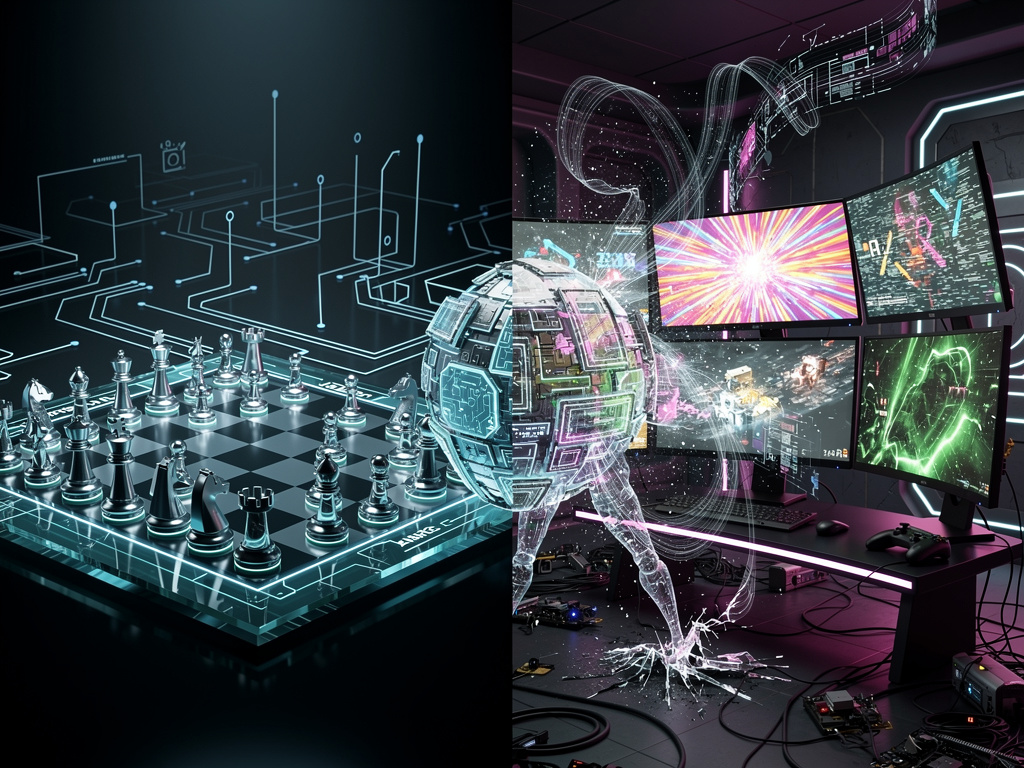
Artificial intelligence can defeat the world’s best chess players without breaking a computational sweat. It can fold proteins, generate photorealistic images, and write passable legal briefs. But ask it to play a modern video game — one with shifting objectives, unpredictable opponents, and layered strategic demands — and something curious happens. It falters.
Not always dramatically. Not always immediately. But consistently enough that researchers, game developers, and AI engineers are confronting an uncomfortable truth: the kind of intelligence required to master structured, rule-bound systems like chess is fundamentally different from what’s needed to thrive in the chaotic, evolving environments of contemporary gaming.
This gap matters far beyond entertainment. It speaks to the limits of current AI architectures and raises hard questions about what “intelligence” actually means when the rules keep changing.
The Chess Illusion: Why Board Game Mastery Doesn’t Transfer
Chess has long served as the benchmark for machine intelligence. IBM’s Deep Blue defeated Garry Kasparov in 1997. Google DeepMind’s AlphaZero taught itself to play at superhuman levels in a matter of hours. These achievements created a narrative — AI is getting smarter, and fast.
But as Digital Trends recently reported, this narrative obscures a critical limitation. Chess is a perfect information game. Both players see the entire board. The rules never change mid-match. There are no teammates to coordinate with, no fog of war, no sudden patch updates that alter the meta overnight. AI excels here because the problem space, while astronomically large, is bounded and well-defined.
Modern video games are a different animal entirely.
Consider a title like League of Legends, Dota 2, or Fortnite. These games feature incomplete information, real-time decision-making, cooperation with and against human players whose behavior is erratic and context-dependent, and — perhaps most critically — they change. Developers push balance patches. New characters arrive. Strategies that worked last week become obsolete. The environment is, by design, unstable.
AI systems built on reinforcement learning can be trained to perform well in a specific version of a game at a specific moment in time. OpenAI’s Dota 2 bot, OpenAI Five, demonstrated this in 2019 when it defeated the reigning world champions. But that system was trained on a simplified version of the game, with a restricted hero pool and specific constraints. And it couldn’t adapt when conditions shifted. It was brittle in ways that even a mediocre human player is not.
That brittleness is the core problem.
As Digital Trends notes, AI agents trained through millions of simulated games develop strategies that are optimal for the exact conditions they’ve seen. Change those conditions even slightly — a new map layout, an altered ability cooldown, a teammate who plays unpredictably — and performance degrades. Sometimes sharply. Humans, by contrast, adapt. We generalize. We notice when something feels different and adjust on the fly, drawing on intuition, analogy, and a lifetime of varied experience.
This capacity for generalization is what AI researchers call the “transfer problem,” and it remains one of the most stubborn challenges in the field. An AI that masters one game doesn’t automatically become competent at another, even a closely related one. Each new environment requires extensive retraining. Humans don’t work that way. A skilled StarCraft player can pick up Age of Empires and be reasonably competent within hours. Current AI cannot.
Why This Matters Beyond Gaming
The implications extend well past the gaming industry. The same limitations that prevent AI from adapting to a balance patch in Valorant are the limitations that make autonomous driving so difficult, that complicate robotic surgery in novel situations, and that constrain AI assistants when they encounter prompts outside their training distribution.
Real-world environments are messy. They change without warning. They’re full of incomplete information and ambiguous signals. If AI can’t handle a video game update, it raises legitimate concerns about deploying these systems in high-stakes domains where adaptability isn’t optional — it’s everything.
Researchers at DeepMind have been exploring this territory with projects like Gato, a generalist agent designed to perform multiple tasks across different domains. But Gato’s performance, while broad, is shallow compared to specialist systems. It can do many things adequately. It does few things well. The tradeoff between generality and mastery remains steep.
Meanwhile, large language models like GPT-4 and Claude have shown surprising aptitude at reasoning about games in natural language — explaining strategies, analyzing positions, even playing text-based adventures. But translating that reasoning into real-time action within a graphical, physics-driven game environment is a different challenge altogether. Language models think in tokens. Games demand spatial awareness, timing, and motor-level precision that current architectures aren’t built for.
Some researchers are experimenting with hybrid approaches. Combining the pattern recognition of deep learning with the structured reasoning of symbolic AI. Pairing language models with reinforcement learning agents so that one system can “reason” about strategy while another executes. These are promising directions, but early-stage. Nothing production-ready.
The gaming industry itself has a complicated relationship with AI opponents. Game developers have long used relatively simple AI for non-player characters — scripted behaviors, decision trees, basic state machines. These systems aren’t trying to be intelligent. They’re trying to be fun. An NPC that plays perfectly isn’t enjoyable to compete against. Players want opponents that feel human: capable of mistakes, susceptible to deception, occasionally brilliant.
But there’s growing interest in AI that can serve as a training partner, a dynamic difficulty adjuster, or even a teammate in cooperative play. For these applications, adaptability is essential. A training partner that can’t adjust to a player’s improving skill level is useless. A teammate that can’t respond to changing in-game conditions is worse than useless — it’s a liability.
Companies like Riot Games, Epic Games, and Valve have invested in AI research teams, though much of their work remains proprietary. What’s publicly known suggests they’re grappling with the same fundamental issues: training AI that doesn’t just optimize for a fixed objective but can respond flexibly to novel situations.
And then there’s the computational cost. Training OpenAI Five required tens of thousands of years of simulated gameplay, compressed into months of real time using massive GPU clusters. That’s for a single game, in a single configuration. The idea of training an AI to handle every possible state of a live-service game that updates biweekly is, with current methods, economically impractical.
So where does that leave us?
The Road Ahead Is Longer Than the Hype Suggests
The gap between AI’s performance in structured environments and its struggles in dynamic ones isn’t a minor engineering challenge. It’s a fundamental architectural limitation. Current systems — whether based on reinforcement learning, transformers, or some combination — are optimized for pattern matching within distributions they’ve already seen. They don’t truly understand the environments they operate in. They approximate understanding through statistical correlation, and that approximation breaks down when the distribution shifts.
Closing this gap will likely require new approaches. Not just bigger models or more training data, but different kinds of learning. Systems that can build internal models of how environments work and use those models to reason about novel situations. What some researchers call “world models.” Others call it common sense. Whatever the label, it’s what humans have and machines don’t.
The chess victory was real. Impressive. Historic, even. But it answered a narrow question: can machines optimize within fixed constraints? The answer was yes, emphatically.
The harder question — can machines think on their feet when the ground shifts beneath them? — remains open. And every time a state-of-the-art AI agent gets confused by a simple game update, the answer inches closer to: not yet.
Not even close.


 WebProNews is an iEntry Publication