
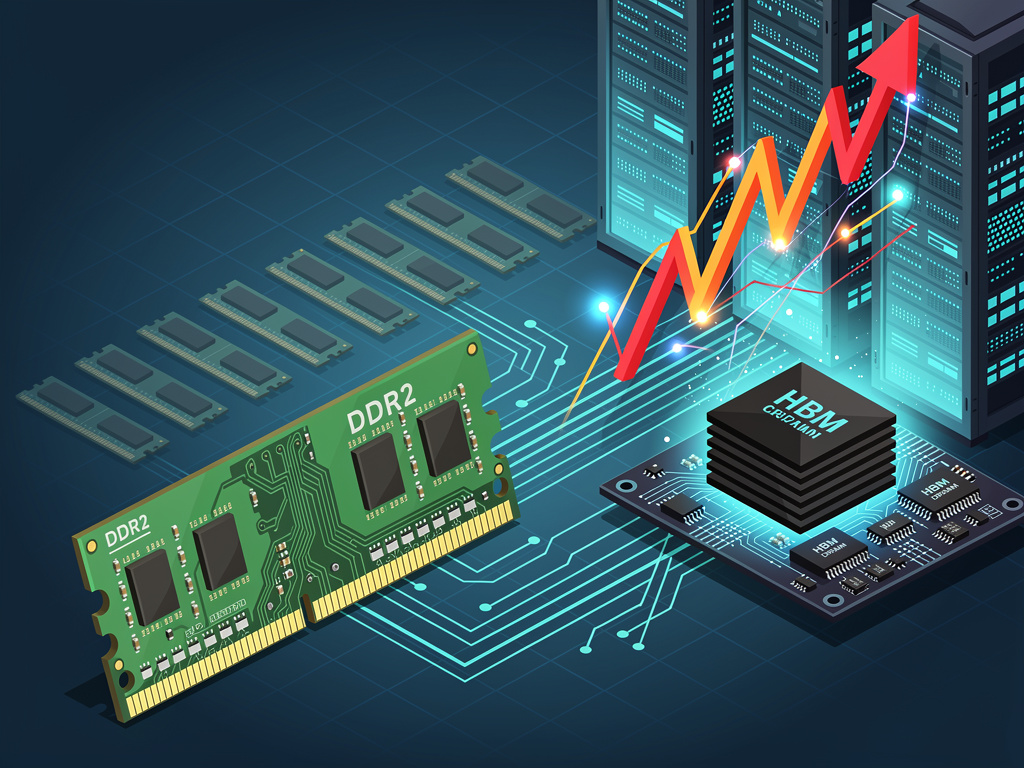
Memory chips from the George W. Bush administration are suddenly in demand. DDR2, a standard introduced in 2003 and now 23 years old in practice, faces contract price jumps of 55% to 60% in the current quarter. Another 35% to 40% rise looms in the third quarter. The cause traces directly to data centers hungry for AI training capacity.
Suppliers have redirected production. They favor high-bandwidth memory modules and server-grade DRAM that command far higher margins. The shift leaves older product lines starved. Even mature-node wafers once taken for granted now carry scarcity premiums. Legacy systems feel the pinch first.
TrendForce first flagged the numbers in a report published days ago. Contract pricing for DDR2, still sold under long-term agreements rather than spot markets, will climb sharply. Winbond has already cut its DDR2 output. The Taiwanese firm redirects limited capacity toward DDR3, DDR4 and LPDDR4 variants. Elite Semiconductor Memory Technology, or ESMT, has moved the opposite way. It squeezes more DDR2 from existing wafer allocations to meet sudden orders. (VideoCardz, June 22, 2026)
TechRadar picked up the TrendForce data and framed the story in blunt terms. Some manufacturers now redesign DDR3-based boards around DDR2 chips simply because they can secure supply. The article notes DDR4 contract prices once spiked as much as 2,200% before partial relief arrived. Volatility remains the rule. Nothing CEO Carl Pei warned that phone prices will keep climbing into next year because the memory squeeze shows no quick end. Framework, the modular laptop maker, spoke of “more RAM price hike misery” and forecasted cost pressure through the rest of 2026. (TechRadar)
But the DDR2 surge marks something new. Previous chip cycles affected cutting-edge parts. This one has traveled backward in time. Data center operators buy massive quantities of the latest HBM stacks for GPU clusters. That consumption crowds out standard DRAM production. Manufacturers respond by tilting cleanroom space toward the highest-paying customers. Hyperscalers win. Everyone else pays more or redesigns.
IDC analysts described the dynamic in December 2025. AI workloads require far more memory per rack than traditional servers. Suppliers Samsung, SK Hynix and Micron have pivoted capital spending accordingly. The result appears across the entire DRAM spectrum. Consumer PCs, smartphones, embedded devices and now vintage industrial controllers all compete for shrinking leftovers. (IDC, Dec. 18, 2025)
Tom’s Hardware cited projections that data centers could absorb 70% of global memory chip output in 2026. The figure sparked debate on forums. Some analysts pegged AI’s wafer consumption closer to 20% when measured in bits rather than raw area. The distinction matters. HBM stacks consume three times the silicon real estate of equivalent DDR5. Either way, the pressure is real. Panic buying by PC and phone makers has amplified spot prices. Lenovo reportedly stockpiled enough inventory to last through the year. Others scrambled and drove quotes higher. (Tom’s Hardware)
Discussions on X reflect the surprise. One user noted manufacturers downgrading specifications from DDR4 to DDR3 and even DDR2 to keep production lines running. Another observed that the AI race now makes 25-year-old parts more expensive than at launch when adjusted for inflation. Posts from late June 2026 repeatedly credit the TechRadar story and TrendForce data.
The pattern echoes past cycles but with a twist. In the mid-2000s DDR2 prices eventually fell as new fabs came online. Today’s constraints look structural. New fabrication capacity for advanced memory takes years and billions of dollars. Meanwhile AI buildouts continue at pace. OpenAI’s Stargate project alone has been linked to enormous wafer commitments, though exact numbers remain disputed.
Embedded systems operators face the hardest choices. Many industrial controllers, medical devices and networking appliances still rely on DDR2 because redesign carries regulatory costs and long qualification cycles. A 100% price increase on a memory module that represents a small bill-of-materials share can still delay shipments or force inventory write-ups. Cost-sensitive applications such as point-of-sale terminals or older servers now see budget pressure they never anticipated.
Market watchers expect the tightness to persist. Counterpoint Research tracked memory price jumps of up to 90% between late 2025 and early 2026. Wikipedia’s entry on the 2025-present global memory supply shortage lists AI infrastructure demand, the HBM shift and strategic capacity allocation by suppliers as root causes. Geopolitical factors and trade restrictions add further friction but remain secondary.
So what happens next? New DRAM fabs scheduled for 2027 and 2028 may ease the bottleneck. Until then buyers will hunt for inventory, accept substitutions or delay projects. The irony is clear. A technology meant to accelerate computing now slows the very hardware refresh cycles that keep older fleets viable. DDR2, long written off as obsolete, has become an unexpected barometer of the AI boom’s reach.
Prices will probably peak and then moderate. But the episode reveals how concentrated demand at the high end ripples through every layer of the supply chain. Even memory that powered Windows XP machines now carries the AI premium.


 WebProNews is an iEntry Publication