
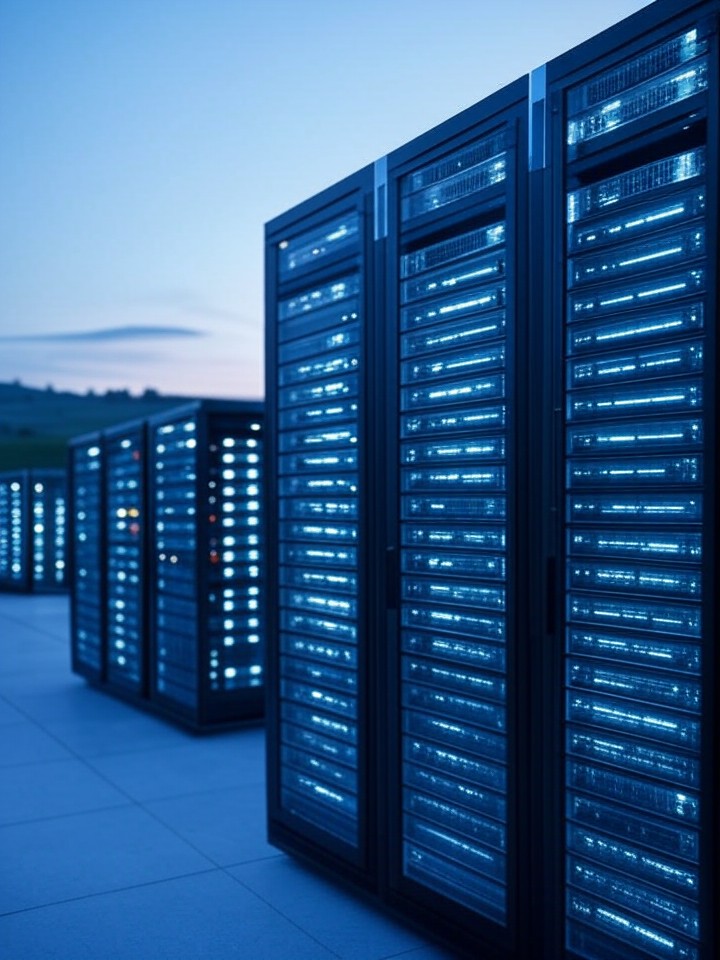
The AI Debt Surge: How Tech’s Borrowing Binge Could Reshape Borrowing Costs
The artificial intelligence boom is fueling an unprecedented wave of capital spending, but it’s not just innovation that’s accelerating—it’s debt. Major technology companies, often dubbed hyperscalers, are issuing bonds at a record pace to finance the massive data centers required for AI advancements. This borrowing frenzy, while enabling rapid expansion, is raising alarms among economists and investors about potential upward pressure on interest rates. As these firms tap debt markets to fund their ambitions, the sheer volume of new issuance could divert investor capital away from traditional safe havens like U.S. Treasurys, potentially driving yields higher across the board.
Torsten Slok, chief economist at Apollo Global Management, has been vocal about this dynamic. In a recent analysis, he highlighted how the surge in corporate bond sales tied to AI infrastructure might pull demand from government securities. “The AI-led borrowing frenzy could end up driving interest rates higher,” Slok noted, pointing to the competition for investor dollars. This isn’t mere speculation; data from recent months shows tech giants ramping up debt offerings to unprecedented levels, with implications that could ripple through financial markets well into 2026 and beyond.
The scale of this investment is staggering. Projections suggest that AI-related capital expenditures could exceed $500 billion in 2026 alone, according to insights from Goldman Sachs. Much of this spending targets data centers, which house the powerful servers and cooling systems essential for training and running AI models. Companies like Microsoft, Amazon, and Google are at the forefront, but even traditionally conservative players are joining the rush, borrowing heavily to avoid falling behind in the AI arms race.
The Flood of Tech Bonds Hits Markets
This debt issuance isn’t happening in a vacuum. In 2025, global technology firms set records with their borrowing, issuing roughly $121 billion in new debt specifically for AI and data center expansion, as reported by Mellon Investments Corporation. That’s a dramatic increase from previous years, driven by the need to build out energy-intensive facilities that can handle the computational demands of generative AI. Reuters has covered this trend extensively, noting in one piece that even cash-rich companies are turning to bonds to fuel their investments, as detailed in their article on the AI spending spree driving global tech debt to record highs.
Investors are taking notice, but not without caution. The influx of corporate bonds is creating what some describe as hotspots in the debt market. For instance, Reuters identified five key areas of concern where AI-driven financing could lead to vulnerabilities, including overleveraged balance sheets and rising borrowing costs. As more capital flows into these high-yield opportunities, the traditional Treasury market might see reduced demand, pushing yields up. This shift could affect everything from mortgage rates to corporate lending, amplifying the economic impact of the AI boom.
On social media platforms like X, sentiment reflects a mix of excitement and worry. Posts from financial analysts highlight the explosion in hyperscaler capex, with projections for 2026 reaching $527 billion, underscoring the rapid escalation. One user noted the jump in investment-grade bond issuance to $88 billion from AI-focused Big Tech, echoing data from market observers. These discussions often point to specific cases, like Oracle’s aggressive buildout pushing it toward junk bond status, as explored in a blog post by Tomasz Tunguz.
Risks in the AI Financing Model
The economics of data centers add another layer of complexity. These facilities require enormous upfront investments in hardware that depreciates quickly—chips and networking gear often become obsolete within two to four years. A post on X referenced an analysis suggesting that annual depreciation on 2025 builds could hit $40 billion, outpacing projected revenues of $15-20 billion. This mismatch raises questions about long-term sustainability, especially as companies layer on debt to fund expansions.
Debt investors are growing wary, demanding higher interest rates to compensate for perceived risks. The New York Times reported that AI companies are facing lofty borrowing costs as caution sets in, detailed in their coverage of AI firms borrowing billions amid investor skepticism. This caution stems from concerns over power constraints and the sheer scale of projects, with some data centers rivaling small cities in energy consumption. CNBC has chronicled how these deals hit record levels in 2025, with hyperscalers turning to outside capital for energy-intensive infrastructure, as seen in their article on data center funding concerns.
Fortune magazine recently delved into the broader implications, noting that as U.S. debt surpasses $38 trillion, the flood of corporate bonds poses a threat to Treasury supply. Their piece warns of questions around who will buy all this investment-grade paper, potentially leading to higher yields, as outlined in their analysis of corporate bonds and AI’s impact. This competition for capital could force the Federal Reserve to reconsider its rate path, especially if inflation pressures resurface amid increased economic activity from AI investments.
Projections and Market Selectivity
Looking ahead to 2026, forecasts from sources like Moody’s, shared via X posts, indicate at least $3 trillion flowing into AI data centers over the next five years—averaging $600 billion annually. This capital will target bottlenecks in raw materials, power generation, and semiconductors, benefiting companies in those sectors. However, investor selectivity is on the rise; Goldman Sachs points out that while capex projections are climbing, share prices are diverging, with markets favoring firms poised to monetize AI effectively.
Specific company moves illustrate the trend. Meta has signaled that its 2026 capital expenditures could be “notably larger” than 2025’s $70-72 billion, potentially reaching $100 billion for AI infrastructure, including custom chips and data centers. X posts from industry watchers detail similar escalations at Amazon, Microsoft, Google, and Oracle, with collective spending estimates hitting $400-450 billion in 2025 and surging higher in 2026. Morgan Stanley’s forecasts, referenced in online discussions, predict a 20%+ earnings per share compound annual growth rate for semiconductors, driven by sustained demand.
Yet, the debt-fueled nature of this growth introduces fragility. CNBC’s year-end review described how Big Tech is remaking the American terrain with kingdom-scale data centers, backed by unprecedented debt and a belief in scaling, as covered in their feature on AI’s transformation of infrastructure. Profits are lagging behind investments, with one X analysis noting $450 billion in projected profits against $1 trillion needed to sustain operations, compounded by rising debt payments and bond spreads.
Broader Economic Ripples
The interplay between AI capex and interest rates could have far-reaching effects. If bond issuance continues to crowd out Treasury demand, as Slok suggests in the Business Insider article, benchmark rates might climb, affecting borrowing costs economy-wide. This scenario echoes past tech booms but with higher stakes, given the energy and resource demands of modern AI.
Private credit is stepping in where traditional bonds fall short, with X posts estimating $800 billion of the $3 trillion in data center spending through 2028 coming from such sources. This shift highlights how lenders are bankrolling the AI race, potentially amplifying risks if defaults rise. Bank of America, via social media insights, warns of an “air pocket” rather than a full bubble burst, but the quadrupling of annual debt issuance from hyperscalers signals caution.
Economists like those at Apollo argue that this borrowing could indirectly influence monetary policy. With global financing for data centers ballooning to nearly $3 trillion by 2028, as noted in X discussions from figures like Lisa Abramowicz, the pressure on rates might persist. Investors are advised to monitor yield curves closely, as the diversion of funds could lead to sustained higher borrowing costs.
Navigating the AI Debt Horizon
As 2026 unfolds, the tech sector’s debt strategy will be under scrutiny. Companies must balance aggressive expansion with financial prudence, especially as rapid depreciation and chip obsolescence challenge return on investment. X posts from analysts like Ilia Sakowski emphasize how AI datacenter financing jumped 733% year-over-year in 2025, with revenues slowing from 70% to 25% growth amid mounting obligations.
The narrative isn’t all doom; opportunities abound for those positioned correctly. Semiconductors and power providers stand to gain from the capex wave, as highlighted in Moody’s projections shared online. Yet, the core question remains: Can AI’s promised revenues justify the debt mountain?
Ultimately, this borrowing surge underscores a pivotal moment for tech and finance. As hyperscalers reshape markets with AI-driven investments, the resulting debt dynamics could redefine interest rate trajectories, demanding vigilance from insiders across industries.


 WebProNews is an iEntry Publication