
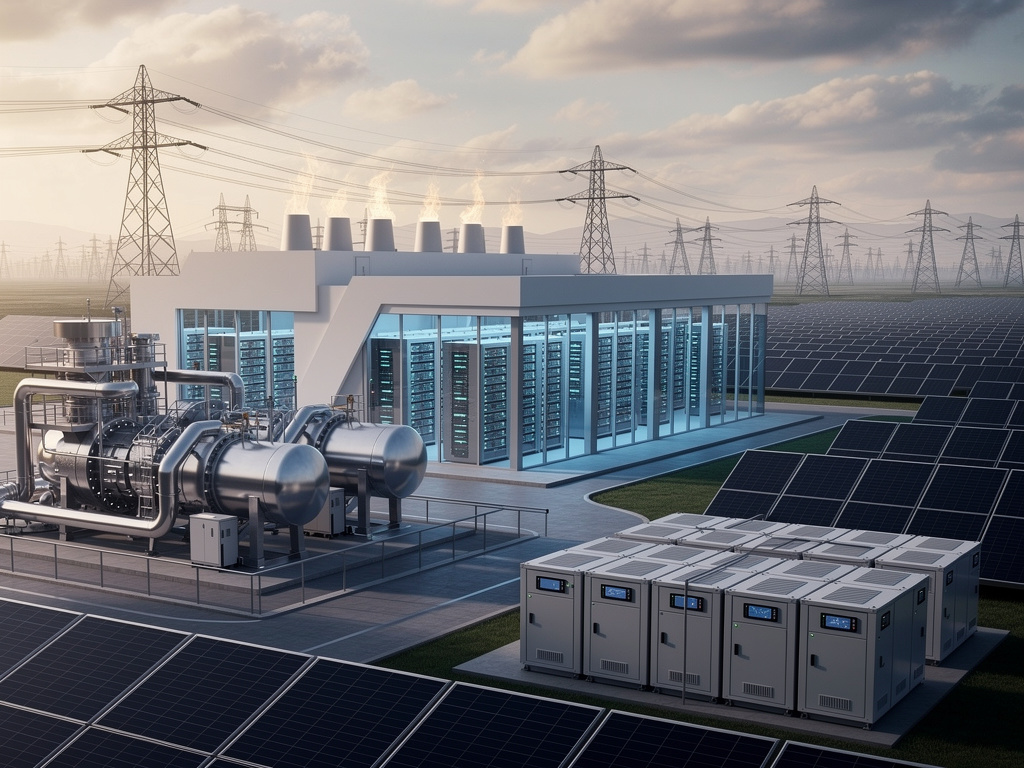
Fueling the AI Revolution: Labs Ditch the Grid in Race for Power
The artificial intelligence boom is pushing the boundaries of energy consumption, with data centers hungry for electricity on a scale that’s straining national grids. Major tech companies, facing delays in grid expansions and soaring power demands, are turning to innovative solutions to keep their AI operations running. At the forefront of this shift is the adoption of onsite power generation, particularly using natural gas, as a way to bypass traditional utility constraints and ensure reliable energy supply for massive computing clusters.
This move isn’t just a stopgap; it’s becoming a strategic imperative. AI labs are investing billions in building their own power plants right next to data centers, leveraging technologies like gas turbines and reciprocating engines to generate electricity independently. The rationale is clear: with AI models requiring unprecedented computational power, waiting for grid upgrades could mean falling behind in the competitive race for AI dominance. Sources indicate that companies like Microsoft and Google are exploring or already implementing such systems to meet their escalating needs.
But this transition raises questions about sustainability, cost, and long-term viability. While onsite generation offers immediacy, it also ties AI’s future to fossil fuels, potentially conflicting with corporate carbon-neutral pledges. Industry insiders note that the power requirements for training large language models can rival those of small cities, making self-sufficiency not just advantageous but necessary in some regions where grid capacity is maxed out.
The Onsite Generation Pivot
One key player in this evolving scenario is the push toward “bring your own generation” strategies, as detailed in a recent analysis by SemiAnalysis. In their report, How AI Labs Are Solving the Power Crisis, experts break down how AI firms are saying goodbye to reliance on the electric grid. The piece explores options like gas turbines, reciprocating engines, and fuel cells, weighing their pros and cons for data center applications.
Gas turbines, for instance, offer high efficiency and scalability, making them suitable for large-scale operations. Reciprocating engines provide flexibility and quicker startup times, ideal for variable loads typical in AI workloads. Fuel cells, while cleaner, face challenges in cost and hydrogen supply. The SemiAnalysis report delves into total cost of ownership, showing that onsite natural gas generation can be more economical than grid power in high-demand areas, especially when factoring in avoided transmission fees and reliability premiums.
Beyond economics, this shift is driven by necessity. Grid connection wait times in key U.S. regions can stretch to five years or more, a timeline that’s untenable for AI development cycles. Tech giants are thus procuring land not just for servers but for integrated power facilities, creating self-contained ecosystems that could redefine data center design.
Grid Strains and AI’s Insatiable Appetite
The scale of AI’s energy demands is staggering. According to a Goldman Sachs analysis, AI is poised to drive a 160% increase in data center power demand by 2030. A single ChatGPT query consumes nearly 10 times the electricity of a Google search, highlighting the intensive nature of generative AI. This surge is prompting a reevaluation of energy infrastructure worldwide.
Posts on X from industry observers underscore the urgency. Users have noted that AI data centers could soon match the energy usage of 40 million U.S. homes, with projections from sources like Boston Consulting Group amplifying concerns. Another post highlights that data centers account for 80% of AI’s energy use, split between computing and cooling, emphasizing the dual challenge of power and heat management.
MIT Technology Review has also weighed in, calculating AI’s energy footprint in a piece titled We did the math on AI’s energy footprint. The article points out that while individual queries seem minor, the aggregate emissions are substantial, especially as AI integrates into everyday applications. It calls for better tracking of indirect energy costs, like those from manufacturing chips and building infrastructure.
Innovative Solutions Beyond Gas
While natural gas dominates current onsite strategies, alternatives are emerging. Solar and battery storage, championed by companies like Tesla, are being integrated into data center plans to offset fossil fuel use. X posts from stock analysts praise Tesla’s role in revolutionizing energy storage for AI, suggesting that combining renewables with onsite generation could mitigate environmental impacts.
The International Energy Agency’s report on Energy demand from AI analyzes global trends, forecasting that AI could add significantly to electricity consumption. It advocates for efficiency improvements in algorithms and hardware to curb growth. Similarly, Nature’s exploration in How much energy will AI really consume? urges transparency from firms about their power usage, noting the good, bad, and unknown aspects of AI’s energy trajectory.
Space-based data centers, an outlandish yet discussed idea, have surfaced in recent news. Live Science reports on Google’s proposal for orbital servers in Could data centers in space help avoid an AI energy crisis?, debating feasibility amid physics and energy constraints. Experts are divided, with some calling it impractical, but it illustrates the lengths to which innovators are going to solve power issues.
Comparing Power Technologies
Diving deeper into technology choices, the SemiAnalysis report compares gas turbines against reciprocating engines and fuel cells for AI applications. Turbines excel in continuous operation but require more space and maintenance. Recips offer modularity, allowing labs to scale power incrementally as AI clusters grow. Fuel cells promise zero emissions if using green hydrogen, though supply chains lag.
Why not just build more combined-cycle gas turbines (CCGTs) on the grid? The analysis explains that regulatory hurdles and transmission bottlenecks make onsite options preferable. Onsite total cost of ownership often undercuts grid power, especially with natural gas prices stable in key markets.
MIT News addresses the multifaceted challenge in The multifaceted challenge of powering AI, where researchers explore policy and tech angles. They highlight the need for government incentives to accelerate clean energy adoption, warning that unchecked growth could strain resources.
Sustainability and Policy Implications
Sustainability remains a flashpoint. While onsite gas generation solves immediate power shortages, it could lock in carbon emissions for decades. Companies are countering this by committing to carbon capture or offsets, but critics argue it’s greenwashing. Nature’s editorial on Fixing AI’s energy crisis stresses hardware innovations for lower power use, like specialized chips that reduce consumption without sacrificing performance.
Recent X posts reflect public sentiment, with users projecting AI data centers consuming up to 1,600 terawatt-hours by 2035, quadrupling current levels. This equates to 4.4% of global electricity, underscoring the need for more generation capacity. Another post from energy analysts notes AI’s byproduct: a major energy shortage, pushing for diversified sources.
StateTech Magazine offers practical advice in How Cities Can Build AI Systems That Don’t Break the Grid, suggesting public-sector leaders balance insight, cost, and consumption through efficient designs and renewables. For cities hosting data centers, this means upgrading local grids or incentivizing green tech.
Case Studies from Leading Labs
Real-world implementations are already underway. ByteDance’s investment in ten-thousand-GPU clusters, as analyzed in a DEV Community post on Computing Power as Strategy, reveals infrastructure challenges. The company is navigating power hurdles by integrating onsite solutions, ensuring their AI ambitions aren’t derailed.
Power Magazine’s year-end outlook in Power Generation in the Age of AI discusses how the sector is adapting, with renewables buildout continuing amid AI demands. It notes a shift from the 2020 narrative, where AI wasn’t yet a dominant factor.
Research from AIMultiple in AI Energy Consumption: Statistics from Key Sources [2026] compiles data showing best practices, like optimizing models to reduce queries’ energy footprint. It cites leading agencies advocating for sustainable AI development.
Future Horizons in AI Power Management
Looking ahead, hybrid approaches may prevail, blending onsite gas with emerging tech like advanced batteries and nuclear microreactors. X users speculate on nuclear’s role, with posts noting AI’s computational demands aligning with reliable, low-carbon sources.
The Penn State IEE blog on AI’s Energy Demand: Challenges and Solutions outlines steps for alignment with sustainability, including better cooling and edge computing to distribute loads.
Ultimately, as AI evolves, so must its energy strategies. Industry leaders are betting on onsite innovation to fuel progress, but balancing growth with environmental responsibility will define the next era. With ongoing research and policy shifts, the path forward promises efficiency gains that could temper the power crisis.


 WebProNews is an iEntry Publication