
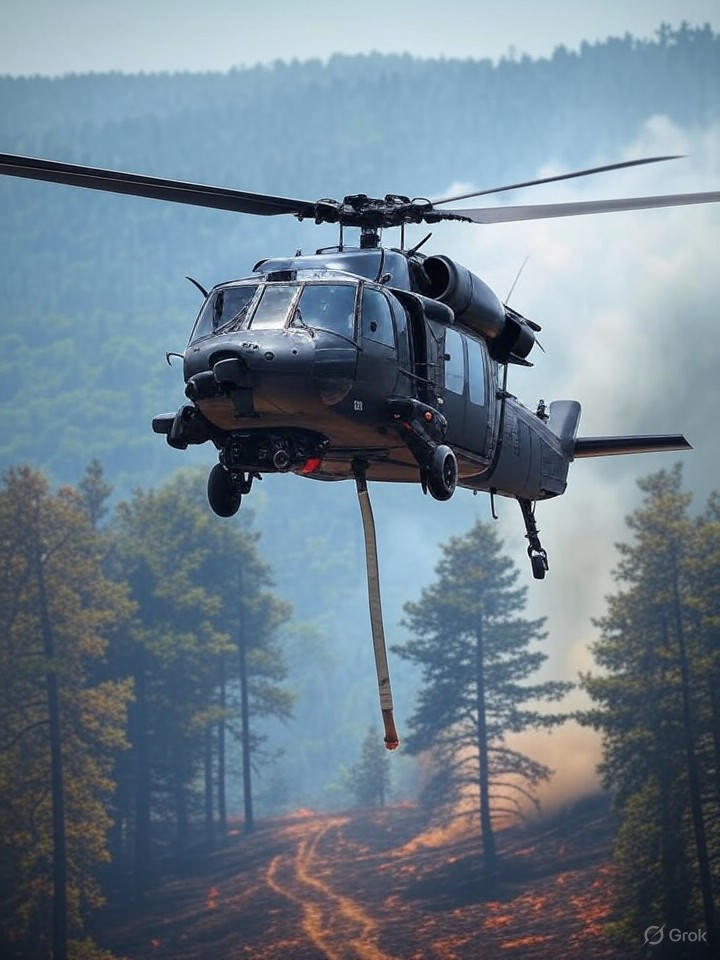
In the scorching wilds of California, where wildfires have become an annual scourge, a revolutionary technology is taking flight—literally. An autonomous Black Hawk helicopter, guided by artificial intelligence, has been tested to detect and suppress blazes with unprecedented speed and precision. This isn’t science fiction; it’s the result of collaborations between aerospace giants and startups, aiming to transform how we combat one of nature’s most destructive forces. Recent demonstrations have shown the helicopter autonomously locating fires, deploying water drops, and returning to base, all without human intervention in the cockpit.
The technology builds on Sikorsky’s MATRIX autonomy system, integrated with AI from partners like Rain, a firetech firm specializing in aerial containment. In a test detailed by Slashdot, the helicopter responded to a simulated lightning-sparked fire detected by overhead satellites. Sensors onboard used AI to map the blaze, generate a suppression plan, and execute it by dropping water from an attached tank. Witnesses, including firefighters and tech executives, watched as the unmanned craft hovered precisely over the flames, releasing payloads that doused the fire in minutes.
Advancements in Autonomous Flight Systems
This breakthrough stems from years of development under programs like DARPA’s Aircrew Labor In-Cockpit Automation System (ALIAS), which retrofits existing helicopters for pilot-optional operations. Lockheed Martin, Sikorsky’s parent company, has been at the forefront, as highlighted in their November 2024 press release. The system fuses AI with advanced sensors, allowing the Black Hawk to navigate complex terrains, avoid obstacles, and make real-time decisions. In a follow-up test reported by Lockheed Martin in May 2025, the helicopter suppressed multiple test fires in Hesperia, California, demonstrating rapid response times that could shave hours off traditional firefighting efforts.
Industry insiders note that human pilots face immense risks in wildfire zones—smoke, turbulence, and fatigue can lead to accidents. By automating these missions, the technology promises to save lives while enhancing efficiency. Pacific Gas and Electric Company (PG&E) is an early adopter, as covered in Renewable Energy World, integrating the system into their grid protection strategies to prevent utility-sparked fires from escalating.
Expanding Applications Beyond California
The momentum isn’t confined to the West Coast. Texas, grappling with its own intensifying wildfire seasons, has committed nearly $60 million to retrofit Black Hawk helicopters with AI for autonomous operations. According to a report from KFYO News, the state is partnering with DARPA and Texas A&M University to deploy these pilotless aircraft for tasks like water drops and aerial surveys in hazardous areas. This investment, detailed in Homeland Preparedness News, aims to create a fleet capable of 24/7 operations, reducing response times in vast rural expanses where manned flights are logistically challenging.
Posts on X (formerly Twitter) reflect growing public and industry excitement, with users discussing DARPA’s role in testing unmanned Black Hawks for 2025 deployments. One thread highlighted Lockheed’s Sikorsky MATRIX system enabling remote control from hundreds of miles away, underscoring the tech’s potential for false-flag prevention in military contexts, though experts emphasize its civilian firefighting focus.
Challenges and Ethical Considerations
Despite the promise, hurdles remain. Regulatory approval from the FAA for fully autonomous commercial flights is pending, with safety certifications expected to take months. Costs are another barrier; retrofitting a single Black Hawk can exceed millions, though proponents argue the long-term savings in lives and property justify it. Environmental groups, as noted in discussions on platforms like X, worry about over-reliance on tech amid climate change, potentially diverting funds from prevention strategies like forest management.
Moreover, integrating AI raises questions about decision-making in dynamic scenarios. What if sensors fail in heavy smoke? Engineers at Rain and Sikorsky are addressing this through redundant systems and machine learning algorithms trained on vast datasets of past fires. A demonstration video from New Atlas showcases the helicopter’s ability to adapt mid-flight, adjusting drop patterns based on wind shifts detected in real-time.
Future Prospects and Industry Impact
Looking ahead, this technology could redefine aerial firefighting globally. California’s “wildfire moonshot,” as described in a Yahoo News piece, involves scaling up autonomous fleets with partners like Cal Fire. Texas’s initiative, per Audacy, positions the state as a leader in AI-driven disaster response, potentially exporting the model to fire-prone regions like Australia or the Mediterranean.
For aerospace firms, the wildfire application opens doors to broader markets, from search-and-rescue to cargo delivery in remote areas. Lockheed Martin’s stock has seen upticks following these announcements, signaling investor confidence. As one industry analyst put it, this isn’t just about fighting fires—it’s about pioneering a new era of autonomous aviation that could reshape multiple sectors.
In essence, the AI-guided Black Hawk represents a convergence of military-grade tech and civilian needs, driven by necessity in an era of megafires. With ongoing tests and deployments, it may soon become a staple in the arsenal against wildfires, proving that innovation can indeed rise from the ashes.


 WebProNews is an iEntry Publication