
AI Billions Under Fire: Big Tech’s Earnings Reckoning
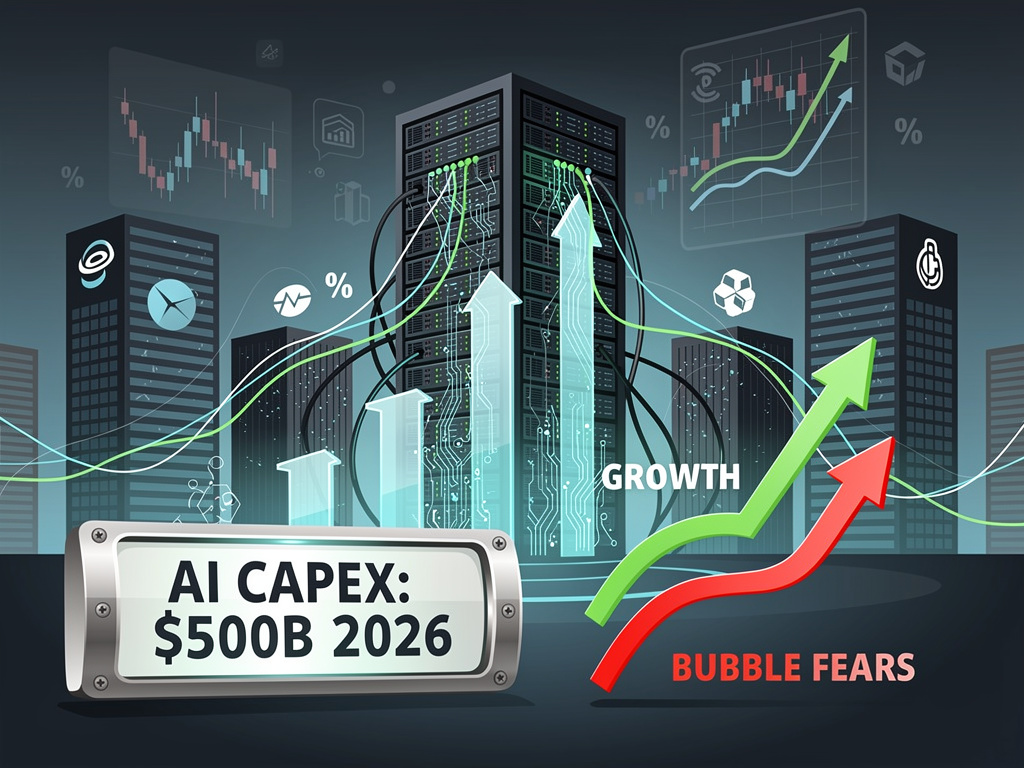
As earnings season unfolds in early 2026, Wall Street’s gaze fixes on the hyperscalers—Microsoft, Alphabet, Amazon, and Meta—whose voracious appetite for artificial intelligence infrastructure has propelled capital expenditures toward $470 billion this year, up sharply from $350 billion in 2025, according to FactSet estimates cited in a CNBC analysis. Investors, once enamored with the AI promise, now demand proof of returns amid whispers of an overbuilt bubble. Microsoft and Meta report Wednesday, followed by Apple and Tesla, with Alphabet and Amazon next week.
The pressure stems from late 2025’s sentiment shift, when Meta’s stock plunged 11% after lifting its full-year capex guidance without clear profitability paths, as detailed in the same CNBC report. “Investor fears around the potential impact to earnings from the projected spend, as well as reduced financial flexibility from the elevated investments in the near-to-mid-term, could somewhat outweigh optimism around faster growth,” warned Deutsche Bank analysts. OpenAI’s $1.4 trillion infrastructure commitments, secured via deals with Nvidia, Broadcom, Oracle, Amazon, and Google, underscore the scale, though public companies face quarterly accountability private firms evade.
Hyperscalers’ Capex Surge Accelerates
Microsoft’s fiscal 2026 capex is projected at $98.8 billion by FactSet, with Q2 estimates at $36.25 billion, a 60% year-over-year jump per Visible Alpha. CFO Amy Hood signaled accelerated growth after prior slowdown hints, fueling a stock dip in October 2025. Azure growth is eyed at 37% constant currency, down slightly from 39%, amid Copilot adoption concerns: KeyBanc analysts noted on January 22 that over half of organizations license Copilot for just 10% of Microsoft 365 users, as reported by CNBC.
Meta, lacking a cloud arm, bets on AI for ad improvements after a $14.3 billion Scale AI investment. CEO Mark Zuckerberg defended the strategy: “We’re seeing the returns in the core business that’s giving us a lot of confidence that we should be investing a lot more, and we want to make sure that we’re not underinvesting,” he said in October 2025 earnings. FactSet sees 2026 capex over $110 billion, a 57% rise; Goldman Sachs forecasts $125 billion, climbing to $144 billion in 2027.
Amazon leads with $125 billion 2026 guidance, up from $118 billion, targeting $146 billion per FactSet, driven by AWS AI demand. A $38 billion OpenAI deal for Nvidia-equipped infrastructure highlights stakes. Alphabet, fresh off its best stock year since 2009, raised 2025 capex to $91-93 billion; 2026 estimates exceed $115 billion amid Gemini deals with Apple and OpenAI/Anthropic pacts.
ROI Skepticism Grips Investors
The Los Angeles Times reported Big Tech’s $475 billion 2026 capex projection, nearly double 2024’s $230 billion, as profit growth slows to 20%—the weakest since early 2023. “We’re no longer in an environment where companies can beat by 1% to 2% and continue spending on capex and get rewarded,” said Chris Maxey of Wealthspire. Goldman Sachs pegs consensus at $527 billion, noting underestimates in prior years, with Q3 2025 hyperscaler spend at $106 billion, up 75% year-over-year.
Reuters highlighted a 30% AI spend lift to over $500 billion, sharpening scrutiny as Alphabet surges on AI confidence. Seeking Alpha noted earnings will test if AI pays off, with rotation to suppliers like memory firms amid megacap caution. On X, investor George Noble posted Duke CFO Survey data showing most report “no change” in productivity despite 78% investing, echoing Goldman’s view of negligible labor impact until 2027.
Tesla diverges, with $11 billion 2026 capex versus $9.5 billion prior, focusing on Optimus robots and Robotaxi amid 8.6% delivery drop. Apple eyes Siri Gemini integration post-delays, with Bank of America analysts citing iPhone upgrade potential despite AI lags.
Cloud Wars and Adoption Hurdles
Evercore ISI praised Azure’s position post-New York AI Tour, but KeyBanc flagged Copilot limits. Amazon’s Andy Jassy noted AWS “gaining momentum” from AI workloads. Alphabet balances search protection with cloud; OpenAI’s ChatGPT ads test monetization. Meta develops “Avocado” amid Llama setbacks.
The Los Angeles Times emphasized Magnificent Seven leadership reversal late 2025 on ROI doubts. CNBC linked Meta’s woes to no cloud buffer. X user Jim Stewartson decried AI as “economic suicide,” citing OpenAI’s trillions in dead-end chatbot centers.
Goldman Sachs Research warns capex slowdown risks valuations, with infrastructure firms up 44% year-to-date versus 9% earnings growth. IEEE ComSoc noted $400 billion 2025 aggregate, more in 2026, as firms like Meta eye “notably larger” outlays.
Pathways to Profitability Emerge?
Executives insist demand outstrips supply. Nvidia’s Jensen Huang called it history’s largest buildout at Davos. Tim Cook hailed iPhone 17 as “off the chart.” Yet, Business Insider detailed Q3 surges: Microsoft $35 billion, Amazon close behind, Meta $19.4 billion, all signaling 2026 escalation.
Investor X posts like Wes Roth’s frame spending as modest versus computing shift potential. But ToonHive highlighted OpenAI’s $14 billion 2026 losses, $207 billion industry shortfall by 2030. Reuters sees AI, profits, Fed cuts key to 2026 markets, with Mag 7 growth at 23% versus 13% rest.
Stakeholders watch for construction shifts from announcements, timelines, and deals tying fates. Earnings will reveal if AI infrastructure yields revenue acceleration or forces recalibration in this high-stakes race.


 WebProNews is an iEntry Publication