
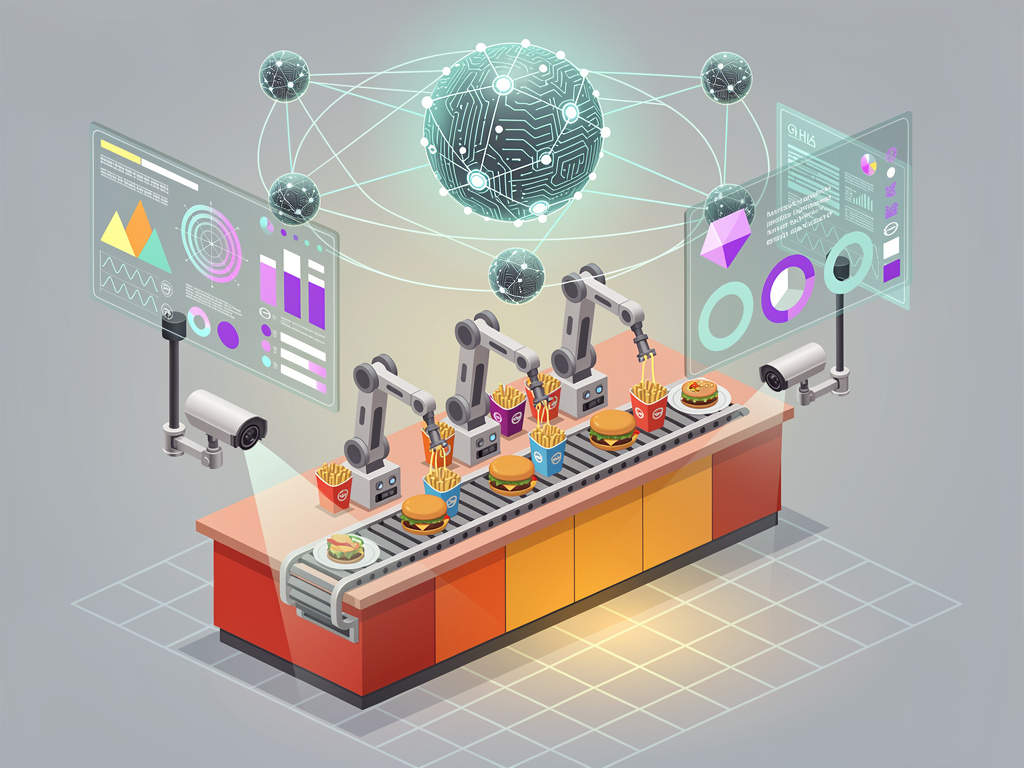
Fast food chains face relentless pressure to cut costs and lift service standards. Now they turn to artificial intelligence systems that sit beside workers, answer questions, track performance and sometimes report upward. These tools go far beyond order-taking kiosks. They function as always-on colleagues with perfect recall of recipes, policies and inventory levels.
At Burger King, one such system already listens through employee headsets in hundreds of drive-thrus. Named Patty, it reminds crew to say please and thank you. It logs friendliness scores. It tells managers which team hit the highest marks this week. The company plans to make the platform available across all its U.S. locations by the end of 2026. BBC News first detailed the rollout and the backlash that followed.
But. This marks only one piece of a broader shift. Similar platforms operate at Starbucks, Chipotle and operations under Yum Brands. They coach staff in real time. They forecast demand using weather data and local events. They nudge managers toward better decisions. Executives describe the technology as an assistant manager that never needs a break.
Starbucks rolled out Green Dot Assist last year. Baristas ask it for drink recipes or customization guidance instead of hunting through manuals or sticky notes. COO Mike Grams explained the appeal in January. “Starbucks baristas can now ask the company’s ‘Green Dot’ assistant for recipes or operational guidance instead of ‘fumbling through a computer’ or sticky laminated pages behind the counter.” The system has drawn mixed reviews from store workers who call responses hit or miss and sometimes slow.
Chipotle deploys Ava Cado as a virtual manager. It screens applicants and handles parts of onboarding. CEO Scott Boatwright reported that the tool earned a standing ovation when presented to company leaders. The chain joins McDonald’s, KFC and Taco Bell in testing comparable employee-facing AI that pulls from vast internal data sets.
Burger King’s chief digital officer Thibault Roux framed Patty in similar terms. He told reporters the goal is assistance, not surveillance. Managers gain time with customers rather than buried in back-office reports. “We almost joke about it like it shouldn’t even be called BK Assistant… We should call it assistant manager.” Roux’s comments appeared in coverage that also captured online criticism labeling the system dystopian.
Industry consultants express caution. Ray Camillo, founder of Blue Orbit Restaurant Consulting, questions whether hourly workers will accept nudges from software telling them to move faster. He sees clearer value in AI for scheduling and inventory planning than in real-time performance coaching. “I’m not so sure I’m sold on the idea that employees are going to embrace being nudged by a system saying, ‘Hey, you’re not working fast enough.'” Camillo’s skepticism echoes in conversations across restaurant operations.
Yum Brands built Byte Coach with Nvidia. The platform reviews online feedback, sales forecasts and operational data. It then issues daily priorities for kitchen flow, delivery timing, stock levels and staffing. A company representative described the output as “clear, actionable priorities across areas like kitchen optimization, delivery, inventory and labor management to drive stronger performance and consistency.” The approach aims to translate complex information into steps any shift leader can follow.
McDonald’s tests Boost, an AI capability designed to ease pressure on shift managers and reduce stress for crews. Details remain limited. Yet the pattern across these operators shows a common direction. Chains want data-driven consistency in businesses long known for high variability between locations and shifts.
Critics see risks. Lacey Kaelani, CEO of job search engine Metaintro, draws a sharp line. Scheduling tools solve real problems. Rating individual politeness crosses into surveillance. “There’s a major difference between AI that assists in scheduling hourly workers — a significant issue — and AI that rates an employee’s politeness.” She warns some workers may simply avoid employers who adopt such monitoring. Her comments appeared in Nation’s Restaurant News, which examined how these assistants could reshape labor practices.
Recent coverage reinforces the momentum. A May 11 Business Insider investigation cataloged how these systems now act as digital managers that monitor performance and direct next steps. Business Insider quoted workers frustrated that Green Dot sometimes freezes or gives conflicting advice, making it harder to access accurate information quickly. One store veteran said almost no one uses it.
Yet adoption accelerates. Operators chase thinner labor margins while customers demand faster, friendlier service. AI promises both. It catches low stock before a crew member mentions running out of Diet Coke. It suggests which menu item to push based on real-time sales patterns. It generates schedules that factor in local events and weather forecasts.
Restaurant consultant circles debate the long-term effects. Some predict AI will handle more planning tasks and leave humans freer for guest interaction. Others foresee greater tension if the technology feels like an algorithmic boss that never clocks out. And the data these systems collect creates its own feedback loop. Chains gain unprecedented visibility into every shift, every interaction, every deviation from standard.
Patty does not record full conversations, Burger King insists. It identifies keywords such as hospitality phrases to measure overall service quality. The company stresses hospitality remains human. Technology simply supports teams so they stay present with guests. Still, promotional videos that show the AI congratulating teams on friendliness scores have fueled online complaints about constant oversight.
Similar tools appear beyond the biggest chains. Emerging reports from early 2026 describe AI inside inventory systems and labor forecasting software quietly reshaping back-of-house decisions. These systems do not replace line cooks today. They influence what gets prepped, when staff clocks in and how managers allocate hours. The cumulative effect could determine which operators thrive amid tight margins and persistent labor shortages.
Executives at multiple brands describe a future where veteran leaders welcome the assistance. Grams at Starbucks noted positive reactions from experienced operators. Boatwright highlighted strong internal reception for Ava Cado. The question lingers whether frontline crews will share that enthusiasm once the tools move from pilot to daily reality.
One industry voice put the crossroads clearly. Workers might reject employers who use AI primarily to watch rather than support. The technology itself carries less weight than the intent behind its deployment. Chains that position these digital coworkers as genuine aids may gain loyalty. Those perceived as building invisible supervisors risk alienating the very staff they need to retain.
The experiment continues. Patty listens in drive-thrus. Green Dot answers drink questions. Byte Coach sets daily priorities. Each implementation adds another layer of artificial intelligence into operations long managed by human judgment and paper checklists. Fast food, once defined by uniformity and speed, now tests how far that model extends when the supervisor never sleeps.


 WebProNews is an iEntry Publication