
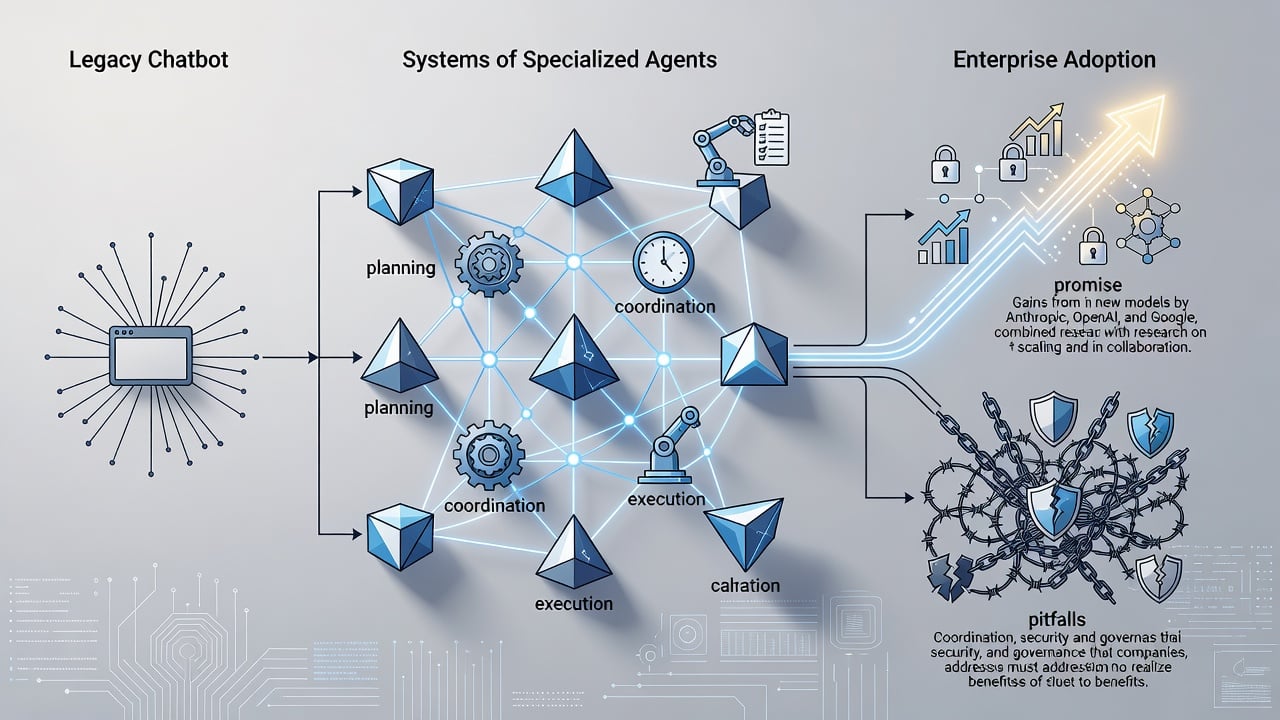
Tech executives once viewed artificial intelligence as a clever assistant for drafting emails or summarizing reports. That view has shifted. Companies now deploy systems of specialized agents that plan, debate, execute and even critique one another to finish complex assignments without constant human guidance.
Anthropic pushed the boundary in October 2024 when it gave its Claude 3.5 Sonnet model the ability to control a computer directly. The model can move a cursor, click buttons, type text and scroll through screens just as a person would. In early tests the system scored 14.9 percent on the OSWorld benchmark using only screenshots, beating the next best result of 7.8 percent. With additional steps the score climbed to 22 percent. Anthropic called the feature experimental, cumbersome and error-prone yet a first for any frontier model released to the public.
The move arrived alongside upgrades that lifted Claude 3.5 Sonnet’s score on SWE-bench Verified from 33.4 percent to 49 percent. That benchmark measures how well a model can fix real GitHub issues. The same model also improved on TAU-bench, jumping from 62.6 percent to 69.2 percent in retail scenarios and from 36 percent to 46 percent in airline tasks. These gains matter because they show progress in areas that demand planning over many steps.
OpenAI took a different route. Its o1 model family emphasizes internal reasoning chains before producing an answer. The approach mimics the way a skilled employee might pause, consider alternatives and double-check work. Early users reported the model excels at tasks that require sustained focus, though exact benchmark numbers for agentic behavior remain sparse in public releases.
Google has rolled out customizable agents inside its Search product. At the 2026 I/O event the company demonstrated how users can spin up multiple specialized agents that monitor topics, gather updates and collaborate without repeated prompts. TechCrunch described the effort as part of a broader push toward systems that take initiative rather than wait for the next question.
Yet raw capability tells only part of the story. A research team from Google and MIT examined what happens when developers simply add more agents. Their paper tested 180 configurations across financial reasoning, web navigation, game planning and workflow execution. The headline finding surprised many: multi-agent systems delivered an average performance drop of 3.5 percent. Results swung wildly, from an 81 percent gain on certain parallel tasks to a 70 percent loss on sequential planning jobs. The paper concluded that task structure, tool count and baseline single-agent strength matter far more than the number of participants.
Coordination overhead proved especially costly. When a task involved 16 different tools, even the best multi-agent setups underperformed a lone model. Errors also multiplied. Independent agents amplified mistakes by a factor of 17.2. Centralized designs that included verification steps limited that explosion to 4.4 times. The researchers built a predictive model that forecasts the best architecture with 87 percent accuracy on held-out data. Their work replaces rule-of-thumb decisions with measurable principles.
Enterprises have taken notice. Accenture expects clients to orchestrate multiple agents across departments within the next few years. A Wall Street Journal report from May 2025 quoted consultants urging companies to map out how agents will hand off work, share memory and resolve disagreements. Deloitte predicted that 25 percent of organizations using generative AI would launch agentic pilots in 2025, rising to 50 percent by 2027. The firm warned executives to maintain healthy skepticism because many flashy demonstrations still fail in messy real-world conditions.
Startups have raced to fill the gaps. Arena, a San Francisco company, studied actual usage patterns and found that professionals in technology roles adopt agents fastest, especially for coding and debugging. The New York Times reported in June 2026 that agents often spend minutes or hours researching topics across finance, law and health care. The same article noted that code-related tasks dominate early deployments.
Payment and trust issues loom large. One recent discussion on X highlighted that by 2030 AI agents could move nearly $9 trillion in transactions. Every transfer carries the chance of honest disagreement over whether terms were met. GenLayer and similar projects aim to build adjudication layers that let agents resolve disputes at machine speed. Without such infrastructure, human reviewers could become the bottleneck that defeats the entire promise of autonomous operation.
Security teams face their own headaches. Agents need access to credentials, APIs and internal databases. Traditional secrets management was built for human users, not autonomous software that might spawn dozens of sub-agents. Infisical and other vendors now pitch solutions designed for machine identities and zero-trust designs that keep keys out of agent processes entirely.
Academic interest has surged. A survey of large language model-based multi-agent systems cataloged shared memory architectures, specialized roles, real-time coordination and collective learning. Applications already appear in autonomous driving simulators, drug discovery pipelines, high-frequency trading bots and even large-scale economic modeling. Yet the authors flagged persistent open questions around benchmarking, reliability at scale and the leap from coordination to genuine collective intelligence.
Recent papers continue to refine the picture. One proposal called Multi-Agent Computer Use replaces serial screen observation with a manager that builds a dynamic directed acyclic graph of subtasks. Independent branches run in parallel. The manager updates the graph when the environment changes, cancels dead ends or rewrites failed steps. On desktop and web benchmarks the approach improved over strong single-agent baselines by 3.4 percent to 25.5 percent and cut average completion time by roughly half on long-horizon tests. The insight is simple. Parallelism alone is not enough. An explicit, editable dependency structure makes the difference.
Another cluster of open-source projects, including LatentMAS, Puppeteer, MADD for drug discovery, MATPO, QuantAgent for trading, MAC-Flow, MrlX, M-GRPO and MarsRL, explores everything from latent communication channels to reinforcement learning across agents. Their rapid appearance on repositories signals that researchers treat multi-agent design as a core frontier rather than a niche experiment.
Practical limits remain. Agents still struggle with scrolling, precise dragging, long-horizon consistency and novel situations that lack clear precedents. Safety teams at Anthropic, OpenAI and Google run joint evaluations with government labs to probe for catastrophic risks. Current models sit at ASL-2 under Anthropic’s responsible scaling policy, a level that permits broad deployment with monitoring but not unchecked autonomy in high-stakes domains.
Business leaders who ignore the shift risk falling behind. Those who rush in without clear governance, data hygiene and escalation paths court costly failures. The winning organizations will treat agents less like magical oracles and more like junior colleagues who need training, oversight, clear handoff protocols and the occasional firm correction.
Progress has arrived faster than many forecasts predicted. Yet the gap between impressive demos and dependable enterprise deployment still yawns wide. Companies that master the messy details of coordination, trust, security and measurement will capture the real value. The rest may find themselves watching from the sidelines as their competitors’ digital workforces quietly outpace them.


 WebProNews is an iEntry Publication