
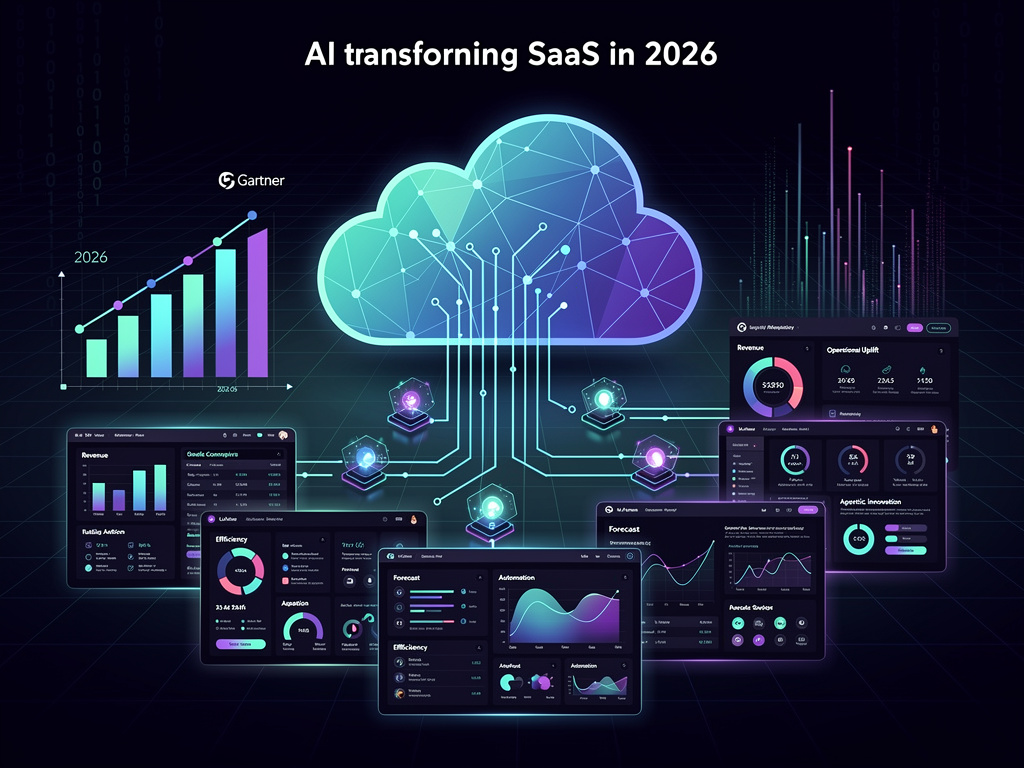
In the rapidly shifting domain of cloud-based enterprise software, artificial intelligence has moved beyond mere enhancements to become the foundational force propelling SaaS platforms into autonomous operations. Ankita Bhargava, senior software engineer at Firstup, asserts in a CIO.com opinion piece, ‘AI isn’t just an add-on anymore — it’s making SaaS smarter, faster and more personal, changing how cloud tools work and how teams compete.’ This evolution is evident as platforms integrate machine learning for predictive scaling, anomaly detection, and personalized user experiences, driving efficiency gains that traditional systems could not achieve.
Gartner’s forecast underscores the momentum: by 2027, more than half of cloud-native SaaS platforms will leverage AI and machine learning for performance optimization, as noted in their press releases cited by CIO.com. Real-world applications abound, such as AI-driven resource systems that anticipate traffic spikes and auto-scale servers, slashing costs and boosting uptime. Bhargava describes this as SaaS acquiring a ‘self-healing’ immune system, capable of preempting bottlenecks and security breaches through anomaly detection.
Business outcomes are equally transformative. Predictive models have reduced customer churn by 15% in a single quarter for one team, according to Bhargava, while McKinsey reports in a linked study that personalization can lift revenues by up to 40%. Natural language processing chatbots have cut support resolution times by 40%, illustrating AI’s direct impact on retention and revenue.
Operational Automation Takes Command
AI’s infiltration into SaaS operations marks a departure from manual interventions. Platforms now employ machine learning to automate ‘un-fun’ tasks, from resource allocation to error correction. In multi-tenant environments, AI rebalances loads based on usage patterns, eliminating overprovisioning waste. Major providers like Microsoft, Google, and AWS are embedding these capabilities into their developer stacks, enabling real-time adaptations in features, interfaces, and even pricing.
The rise of agentic AI amplifies this shift. As detailed in a RevenueGrid analysis of 2025 trends, agentic AI enables software agents to autonomously plan and execute tasks, automating complex processes without human oversight. This promises unprecedented efficiency, with Gartner projecting 80% of enterprises deploying generative AI-enabled applications by 2026, per BetterCloud’s report.
Vertical SaaS leaders like Samsara, ServiceTitan, and Guidewire stand to benefit immensely, as highlighted in X posts from industry observers. Their vast data troves position them to deliver transformative AI insights, outpacing generalists in specialized domains.
Agentic AI Ushers in Autonomy
Agentic systems represent the vanguard, evolving from copilots to independent decision-makers. Aaron Levie, CEO of Box, posted on X that ‘AI Agents are about to explode in SaaS,’ leveraging multi-user collaborative architectures for seamless automation. A16z echoes this in their analysis, noting AI-native startups achieve $5 million ARR in nine months, far surpassing traditional SaaS growth, due to dedicated enterprise AI budgets.
Satya Nadella’s vision, as referenced in X discussions, positions apps as background data layers for agents handling workflows. This paradigm demands ‘Agent Experience’ (AX) design, prioritizing AI consumability across products, not just developer tools, as yenkel outlined in his X thread and linked article.
Funding surges validate the trend: AI-driven SaaS platforms attracted $89.4 billion in VC in 2025, per Qubit Capital, with mega-rounds like OpenAI’s $40 billion signaling investor fervor into 2026.
Business Impact and Revenue Shifts
Retention and revenue metrics highlight AI’s potency. Bhargava’s examples—churn prediction and NLP chatbots—align with broader trends where generative AI powers customer support, report generation, and content creation, per Qrvey’s 2026 state report. McKinsey verifies rapid adoption toward Gartner’s 80% benchmark.
Pricing models are adapting: usage-based and credit systems for AI features, as explored in Forbes’ Metronome piece, allow flexibility amid uncertain value. Vertice’s $50 million raise, reported by TechCrunch, targets optimizing the $3.4 billion in SaaS/cloud spend it has analyzed, using AI akin to cybersecurity threat modeling.
Enterprise spending on AI apps could hit $644 billion in 2025, a 76.4% jump, fueling a SaaS market from $266 billion in 2024 to $315 billion by early 2026, according to BetterCloud.
Implementation Roadmaps and Challenges
Bhargava offers a pragmatic roadmap: target high-impact issues like churn or uptime, ensure data quality, pilot small, prioritize compliance, and iterate. This phased approach mitigates risks like bias and privacy breaches, critical as AI scales.
Challenges persist: data quality limits AI efficacy, and ‘big bang’ launches often fail. Constellation Research predicts agentic AI pricing will normalize with all-you-can-eat models, amid data access skirmishes, as in Celonis-SAP disputes. EY emphasizes measuring AI roadmap integration and development cycle reductions for ROI.
Forbes councils stress augmentation over replacement, with Salesforce Einstein exemplifying AI-enhanced CRM predicting churn within SaaS ecosystems.
2026 Horizons: Agents and Ecosystems
Looking to 2026, MindInventory lists AI-driven automation, AIaaS, and composable ecosystems as top trends, democratizing intelligence via APIs without in-house ML infrastructure. IBM foresees multi-agent systems entering production, lowering barriers for business users to deploy intelligent agents.
Microsoft’s trends include AI as partners in medicine and development, with Diagnostic Orchestrator achieving 85.5% accuracy on complex cases. Battery Ventures sees an ‘AI supercycle’ unlocking larger markets than SaaS 1.0, with agents completing human-level tasks in software, healthcare, and legal.
Spenser Skates of Amplitude warns against thin AI layers, advocating rebuilt interfaces building on SaaS heritage, as in Figma and Notion. Winners will embed deeply, per a16z, forging moats through workflow integration.
Strategic Imperatives for Leaders
SaaS firms must embrace the ‘AI trident’: internal efficiency, AI features, and agent-ready design, as yenkel advises. Speed is paramount—fast movers like Cursor and Shopify seize dominance.
Bhargava concludes, ‘The next SaaS leaders won’t treat AI as a feature — they’ll build it into the DNA of how their products evolve.’ With global SaaS projected to $299 billion by 2026 per Salesmate, early adopters integrating agentic AI will command the field, turning software into self-evolving powerhouses.


 WebProNews is an iEntry Publication