
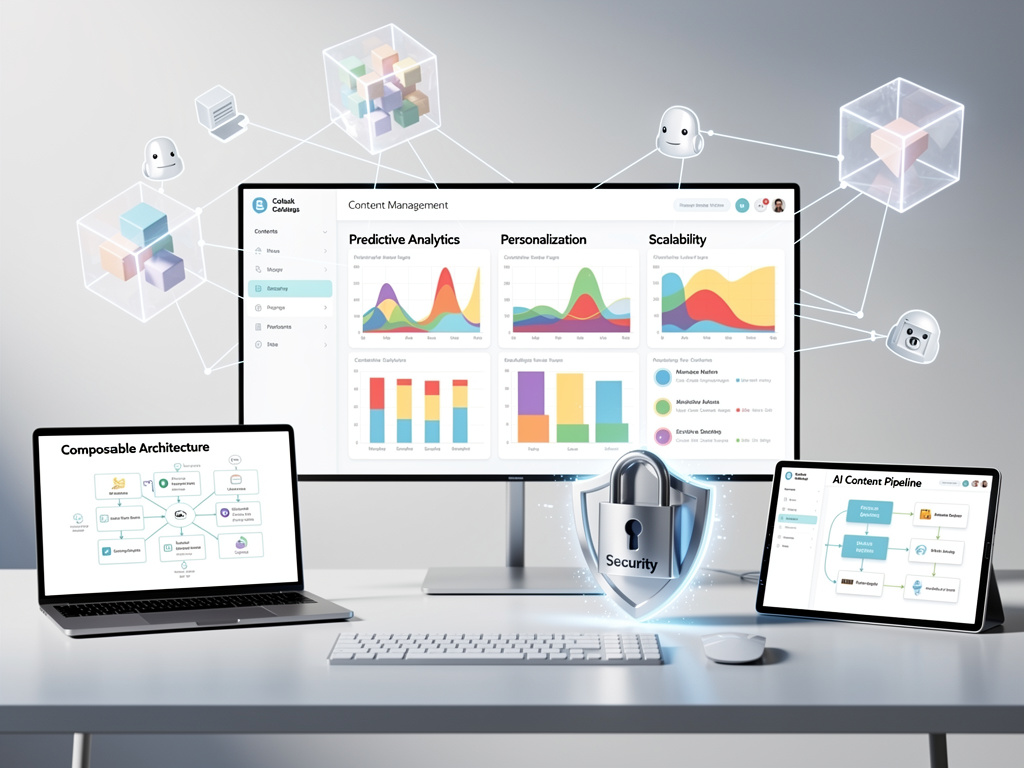
In the opening weeks of 2026, content management systems are undergoing a profound transformation driven by generative AI and its more autonomous offspring, agentic AI. Organizations that once experimented with AI pilots are now embedding these technologies into core operations, promising efficiency gains but also raising questions about control and creativity. TechTarget identifies generative AI as the leading trend, with enterprises shifting from testing phases to full deployment across content workflows.
This evolution builds on 2025’s foundations, where AI tools automated routine tasks like drafting and editing. Now, systems integrate predictive analytics to forecast content performance and automated security measures to safeguard sensitive data. As one executive noted in a recent MIT Sloan Management Review piece, “AI experts Thomas H. Davenport and Randy Bean explain the top 2026 AI trends leaders should watch for,” highlighting the urgency for data science integration.
Posts on X echo this shift, with developers discussing AI autocomplete for everything from LinkedIn posts to investor updates, signaling a broader move toward code-based content generation over traditional CMS platforms.
Generative AI Moves from Experiment to Engine
Generative AI’s dominance in 2026 stems from its ability to produce tailored content at scale. According to TechTarget, many organizations are advancing beyond pilots, integrating GenAI into digital experience platforms for personalized user journeys. This includes real-time content adaptation based on visitor behavior, reducing manual oversight.
Kentico’s analysis points to agentic AI as a step further, where autonomous agents handle complex tasks like multi-channel orchestration without human prompts. “Discover the top 10 web content management trends for 2026; from Agentic AI and composable architectures,” their report states, emphasizing developer-friendly integrations.
The Content Marketing Institute surveyed 42 experts who stress balancing AI with human elements: “AI isn’t the whole story for 2026. Learn the trends that will help your brand integrate AI without giving up the value of humanity, trust, and data.” This hybrid approach is gaining traction amid concerns over AI-generated homogeneity.
Agentic AI Takes Autonomy to New Levels
Agentic AI represents the next frontier, enabling systems to act independently on goals like optimizing content for search or engagement. TechTarget notes its role in predictive analytics, where AI anticipates trends and adjusts strategies proactively. For instance, platforms now use agentic workflows to A/B test variations across global audiences in real time.
In data management realms, TechTarget explores how agents require rich context to thrive, influencing content systems to prioritize structured data feeds. “Look at this deep exploration of trends that will influence data management and AI development in 2026,” the article details, underscoring the need for robust integrations.
X discussions reveal practical applications, such as Cursor’s shift from CMS to code and object storage, with users praising AI for accelerating idea development. “I’ve been using and building CMS platforms since WordPress in early 2000s,” one poster reflected, signaling a pivot among tech teams.
Composable Architectures Gain Momentum
Composable architectures dismantle monolithic CMS into modular components, allowing seamless swaps of AI engines or personalization tools. Kentico predicts this will dominate, enabling cross-channel experiences via headless setups and customer data platforms. “Integrated data and cross-channel experiences,” they highlight as key for 2026 competitiveness.
WordStream outlines eight influential trends, including AI-driven full-funnel strategies that leverage composable DXP for agility. “See which content marketing trends you need to follow in 2026 and get practical tips,” their guide advises, focusing on real-time optimization.
Enterprise SEO is adapting too, per Search Engine Journal: “Stay ahead of the SEO and AI game with these 2026 Enterprise SEO trends.” Automated satellite projects using LLMs are emerging, optimizing for AI analysis over traditional search.
Personalization Powered by Predictive Tools
Predictive analytics, another TechTarget pillar, uses AI to forecast content resonance, enabling hyper-personalization. Eesel.ai forecasts trends like full-stack creation and human-in-the-loop models: “Discover the top AI content creation trends for 2026, including hyper-personalization.” This ensures AI outputs align with brand voice.
MIT Sloan emphasizes five AI trends, including advanced data science for content: “AI experts Thomas H. Davenport and Randy Bean explain the top 2026 AI trends leaders should watch for.” Leaders are investing in platforms that blend these with customer data for precise targeting.
On X, marketers note AI’s role in automation: “AI analytics is revolutionizing content marketing in 2026. Brands are ditching guesswork for data-driven full-funnel strategies,” one post states, reflecting industry sentiment.
Security and Ethics in the AI Era
Automated information security emerges as critical, with AI scanning for compliance risks in generated content. TechTarget warns of rising threats in agentic systems, pushing vendors toward built-in safeguards.
Nieman Journalism Lab reports publishers bracing for AI pressures: “Newsrooms will prioritize on-the-ground reporting, YouTube, and something called ‘liquid content’ this year.” This underscores the need for ethical AI frameworks amid creator economy shifts.
X users discuss prompts as interactive layers: “The problem with content is that it’s static,” highlighting demands for dynamic, secure personalization.
Headless CMS and Beyond
Headless CMS evolve with GenAI, decoupling frontends for omnichannel delivery. Kentico and others foresee composable stacks integrating Gemini, Grok APIs effortlessly: “Serverless + edge functions lower costs while scaling,” per recent X insights.
Search Engine Journal notes SEO’s AI pivot: “Almost ALL our clients are ditching manual everything… Moving FULLY to automated EMD/KID satellite projects.” This signals a code-first future.
Overall, 2026 positions content management at AI’s vanguard, demanding strategic adaptation from industry players.


 WebProNews is an iEntry Publication