
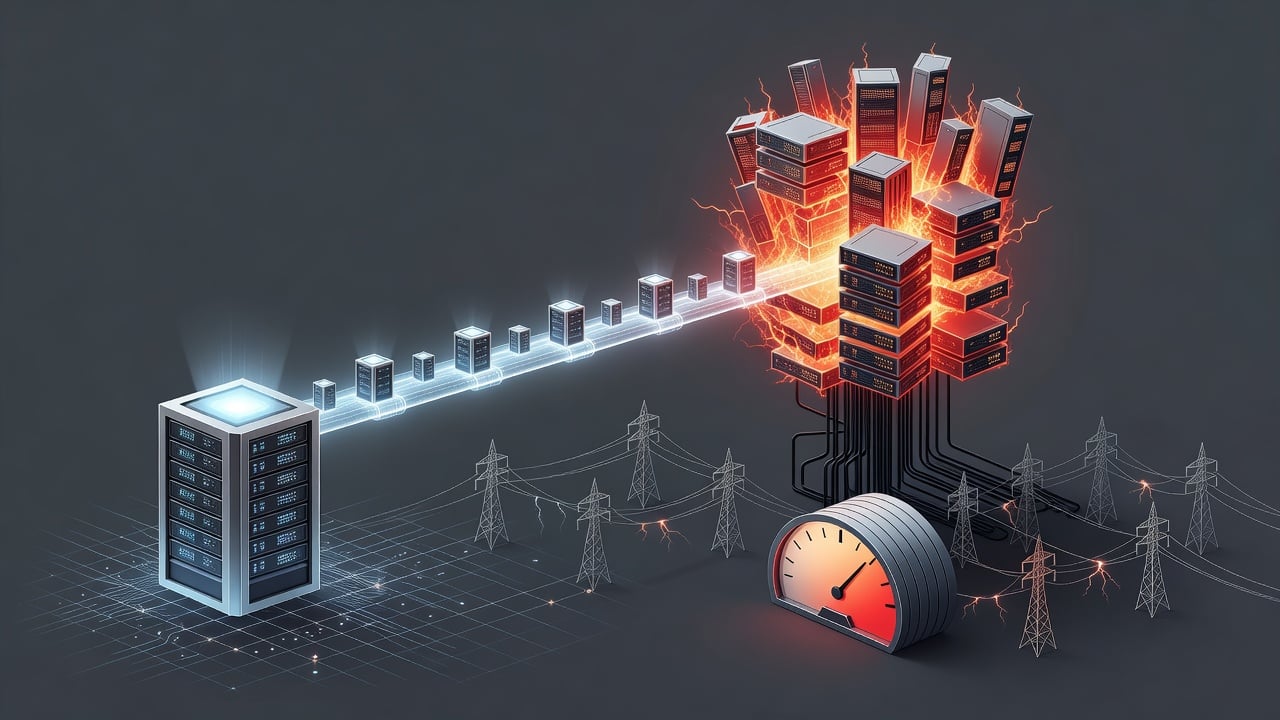
AI agents promise to handle complex tasks on their own. Book a flight. Research a report. Manage your calendar without constant input. Yet fresh data reveals a harsh reality. These systems don’t just think harder. They consume vastly more electricity than today’s chatbots.
A study released this week from the Korea Advanced Institute of Science and Technology delivers the clearest picture yet. AI agents can require up to 136.5 times the energy of a standard generative model per query. One test using a 70-billion-parameter language model burned through 348.41 watt-hours for a single agent run. That dwarfs the few watt-hours typical of a simple ChatGPT-style response. Digital Trends reported the details on July 5, 2026.
The numbers hit hard. Professor Minsoo Rhu, who led the KAIST team, put it plainly. “AI competitiveness is shifting from building smarter AI to building more efficient AI.” His group modeled what would happen if agents handled Google-scale traffic. Think 13.7 billion requests daily. The infrastructure would demand 198.9 gigawatts. Nearly half the average power draw of the entire United States.
Why the explosion? Agents don’t fire off one model call. They loop. They plan. They call external tools. Browse the web. Run code. Wait for results. And wait some more. The KAIST researchers clocked GPUs sitting idle up to 54.5 percent of the time. Hardware still draws full power. Latency balloons as much as 153.7 times compared with basic chain-of-thought prompting. The paper, titled “The Cost of Dynamic Reasoning,” was presented at the IEEE International Symposium on High-Performance Computer Architecture. The team open-sourced its benchmarks to spur more work on the problem.
This arrives at a moment when data centers already strain the grid. The International Energy Agency projected in April 2025 that global data-center electricity use could surge dramatically by 2030. AI servers, mostly running inference, would drive nearly half the net growth. In the United States, Lawrence Berkeley National Laboratory figures showed data centers at 4.4 percent of total electricity in 2023. That share could reach 6.7 to 12 percent by 2028. IEA analysis warned of the trend months ago.
But agents change the equation further. A May 2025 paper on arXiv benchmarked 30 commercial models. Reasoning-heavy systems such as o3 and DeepSeek-R1 consumed more than 33 watt-hours for long prompts. Over 70 times the draw of an efficient model like GPT-4.1 nano. Even a short GPT-4o query used 0.43 watt-hours. Scale that to hundreds of millions of daily interactions and the annual toll matches the electricity needs of tens of thousands of homes. The authors highlighted the paradox. Individual queries look reasonable. Global volume does not. arXiv:2505.09598.
MIT Technology Review tackled the broader math in May 2025. Inference already accounts for 80 to 90 percent of AI’s computing load. Agents and reasoning models push that higher. One expert noted that a single agent booking a flight could use as much power as running a dishwasher. Chain-of-thought prompting in smaller models has shown 43 times the energy for simple problems. The article painted a future of voice companions, video queries and personalized models trained on user data. All multiplying demand. MIT Technology Review.
Industry moves fast anyway. OpenAI reportedly plans agents priced at $20,000 per month for enterprise users. DeepSeek popularized long chain-of-thought outputs that can run to nine pages. Companies race to embed AI everywhere. Search. Fitness apps. Shopping. The convenience comes with a bill utilities and governments are only beginning to grasp.
Water use adds another layer. Cooling those servers evaporates billions of liters. A separate analysis tied AI systems in 2025 to carbon emissions between 33 and 80 million metric tons. That rivals entire countries. Water consumption could exceed global bottled-water production. Researchers stressed uncertainty because companies disclose so little. Yet the direction is clear.
Some see offsets. AI could optimize energy grids, buildings and industrial processes. One PwC study suggested efficiency gains elsewhere might balance AI’s own consumption if adoption stays measured. Still, most analysts view those savings as smaller than needed to offset the direct surge. Brookings Institution analysts noted in April 2026 that U.S. data-center demand could rise 130 percent by 2030. Hyperscalers dominate. They locate where power is cheap or abundant. That shifts costs to ratepayers and strains local infrastructure.
Transparency remains scarce. Google published inference numbers for its Gemini models last year. A median text prompt used 0.24 watt-hours when counting full data-center overhead. The company reported a power usage effectiveness of 1.09. Impressive. Yet competitors stay opaque. Sasha Luccioni of Hugging Face has called for real disclosures instead of reverse-engineered guesses. Without them, projections carry wide error bars.
The KAIST work stands out because it treats agents as a distinct workload. Not just bigger models. Different usage patterns. Dynamic reasoning. Tool use. Idle time. All drive inefficiency. Professor Rhu’s team argues for co-design. Better chips. Smarter scheduling. Data-center architectures built for agent loops. Software that minimizes unnecessary calls. Hardware that powers down during waits. None of this is impossible. But it requires the industry to slow its obsession with scale and focus on systems-level efficiency.
So far the conversation has centered on training costs. Those are large but one-time. Inference runs constantly. Agents multiply the runs. A single complex task might trigger dozens of model invocations. Each with its own context window and reasoning steps. The 136-times multiplier isn’t theoretical. It emerged from real benchmarks on representative agent behaviors.
Power grids feel the pressure first. Virginia, Texas and other data-center hotspots already face delays in new generation. Utilities scramble to add natural-gas plants or push for nuclear restarts. Renewables help but bring intermittency that doesn’t match AI’s 24/7 needs. One Salesforce executive described the requirement as constant power, every hour of every day. That favors firm sources. Often fossil or nuclear.
Emissions follow. Many grids still rely heavily on coal or gas. A query processed in a carbon-intensive region can emit several times more than one in a cleaner area. The IEA estimates data-center emissions could climb from 180 million tonnes today to 300 to 500 million tonnes by 2035 under different scenarios. AI contributes a fast-growing slice.
Yet the technology also offers tools to fight climate change. Smart buildings run by AI agents already cut energy 15 to 30 percent in some deployments. Grid optimization, predictive maintenance and materials discovery could deliver larger wins. The question is whether those gains outpace the direct footprint. Early modeling suggests they help but fall short of full neutralization unless efficiency improves dramatically.
Policy makers watch closely. Europe weighs reporting rules for AI energy use. U.S. lawmakers have proposed transparency bills. The KAIST researchers hope their benchmarks become standard. Companies could then compete on sustainability as well as capability. Investors might reward efficient designs. Consumers could see the data before adopting agent features.
For now the trajectory points up. Bigger models. More autonomous agents. Wider deployment. The 198-gigawatt projection assumes today’s technology at massive scale. Better utilization, specialized hardware and algorithmic improvements could blunt the rise. They must. Otherwise utilities face blackouts, rate hikes and public backlash. Tech giants risk being painted as the new heavy industry. Dirty. Power-hungry. Hard to site.
The KAIST paper ends on a constructive note. It supplies the data. It open-sources the tests. The ball sits with developers and infrastructure teams. Build agents that idle less. Design chips that scale power with load. Architect data centers that match compute to actual work. The alternative is an energy tax that grows faster than anyone planned. And one that arrives sooner than the grid can handle.
Recent coverage reinforces the urgency. A June 2026 update on AI energy statistics projected U.S. AI servers alone could reach 165 to 326 terawatt-hours by 2028. That matches earlier forecasts but now includes more agent-driven scenarios. Another analysis in Patterns journal tied 2025 AI operations to emissions rivaling New York City. The pattern holds. Demand accelerates. Disclosure lags. Solutions remain piecemeal.
Industry insiders know the score. Training a frontier model once grabs headlines. Running agents for millions of users every hour writes the real check. The KAIST figures make that check larger than expected. One hundred thirty-six times larger in the worst case. Even averages in the double or triple digits would reshape energy planning for the decade ahead.
So the shift Rhu described matters. Smarter alone won’t cut it. The winners will deliver intelligence that respects physical limits. Efficient at the model level. At the system level. At the grid level. Anything less risks turning a transformative technology into an unsustainable one. The research is in. The question now is whether the industry listens.


 WebProNews is an iEntry Publication