
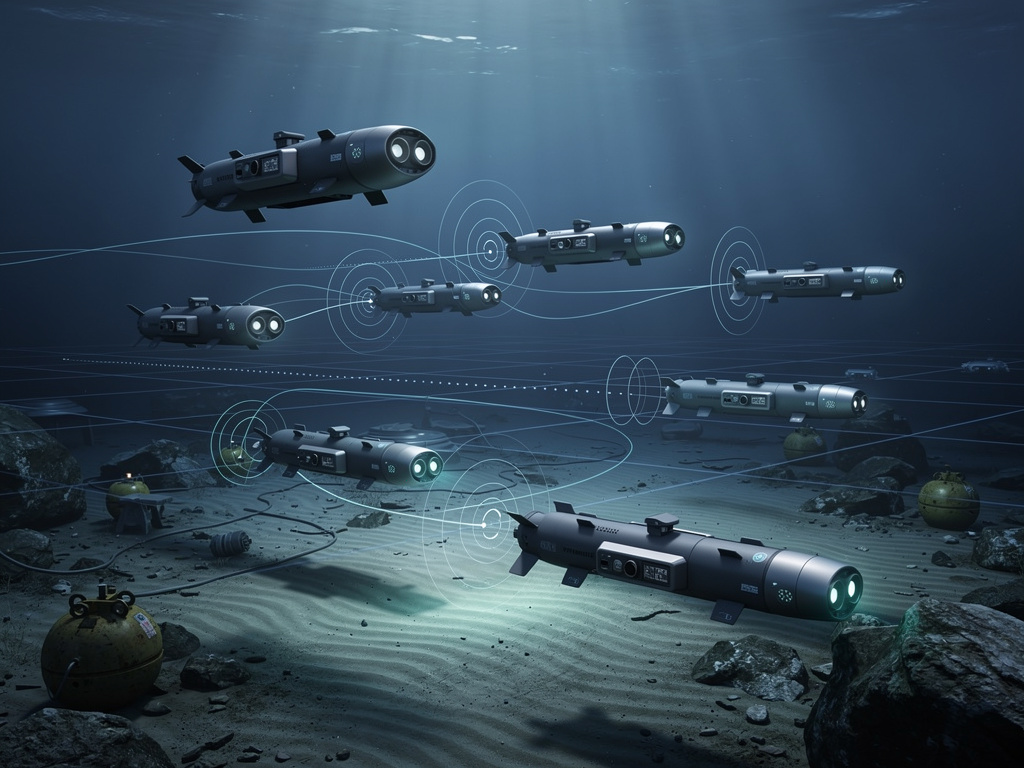
In the depths of the ocean, where traditional radio waves falter and acoustic signals can betray positions, a new era of secure communication is emerging for military underwater robot fleets. Recent advancements, particularly from Skana Robotics, promise to enable autonomous underwater vehicles (AUVs) to coordinate over vast distances without surfacing, a capability that could reshape naval operations. This technology addresses longstanding challenges in underwater data transmission, where water’s density absorbs electromagnetic signals, forcing vessels to risk detection by rising to the surface or relying on vulnerable tethers.
Skana’s breakthrough involves an AI-driven system that allows fleets of robots to share data covertly, using algorithms that adapt to environmental noise and optimize low-bandwidth channels. According to reports from Interesting Engineering, the innovation lets these vessels communicate securely over long ranges, potentially revolutionizing missions like mine countermeasures and surveillance in contested waters. The system, dubbed SeaSphere in some descriptions, employs machine learning to predict and encode messages efficiently, minimizing the energy and bandwidth needed for transmission.
This development comes at a pivotal time for defense strategies, as nations invest heavily in unmanned maritime systems. The U.S. Department of Defense, for instance, is accelerating the deployment of such platforms across sea domains, with budgets soaring into the billions. A recent analysis from GlobeNewswire highlights a $76 billion market shift toward autonomous technologies, underscoring the Pentagon’s push for robot fleets that can operate independently in high-risk environments.
Pioneering AI in Subsea Networks
Building on this, Skana’s decision-making algorithm enables real-time adaptation among fleet members. As detailed in TechCrunch, the tech helps unmanned vessels react to shared data, forming a dynamic network that mimics biological swarms. This is crucial for military applications, where split-second coordination can mean the difference between mission success and failure in anti-submarine warfare or infrastructure protection.
Beyond Skana, broader innovations in AUV technology are contributing to this shift. A review in ScienceDirect notes that AUVs offer unique advantages over tethered remotely operated vehicles (ROVs), including greater autonomy and reduced human risk. These vehicles are equipped with advanced sensors for ocean exploration, but communication has always been the Achilles’ heel—until now.
Posts on X from defense enthusiasts and analysts reflect growing excitement, with users discussing how such systems could counter threats like submarine incursions. One thread emphasized the role of AI in identifying acoustic signatures, drawing parallels to Helsing’s Lura system, which deploys glider swarms for detection. This sentiment aligns with official updates, such as the U.K. Ministry of Defence’s adaptation of commercial robots for ordnance disposal, signaling a convergence of civilian tech and military needs.
Strategic Implications for Naval Power
The integration of secure, long-distance communication could extend to protecting critical undersea infrastructure, like the 800,000 miles of cables that carry global internet traffic. A shark-shaped robot from a German firm, as covered in another Interesting Engineering piece, is designed for cable guardianship, but Skana’s tech could enhance fleet-wide vigilance without constant human oversight.
In the context of unmanned maritime warfare, these robots are transforming tactics. Small Wars Journal explores how unmanned vessels are ushering in a new naval era, with AUVs conducting support missions in contested areas. The ability to communicate silently allows for “silent armies” of robots to perform complex operations, from seabed sensing to fleet support, without revealing positions—a game-changer in asymmetric conflicts.
Moreover, developments like India’s DRDO trials of man-portable AUVs for mine countermeasures illustrate global momentum. These systems operate collaboratively, sharing data to neutralize threats efficiently. As X posts from users like Defence Decode highlight, such trials demonstrate the practicality of swarm intelligence in real-world scenarios, potentially influencing U.S. and allied strategies.
Overcoming Technical Hurdles
At the core of these advancements are breakthroughs in acoustic and optical communication methods. Traditional underwater signals degrade over distance due to absorption and scattering, but AI optimizes modulation techniques to maintain integrity. BitcoinWorld reports on Skana’s system enabling covert coordination, describing it as a “groundbreaking reality” that solves maritime challenges without compromising stealth.
This isn’t isolated; a strategic study from Engineering.org.cn on AUV development emphasizes key technologies like navigation and energy management, which pair well with enhanced comms. For military insiders, the real value lies in encryption layers that prevent interception, ensuring that even if signals are detected, their content remains secure—a vital edge in electronic warfare.
X discussions also touch on historical contexts, such as Russian subs approaching undetected shores, now potentially thwarted by AI-driven networks. Users reference systems like optical fiber-based observations from airshows, which provide situational awareness in littoral zones, complementing robot fleets.
Market Dynamics and Investment Surge
The financial stakes are immense, with investors eyeing stocks powering this autonomous shift. GlobeNewswire’s coverage of the $76 billion robot war identifies key players, from drone manufacturers to AI firms, as the Pentagon ramps up procurement. Skana’s emergence fits into this, attracting attention for its potential in defense contracts.
Research from Research Nester delves into marine robotics’ future, noting how AUVs and ROVs are revamping exploration and monitoring. For industry insiders, this means opportunities in dual-use technologies—civilian applications like environmental surveys could fund military adaptations, accelerating innovation cycles.
On X, posts from tech accounts like Techticia and NextGen Defense amplify the buzz, sharing details of Skana’s unveilings and their implications for underwater ops. This social chatter often precedes formal announcements, offering early insights into adoption trends.
Global Competition and Ethical Considerations
As competition intensifies, nations like China are advancing similar tech, as seen in Zhuhai Airshow exhibits of fiber-optic systems. Eurasia Naval Insight on X notes their potential for naval operations in shallow waters, raising questions about arms race dynamics. U.S. forces must innovate to maintain superiority, integrating Skana-like systems into existing fleets.
Ethical debates simmer beneath the surface. While these technologies enhance safety by reducing human exposure, they also enable persistent surveillance and autonomous strikes. Defense Watch discusses how silent drones transform missions, but insiders must weigh escalation risks in hotspots like the South China Sea.
X users, including those posting about mini UUVs, speculate on covert capabilities traveling thousands of kilometers. This aligns with We Are The Mighty’s roundup of 2025 military tech breakthroughs, positioning underwater AI as science fiction turned reality.
Future Trajectories in Underwater Autonomy
Looking ahead, hybridization of communication methods—combining acoustics with emerging quantum or laser tech—could further extend ranges. Mezha’s coverage of SeaSphere underscores its role in defense, especially for submerged data transmission without surfacing risks.
Integration with surface and aerial drones creates multi-domain networks, amplifying operational reach. As Small Wars Journal posits, this heralds a new era where unmanned systems dominate maritime strategies, from deterrence to rapid response.
For insiders, the key is scalability: can these systems handle fleet sizes in the hundreds? Ongoing trials, like those from DRDO, suggest yes, with collaborative AUVs proving resilient in field tests. X sentiment echoes optimism, with shares of breakthroughs like Skana’s fostering discussions on investment and deployment.
Defense Innovation Ecosystems
Partnerships between startups like Skana and established defense contractors are accelerating progress. TechCrunch’s insights reveal how algorithms enable adaptive data sharing, crucial for swarm behaviors in unpredictable ocean conditions.
Government initiatives, such as the U.K.’s robot adaptations for cable protection, exemplify this ecosystem. Ministry of Defence posts on X highlight remote detection of hazards, integrating AI comms to enhance efficacy.
Ultimately, these developments position underwater robot fleets as force multipliers. As GlobeNewswire notes, the market’s growth reflects strategic imperatives, with AI at the forefront of securing long-distance links.
Evolving Threats and Adaptive Responses
Emerging threats, like cable sabotage, demand robust defenses. Interesting Engineering’s report on the shark-shaped guardian robot complements Skana’s comms by enabling coordinated patrols.
In cyber-physical terms, securing these networks against jamming is paramount. X posts reference naval designs countering interception, as in Littoral Combat Ships, now augmented by AI.
Industry experts anticipate regulatory frameworks to guide ethical use, ensuring innovations bolster security without unintended escalations. This balanced approach will define the next decade of underwater military tech.


 WebProNews is an iEntry Publication