
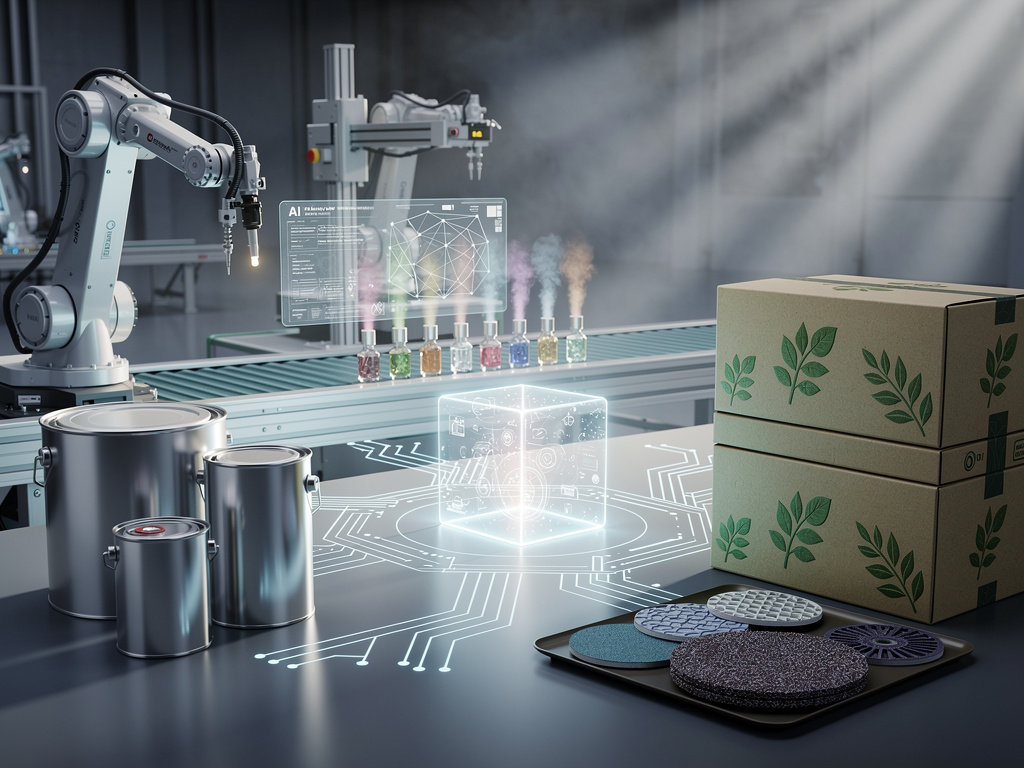
AI’s Unseen Hand: Crafting Tomorrow’s Products Today
In the bustling world of manufacturing, where innovation often hinges on painstaking trial and error, artificial intelligence is emerging as a game-changer. Companies across various sectors are harnessing AI to rethink how they develop new products, from paints that dry in record time to soaps that captivate with novel scents. This shift isn’t just about speed; it’s about uncovering solutions that human intuition might overlook, blending data-driven insights with scientific rigor to push boundaries.
Take PPG Industries, a Pittsburgh-based giant in the coatings industry. Last spring, they launched a groundbreaking clear coat for automotive refinishing that slashes drying time by more than half. This isn’t the result of endless lab experiments but a collaboration between chemists and algorithms. By building a vast database of product properties infused with chemical principles, PPG’s team created a system that proposes formulations in minutes, as detailed in a recent article from The Wall Street Journal.
The implications are profound. Traditional product development can drag on for months or years, constrained by the limits of human expertise and the sheer complexity of chemical interactions. AI, however, sifts through countless variables effortlessly, suggesting combinations that defy conventional wisdom. For PPG, this meant a clear coat that not only dries faster but maintains a flawless finish, addressing a long-standing trade-off in the paint business where speed often compromises quality.
Accelerating Innovation in Everyday Goods
Procter & Gamble, the consumer goods behemoth, has integrated AI into its fragrance development, creating new scents for body washes and laundry products that resonate with consumers in unexpected ways. Similarly, Mars has employed these tools to redesign packaging for its Extra gum, resulting in thinner bottles that cut plastic use by 246 tons annually while reducing development time by 40%. These examples illustrate how AI acts as an invisible collaborator, enhancing efficiency without sacrificing performance.
At 3M, known for its diverse portfolio from adhesives to abrasives, AI serves as an extra set of eyes in the lab. Chief Technology Officer John Banovetz likens it to consulting an additional expert, one that draws from a boundless well of data. This approach has led to innovations like optimized sanding discs that improve dust collection and grinding efficiency, streamlining what was once a labor-intensive process.
The technology underpinning these advancements often relies on deterministic AI, which adheres strictly to scientific laws, avoiding the pitfalls of generative models prone to fabricating information. PPG’s system, for instance, uses digital twins—virtual replicas of physical products—to simulate outcomes, ensuring predictions are grounded in reality before any real-world testing begins.
From Labs to Market: Real-World Applications
Delving deeper into PPG’s breakthrough, the Deltron Premium Glamour Speed Clearcoat exemplifies AI’s potential. In automotive body shops, drying times dictate workflow; a shorter cycle means more vehicles processed daily. PPG’s AI identified an unconventional chemical mix that reduces heated drying from 30 minutes to just five, and air drying from two hours to under one, outperforming competitors.
Shop owners like Andy Powell of Andy’s Auto Body in Illinois have seen tangible benefits. “With this clear, we can throw in an extra job here and there,” he notes, highlighting how such innovations translate to bottom-line gains. PPG reports strong sales, signaling market acceptance of AI-driven products.
Beyond paints, companies like Stepan, a specialty chemical firm, are using platforms from AI specialists such as Citrine Informatics to expedite development. Citrine’s tools enable simultaneous optimization of multiple attributes—strength, weight, durability—something humans struggle with due to cognitive limits. Stepan has cut project timelines from weeks to days, fostering rapid iteration.
Bridging Startups and Established Players
Startups are also riding this wave. TerraSafe, a North Carolina-based venture focused on sustainable packaging, experimented with Citrine’s platform to develop dissolvable laundry sheets. Though the project was shelved for financial reasons, CEO Julie Willoughby remains optimistic about AI’s role in material discovery, viewing it as a tool for future endeavors once funding stabilizes.
This enthusiasm is echoed in broader industry trends. A search on X (formerly Twitter) reveals ongoing discussions among tech insiders about AI’s integration into supply chains, with posts from manufacturing experts praising tools that predict material behaviors with unprecedented accuracy. For instance, recent tweets highlight how AI is aiding in formulating eco-friendly alternatives to plastics, aligning with global sustainability goals.
Moreover, web searches uncover reports from outlets like TechCrunch on similar AI applications in pharmaceuticals, where companies accelerate drug formulation by modeling molecular interactions. This cross-pollination suggests that the methodologies honed in consumer goods could revolutionize other fields, potentially leading to faster vaccine development or advanced materials for electronics.
The Science Behind the Speed
At the core of these systems is machine learning’s ability to navigate vast combinatorial spaces. A single coating might involve 25 ingredients, each interacting in complex ways. “It is impossible for a human to search every possible combination,” explains PPG’s technical manager Jun Deng, underscoring AI’s edge in exploring uncharted territories.
PPG’s collaboration with Carnegie Mellon University, a hub for AI research, has been instrumental. Starting four years ago, they assembled a dedicated team to build this infrastructure, embedding chemical algorithms into their database. The result? A tool that not only suggests but validates ideas virtually, minimizing wasteful experiments.
In the food and beverage sector, Mars’ bottle redesign showcases AI’s environmental impact. By analyzing structural integrity and material usage, the system proposed a thinner wall that maintains strength, reducing plastic waste significantly. This aligns with corporate sustainability pledges, demonstrating AI’s role in balancing innovation with responsibility.
Challenges and Ethical Considerations
Yet, adopting AI isn’t without hurdles. Companies must invest in data quality; garbage in leads to garbage out. PPG spent years curating their digital twins to ensure accuracy. Additionally, while deterministic AI mitigates hallucinations, human oversight remains crucial for lab validation and regulatory compliance.
Ethical questions arise too. As AI suggests counterintuitive solutions, there’s a risk of unintended consequences, like unforeseen environmental impacts. Industry insiders on platforms like LinkedIn discuss the need for robust testing protocols to safeguard against this.
Furthermore, intellectual property concerns loom. Who owns an AI-generated formula? Legal frameworks are evolving, with recent articles in Forbes exploring patent implications for machine-invented products. This adds a layer of complexity as firms navigate ownership in collaborative human-AI creations.
Expanding Horizons: AI in Diverse Sectors
Looking ahead, AI’s influence is spreading to unexpected areas. In agriculture, firms are using it to develop pest-resistant crops by predicting genetic outcomes, as reported in recent Nature articles. This mirrors the material science applications, where simulation speeds up breeding cycles.
In cosmetics, beyond P&G’s scents, AI is personalizing formulations based on skin data, promising tailored products. Web news from Beauty Inc. details how algorithms analyze consumer feedback to refine textures and efficacies, shortening market entry from years to months.
Even in heavy industry, like steel production, AI optimizes alloys for better performance under extreme conditions. A Bloomberg piece notes how this reduces energy consumption, contributing to decarbonization efforts amid climate pressures.
Human-AI Synergy: The Future of Creation
The true power lies in synergy. As 3M’s Banovetz puts it, AI is like a fourth expert in the room, augmenting human creativity rather than replacing it. This partnership allows scientists to focus on high-level strategy while machines handle grunt work.
For smaller players, accessible platforms democratize innovation. Citrine’s CEO Greg Mulholland emphasizes optimizing multiple traits simultaneously, a feat beyond solo human capability. This levels the playing field, enabling startups to compete with giants.
Recent X threads from AI conferences reveal excitement about hybrid models combining deterministic and generative AI, potentially unlocking even more creative outputs while maintaining scientific integrity.
Pushing Boundaries: Case Studies and Insights
Delving into another example, Procter & Gamble’s AI-driven scent creation involves analyzing vast aroma databases to predict consumer preferences. This has led to hits in home fragrances, where subtle notes enhance appeal without overwhelming.
Mars’ gum packaging overhaul not only saved materials but also improved user experience, with easier-to-open designs informed by ergonomic simulations. Such multifaceted improvements highlight AI’s holistic approach.
In the realm of abrasives, 3M’s sanding disc optimizes particle distribution for better performance, reducing waste and enhancing safety in workshops. This precision stems from AI’s pattern recognition, spotting efficiencies humans might miss.
Sustaining Momentum: Investments and Trends
Investment in AI for product development is surging. Venture capital data from Crunchbase shows billions flowing into material science startups leveraging these technologies, signaling strong market confidence.
Regulatory bodies are taking note. The FDA’s guidelines on AI in drug development, as covered in STAT News, provide a blueprint that could extend to consumer goods, ensuring safety without stifling progress.
On the global stage, European firms like BASF are adopting similar tools for chemical innovations, as per Reuters reports, fostering international collaboration and knowledge sharing.
Vision for Tomorrow’s Innovations
As AI evolves, its integration will deepen, perhaps incorporating quantum computing for even faster simulations. Imagine designing self-healing materials or adaptive packaging that responds to environmental changes.
For industry insiders, the message is clear: embrace AI or risk obsolescence. Companies like PPG and 3M are leading the charge, proving that intelligent systems can catalyze breakthroughs that redefine markets.
Ultimately, this technological infusion promises a future where product development is not just faster, but smarter, more sustainable, and infinitely more inventive, bridging the gap between imagination and reality in ways previously unimaginable.


 WebProNews is an iEntry Publication