
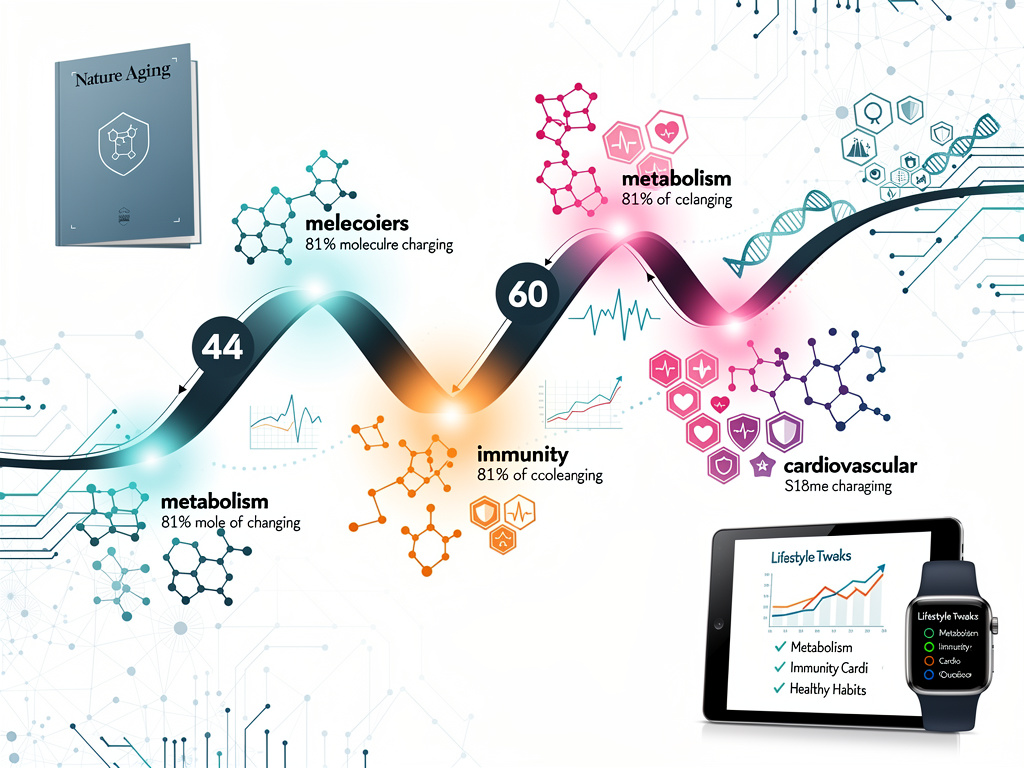
Scientists have long viewed human aging as a steady downhill slope, but a landmark study upends that notion, revealing two sharp inflection points where the body’s molecular machinery undergoes profound disruption. Published in Nature Aging, the research by Stanford Medicine’s Michael Snyder and colleagues tracked 135,000 molecules and microbes in 108 Californians aged 25 to 75, uncovering nonlinear surges averaging around ages 44 and 60. “We’re not just changing gradually over time; there are some really dramatic changes,” Snyder, professor of genetics at Stanford, told Stanford Medicine News. This discovery, amplified in recent coverage by the Irish Mirror, challenges decades of assumptions and spotlights windows for intervention.
The study’s longitudinal design—collecting blood, stool, skin, nasal, and oral samples every few months over up to 7 years—yielded nearly 250 billion data points. Researchers found 81% of aging-linked molecules exhibited nonlinear shifts, clustering into two waves rather than a smooth progression. At age 44, pathways for lipid, alcohol, and caffeine metabolism faltered, alongside rises in cardiovascular risk markers. By 60, immune regulation crumbled, kidney function waned, and carbohydrate processing stuttered, per the paper’s analysis using fuzzy c-means clustering and sliding-window algorithms.
These bursts transcend sex and prior studies’ menopause hypotheses. “This suggests that while menopause or perimenopause may contribute to the changes observed in women in their mid-40s, there are likely other, more significant factors influencing these changes in both men and women,” first author Xiaotao Shen, now at Nanyang Technological University, noted in the Stanford release. Cardiovascular molecules spiked at both junctures, aligning with epidemiology showing disease risks accelerating nonlinearly.
Midlife’s Metabolic Reckoning
Around 44, the body slows breakdown of alcohol and fats, explaining anecdotal woes like brutal hangovers and stubborn midriffs. Molecules tied to skin elasticity and muscle strength also dipped, hinting at why 40-somethings report more aches. Snyder linked this to lifestyle pivots—rising stress, alcohol intake, and sedentary habits amid career peaks and family demands. “The changes in the 40s were unexpected although in hindsight it is a time when people hit their ‘mid-life crisis’ and often injured themselves,” he told Medical News Today.
Cardiologist Cheng-Han Chen of MemorialCare Saddleback Medical Center called the patterns “an important finding that will help us better understand the biochemical changes that underlie aging, and potentially provide targets for therapy depending on someone’s stage in life.” Geriatrics expert Manisha Parulekar of Hackensack University Medical Center added, “It is interesting to see that this study is showing findings at these two age groups, around age 40 and 60. This may help us have a better conversation with our patients regarding various lifestyle modifications early on.”
Pharma scouts are circling: these age-specific pathways could tailor drugs, like statins preempting 40s lipid woes or immune boosters for 60s vulnerabilities. Yet limitations loom—participants hailed from affluent Palo Alto, skewing toward healthier baselines, as Scientific American critiqued.
The Sixties Immune Collapse
Age 60 marks a steeper drop: inflammatory cytokines plummet, signaling immune frailty, while kidney and heart markers signal heightened diabetes and cardiovascular perils. “That so many dramatic changes happen in the early 60s is perhaps not surprising, as many age-related disease risks… increase at that point,” Snyder observed. This echoes a 2020 study noting immune dips in late 30s-40s and mid-60s.
Microbiome flux compounds woes, with gut, skin, and nasal communities shifting abruptly, per the multi-omics scan. Aditi Gurkar of the University of Pittsburgh urged larger, diverse cohorts: “The study also did not follow any individuals for periods longer than about seven years, so scientists cannot be certain that the differences… reflect universal changes.” Still, it validates nonlinear disease curves, like Alzheimer’s odds spiking post-60.
Recent X chatter ties this to real-world gripes. One user recalled, “Soon after turning 44, I could feel the facial muscles become lax… I believe the dramatic change happened because I had been a cigarette smoker,” as cited in the Irish Mirror. Another: “Renewing my passport at 54 was pretty shocking.”
Pathways to Intervention
Snyder preaches preemption: “I’m a big believer that we should try to adjust our lifestyles while we’re still healthy.” For 40s folks, cut alcohol, lift weights for muscle and heart; stat-ins if lipids climb. In 60s, hydrate kidneys, load antioxidants, prioritize immunity via diet. “The goal is to have people live long healthy lives,” he stressed to Medical News Today.
Follow-up citations in 2025 papers, like Frontiers in Aging, affirm the bursts amid hormone dips and inflammation rises, fueling precision geriatrics. No major 2026 updates alter core tenets, but X posts from longevity voices like @BrandonLuuMD reinforce: “Aging happens in bursts… Age 44: cardiovascular, lipid/alcohol metabolism; Age 60: immune dysfunction.” Biotech eyes targets like crest-specific pathways for drugs staving multimorbidity.
For insiders, this reorients trials: phase age-stratified endpoints, probe drivers via animal models. As Snyder put it, “Identifying and studying these factors should be a priority for future research.” The body doesn’t fade evenly—it lurches, demanding timed defenses against its own turbulence.


 WebProNews is an iEntry Publication