
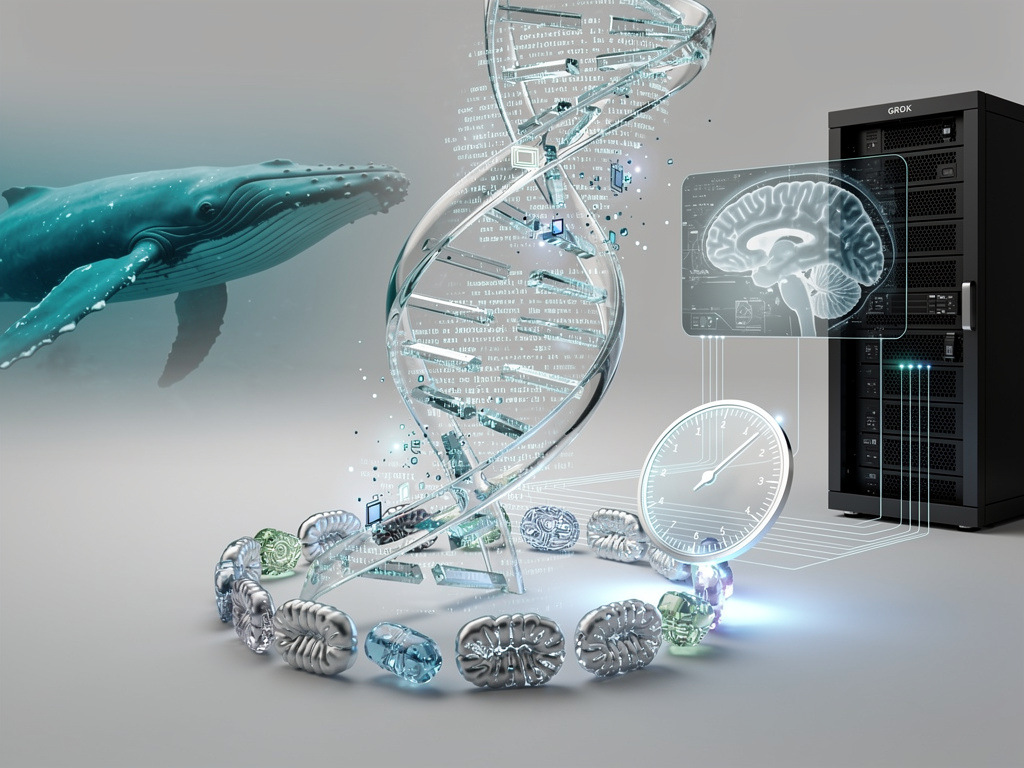
Elon Musk views the human body not as a fragile vessel doomed by time, but as a precisely engineered machine governed by synchronized code. ‘The precision of our biological clock across trillions of cells is incredible. One never sees someone with an old left arm, but a young right arm,’ Musk posted on X in 2023. This engineering perspective aligns closely with longevity pioneer Aubrey de Grey, who argues that aging stems from repairable damage rather than inevitable entropy.
A recent X thread by VraserX captured this convergence, praising Musk’s approach as mirroring de Grey’s: ‘Aging is not chaos. The whole body degrades in sync, so there must be a central mechanism… Programs can be rewritten. Aging is not destiny, it is code.’ The post highlights species like whales, which can live 200 years, and Greenland sharks reaching 500 years, suggesting longevity is a solvable biological puzzle, not mysticism.
Musk recently reinforced his optimism. On January 9, 2026, he shared on X that he uploaded his MRI to Grok, xAI’s AI model, declaring longevity ‘an extremely solvable problem,’ as reported by Business Insider. This move signals AI’s emerging role in decoding aging’s mechanisms.
Engineering the Biological Clock
The idea of a unified ‘biological clock’ challenges traditional views of aging as scattered breakdowns. Musk’s observation of uniform decay implies a master regulator, akin to software dictating hardware wear. De Grey, founder of the SENS Research Foundation, has long advocated ‘engineered negligible senescence,’ targeting seven damage types: cell loss, mutations, and extracellular junk, as detailed in his talks.
Recent science bolsters this. A December 2025 study engineered mice with enhanced mitochondrial proteins, yielding longer lives, better metabolism, and reduced inflammation, per ScienceDaily. ‘Their cells produced more energy while dialing down oxidative stress and inflammation tied to aging,’ the report noted, hinting at cellular power tweaks as a longevity lever.
De Grey discussed mouse lifespan extension at the 2025 Longevity Summit Dublin, aiming to make aging a treatable condition like COVID, according to NMN.com. He predicts therapies could add decades soon, provided funding scales.
Lessons from Long-Lived Species
Whales and Greenland sharks offer blueprints. Bowhead whales hit 200 years with low cancer rates, thanks to efficient DNA repair, while Greenland sharks’ 400-500 year spans involve slow metabolism and robust antioxidants. Musk noted whales’ thermal limits on X in May 2025: ‘Cooling scales as a square with body surface area, but heat generation scales as a cube with body mass.’
These extremes prove longevity genes exist. Research into whale genomes reveals hyperactive tumor suppressors, potentially transferable via CRISPR, as explored in ongoing studies. Greenland sharks’ collagen stability suggests cardiovascular secrets, countering human arterial decay.
Posts on X echo this, with VraserX arguing: ‘Other species already solved it… That means it is not magic. It is biology and engineering.’ Musk’s engineering lens could accelerate translation, much like Tesla optimized batteries.
Musk’s AI Push into Longevity
Musk’s xAI integration marks a pivot. His MRI upload to Grok tests AI for hidden health signals, building on a 2025 case where Grok diagnosed a Norwegian man’s fatal issue missed by doctors, as Musk posted on X. ‘Grok saved the life of a man in Norway,’ he wrote on January 1, 2026.
BioAge Labs exemplifies the shift, developing drugs targeting aging biology for obesity and heart disease, per a January 2026 TIME feature. Musk’s abundance vision—where AI eliminates scarcity—includes extended healthspans, as he told X followers retirement savings may become irrelevant.
Analysts see Musk funding de Grey-style research via xAI or Neuralink. VraserX hopes: ‘Elon uses his capital, influence, and engineering culture to seriously push aging research… Cancer, neurodegeneration, cardiovascular decay should be optional.’
Targeting Age-Related Killers
Cancer, neurodegeneration, and cardiovascular failure drive 70% of deaths over 50. De Grey’s strategy clears senescent cells and amyloid plaques, with trials showing promise. A 2025 Nature article probes 150-year lifespans via partial reprogramming, citing Nature: ‘Extending lifespan might be difficult but… therapies aim to make us feel younger for longer.’
GLP-1 drugs like Ozempic, combined with vitamin D and exercise, slowed epigenetic clocks in 2025 trials, per Fox News. Omega-3s added protection in DO-HEALTH data, as VraserX noted on X.
Musk’s Neuralink could interface brains with AI to combat neurodegeneration, reversing decay through data-driven interventions. Reverse-engineering aging, as VraserX posits, ‘changes everything.’
Path to Escape Velocity
De Grey defines ‘longevity escape velocity’ as therapies adding years faster than time passes. A scientist’s 1,200-year lifespan forecast hinges on such progress, via NAD.com. Musk’s AGI timeline—2026-2027—could supercharge this, per NextBigFuture.
Challenges persist: regulatory hurdles, ethical debates on overpopulation. Yet Musk’s track record—Tesla, SpaceX—suggests execution. His 2023 X query lingers: ‘Aging can obviously be fixed. The real question is whether it should be.’
Industry insiders watch xAI’s health pivot. If aging is code, Musk and de Grey hold the debugger, poised to compile humanity’s next era.


 WebProNews is an iEntry Publication