
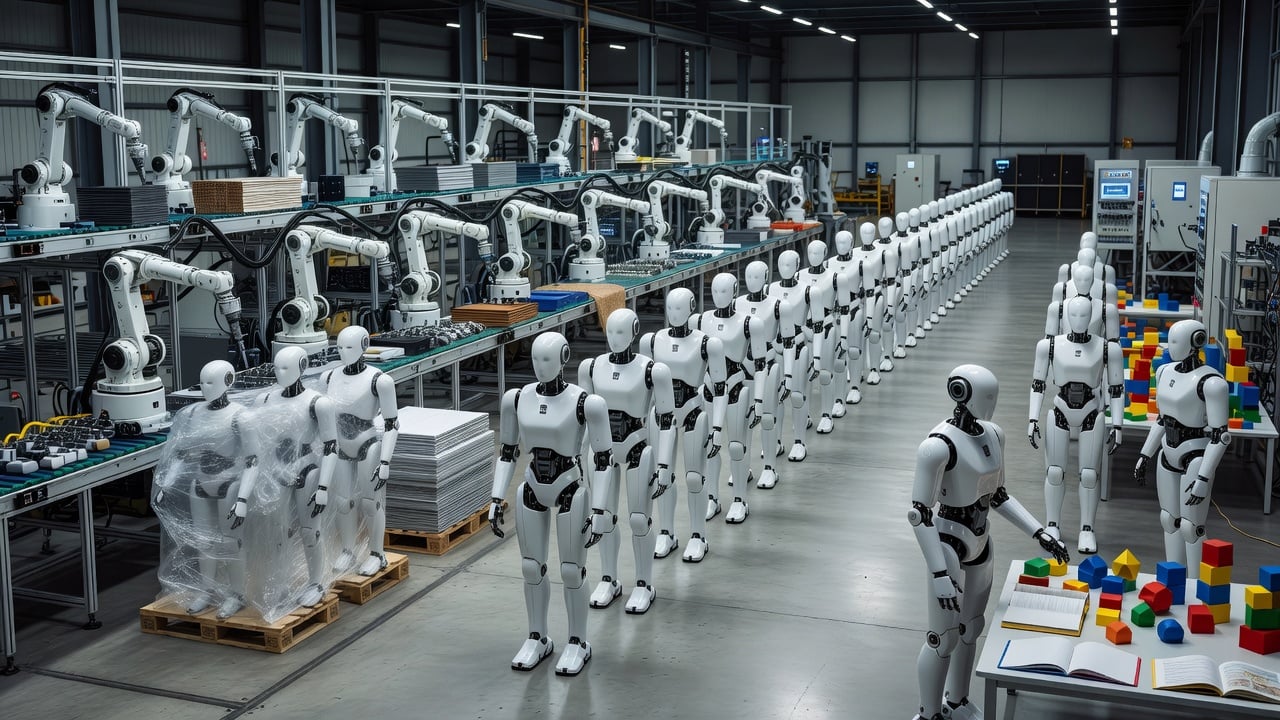
Chinese robotics firm Agibot has shipped more than 15,000 humanoid robots. Its executives make no secret of the goal. Some roles simply don’t suit people. Workers stand for hours repeating the same motions. They handle toxic materials or navigate heights that punish the body. In those cases, the company argues, replacement brings relief.
From Factory Floors to Classrooms
William Shi, president of Agibot for Europe and America, puts it bluntly. “In some jobs, they want to be replaced.” He points to manufacturing lines where employees package smartphones eight hours a day. The task creates neither value nor satisfaction. “They don’t learn when they do this job. They don’t invent things,” Shi told TechRadar in a July 2026 interview.
Agibot’s machines already operate in Chinese electronics plants. One livestream captured a G2 model performing packaging steps at Longcheer. The robots combine three AI systems. One manages interaction with people. Another controls movement across floors or terrain. The third handles objects with growing dexterity. Autonomy remains a work in progress. Yet data collection from real deployments feeds faster improvement.
But the conversation doesn’t stop at the factory gate. Shi sees shortages everywhere. Nurses. Teachers. “There’s a big lack of nurses in every country, from China, to America, to Europe, and also a big lack of teachers.” Robots won’t replace human judgment. They can answer routine questions. Phonics. Basic science. Math problems. Even casual talk about weather or humidity. Large language models make that possible today.
The idea raises eyebrows. Studies show children sometimes respond well to robotic tutors. A 2025 arXiv paper on social robots in classrooms found students rated machines high on competence and low on discomfort. Still, concerns linger about emotional development and trust. Agibot insists its creations stay “under the control and expectation of the human.” They take responsibility for tasks. They never make final decisions.
Production numbers tell their own story. Agibot led global humanoid shipments in 2025 with roughly 5,100 units, capturing 39 percent market share according to Omdia. The total crossed 10,000 early in 2026. Three months later the company hit 15,000. That pace outstripped its first three years combined. Forbes reported the milestone in May. The Robot Report noted IDC ranked Agibot first in total volume and across entertainment, research, education, exhibition, reception and manufacturing sectors.
Dr. Yao Maoqing, president of Agibot’s embodied AI business, described an industry inflection. The field has moved from experimental “X curve” exploration into early “Y curve” deployment growth. “Once robots begin to create stable value in real-world scenarios, demand itself may grow faster than many people expect,” he said. The company now offers robots and robots-as-a-service in more than 17 countries. Rental prices start around $2,000 per day in the U.S.
Its portfolio spans models. The A2 series includes full-size ultra versions, lighter performance variants and flexible manufacturing units. X2 platforms emphasize agility and terrain navigation. G1 and G2 focus on universal embodied intelligence. Supporting infrastructure matters too. AGIBOT WORLD provides large-scale real-world task data. AIDEA handles data collection and processing for training. These systems accelerate learning from actual use rather than simulated environments alone.
Expansion continues. Agibot partnered with automotive supplier Minth Group to manufacture in Europe. Production there is slated to begin later in 2026. The firm debuted in the U.S. at CES and showcased at MWC Barcelona. It even set a Guinness World Record when an A2 model walked more than 106 kilometers across provinces.
Yet questions multiply. Safety in close proximity to children. Potential over-reliance on machines for emotional support. Job displacement beyond the dangerous and dull. Shi acknowledges the limits. Robots supplement. They free humans for creative, caring or strategic work. They don’t erase the need for oversight.
Other research echoes parts of the vision. A Robozaps analysis from June 2026 documented humanoid teaching assistants already operating in schools across more than 40 countries. They manage attendance, answer queries in real time and support students with autism. Results vary. Some children bond quickly. Others prefer human instructors for nuanced guidance.
Agibot’s rise reflects broader supply chain maturity. Founded in 2023 by former Huawei engineers Deng Taihua and Peng Zhihui, the company scaled hardware and software in parallel. Vertical integration helped. So did partnerships with Nvidia and others. CTO Peng Zhihui has spoken of the shift from prototype to commercial demand.
Critics warn of deeper risks. A YouTube discussion from ABC News highlighted fears that advanced humanoids could be weaponized or used for surveillance. Privacy concerns grow when machines enter homes or classrooms. Psychological effects on young learners remain understudied. And while Agibot stresses human control, full autonomy could erode that boundary over time.
Still, the core pitch resonates with certain industries. Construction sites. Hazardous material handling. Night security patrols. Repetitive assembly. These tasks injure bodies and dull minds. If robots handle them reliably, labor shortages ease and workers move to higher-value roles. That logic drives deployments today.
Agibot’s own site touts “unlimited productivity via intelligent machines.” Its A2 models demonstrate capability through record walks and factory trials. The firm launched a wheeled Genie G2 variant recently, expanding options beyond bipedal designs. Real-world data flows back into training loops. Each deployment sharpens performance.
The next few years will test the claims. Can humanoids maintain consistency across thousands of hours? Will parents accept them near children? How quickly does cost fall to make widespread adoption viable? Agibot bets that practical results in dangerous settings will build acceptance. From there, gradual entry into education and care becomes conceivable.
One thing seems clear. The debate has moved past whether robots will enter these spaces. It now centers on how, how fast and under what safeguards. Companies like Agibot are forcing the discussion with hardware already rolling off production lines. The machines are here. The rules for their use are still being written.


 WebProNews is an iEntry Publication