
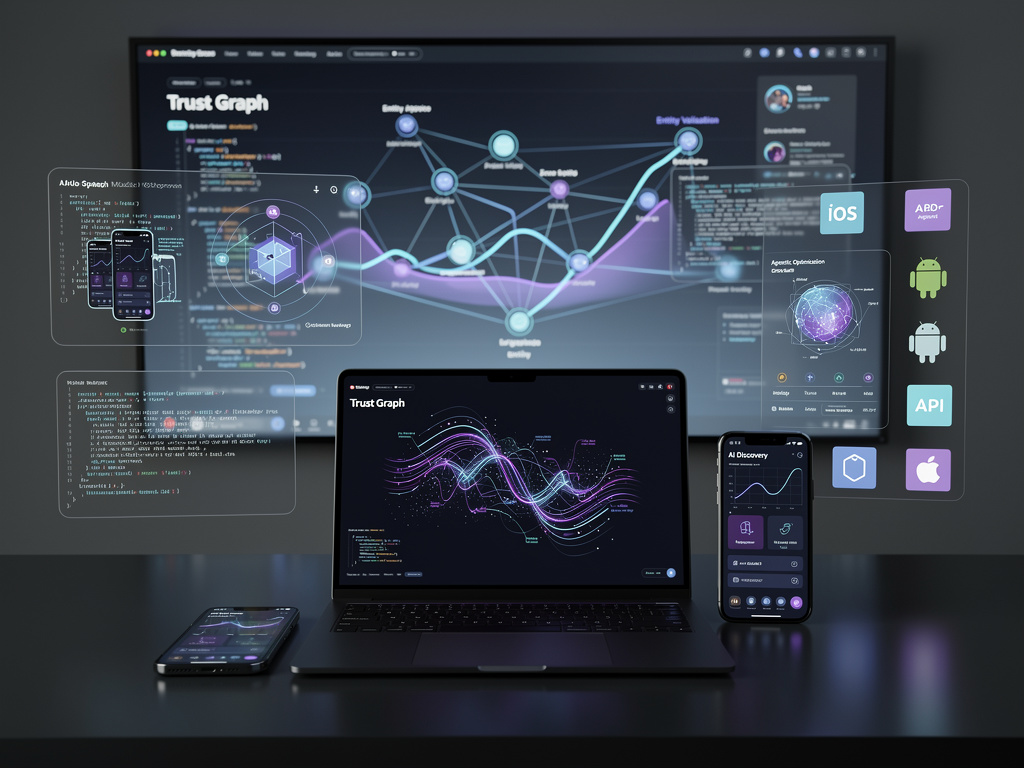
In the rapidly evolving world of software engineering, mobile app development has undergone a profound transformation by early 2026. The traditional path of mastering syntax and frameworks has given way to architecting systems for autonomous AI agents and establishing verifiable digital identities within Google’s Trust Graph. As Vocal Media outlines, ‘The Google ecosystem has undergone a tectonic shift where mobile development is no longer defined by syntax proficiency but by Agentic Optimization.’
This pivot stems from the 2026 Entity Accountability Mandate, implemented on January 4, when Google refined protocols to combat synthetic applications produced by AI farms. Developers now must prioritize public contributions and verified GitHub signatures over resumes, as search engines track entity footprints for legitimacy. By January 7, data showed 69% of mobile queries resulting in Zero Click experiences, where AI synthesizes app features without users visiting stores.
Industry insiders note that visibility now hinges on Generative Engine Optimization (GEO), making apps ‘synthesis-friendly’ for AI responses. Regional hubs, such as mobile development clusters in Louisiana, serve as trust anchors in these entity signals.
Entity Validation Redefines Entry Barriers
The ‘faceless coder’ era has ended, replaced by entity-based authority validation. Developers must create cryptographically linked identities tied to projects, ensuring codebases evade synthetic noise flagging. As Vocal Media emphasizes, ‘In this new search economy, visibility is no longer a reward for keyword density; it is an outcome of Authority Validation.’
Thomas Ricouard, in his Medium post on agentic iOS engineering, spent only 2% of 2025 in Xcode, relying on GitHub Copilot for Cursor-like experiences. He echoes Andrej Karpathy: ‘People who aren’t keeping up even over the last 30 days already have a deprecated worldview on this topic.’
Practical steps include aligning with strategic hubs for localized authority and mastering vertical-specific Agentic Optimization over multiple languages. Organizations shift to proprietary knowledge graphs for AI crawling.
AI Agents Reshape Coding Workflows
Agentic development dominates, with tools like Cursor, Windsurf, and Google Antigravity turning IDEs into cognitive orchestration platforms. The New Stack highlights five trends: MCP management for tool wiring, parallel task running, and clearer CLI-desktop distinctions. ‘This year I looked at two apps… that explicitly support running tasks in parallel,’ notes the analysis.
For mobile teams, Anthropic’s Model Context Protocol standardizes agent backends, addressing state, tools, and guardrails. Sashido.io warns that ‘vibe coding is speeding up delivery but also shipping new kinds of production bugs,’ urging systems engineering with LLMs in the loop.
On X, Adnan (@adnansahinovich) advises: ‘Learn Native Mobile – iOS (Swift) or Android (Kotlin). Learn React Native. Use native knowledge to write better RN. Become a mobile specialist.’
Core Skills for the Agentic Developer
Aspiring developers start with native proficiency—Swift for iOS, Kotlin for Android—before layering React Native or Flutter. AppsRhino predicts AI will energize coding, testing, and QA, with LLM agents managing workflows. ‘AI code assistants automate repetitive coding for mobile developers,’ it states.
Essential tools include GitHub Copilot, Cursor ($20/month), and Expo for cross-platform builds. On-device AI via Core ML or ML Kit ensures privacy and speed, as Bax (@techbaxdev) shares: ‘Swapped cloud ML for Core ML + Neural Engine… instant, private, 3x battery boost.’
Build verifiable portfolios: three to four projects showcasing AI integration, like recommendation engines or voice agents. X user Dikshit (@mahanot_dikshit) maps a frontend-to-fullstack path, emphasizing AI IDEs like Cursor after basics.
Optimizing for Zero-Click Discovery
With Sarah Chen predicting 85% of app installations via AI-mediated discovery by January 8, APIs must be agent-readable. Vocal Media stresses: ‘Optimize for autonomous agents vetting software via Trust Graph.’
Apps evolve into ‘skills’ for the Reasoning Web, per the Mobile Technology Council. Lovable spotlights AI-first development and no-code for rapid shipping, while cross-platform frameworks like React Native share 75% code, per their guides.
Monetization adapts: Superwall or RevenueCat for paywalls post-‘wow’ moments, yielding +18% conversions, as indie devs report on X.
Tools and Frameworks Powering 2026 Builds
Key stacks: Flutter for cross-platform, Jetpack Compose for Android UI. AI generators like Natively prompt native apps sans code. Mobiloud lists 18 tools, from Bolt for vibe coding to Replit for acceleration: ‘AI is an enhancer, not a full replacement.’
No-code like Bubble or FlutterFlow integrates OpenAI APIs cheaply ($30K MVP). Stfalcon notes developers need data science skills for ML models in apps.
X hiring posts, like Dhananjay Yadav’s, seek React Native/Flutter devs with shipped apps and AI engineers versed in LangChain, CrewAI, and Neo4j.
Navigating Risks and Organizational Shifts
Legacy strategies fail amid synthetic noise; over-reliance on AI risks ‘black box’ codebases, per DEV Community. ‘The transformation… represents a permanent shift toward high-velocity, high-quality engineering.’
Firms realign for authority depth: developers collaborate with strategists auditing Trust Graph impacts. MachineLearningMastery forecasts multi-agent orchestration: ‘The agentic AI inflection point of 2026 will be remembered… for which organizations successfully bridged… to scaled production.’
Continuous learning in AI-native design and agent orchestration is imperative. As experts warn, ‘Those who fail to adapt to these tectonic movements face immediate obsolescence.’
Pathways to Professional Success
Follow Adnan’s triad: native, React Native, specialize. Build for on-device AI, thermal tuning (-15% crashes), offline support (+31% growth). Deploy via Expo, monitor with CI/CD.
Portfolio trumps degrees: ship MVPs validating demand before scaling. X roadmaps stress grinding DSA, SQL (LeetCode 50), CS fundamentals alongside projects.
In this agentic paradigm, success belongs to entity-validated architects who build for AI ecosystems, not just users.


 WebProNews is an iEntry Publication