
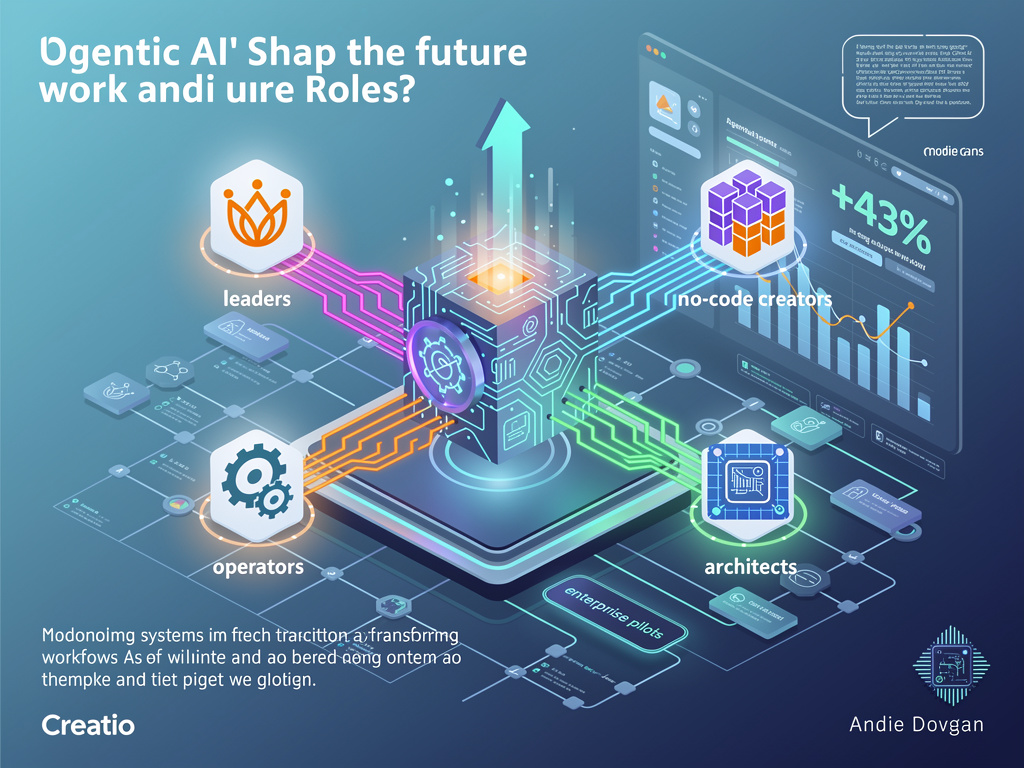
In the accelerating shift toward autonomous AI systems, four pivotal roles are emerging to steer enterprises through the agentic era, blending human oversight with machine agency. As agentic AI—systems capable of independent goal-setting, reasoning, and execution—permeates workflows, professionals must adapt to positions demanding accountability for AI outcomes. This transformation, detailed by industry voices, promises wage premiums but requires mastery of no-code tools, domain expertise, and ethical governance.
ZDNet (Jan. 22, 2026) highlights insights from Andie Dovgan, chief growth officer at Creatio, who identifies AI leaders, agent operators, AI no-code creators, and workflow architects as frontrunners. “AI leaders are responsible for turning AI from a technical capability into business value, ensuring it is used responsibly and strategically,” Dovgan explained. These roles evolve from existing business and operations functions, emphasizing ownership over mere automation.
Gartner’s forecast underscores the scale: by 2026, 40% of enterprise applications will embed task-specific AI agents, evolving assistants into proactive partners, as noted in Forbes (Dec. 31, 2025). PwC’s AI Jobs Barometer reveals a 43% pay bump for AI skills across sectors, signaling broad demand.
Pioneering AI Leaders at the Helm
AI leaders orchestrate strategic deployment, defining use cases that align agents with business imperatives. Lacking predefined paths, these change agents draw from innovation-focused backgrounds, combining human teams with digital counterparts. Dovgan notes they attract professionals eager to drive transformation, overseeing responsible AI integration amid rising regulatory scrutiny.
In practice, companies like Salesforce are hiring forward-deployed engineers for agentic deployments, as seen in job postings demanding expertise in platforms like Agentforce. This role demands not just technical fluency but strategic vision, ensuring agents enhance rather than disrupt core operations.
Agent Operators: Vigilant Workflow Guardians
Agent operators serve as human supervisors, monitoring agentic workflows for accuracy, compliance, and continuity. “They monitor execution, intervene when needed, and ensure accuracy, compliance, and business continuity,” Dovgan stated in ZDNet. Evolving from operations staff, they possess deep workflow knowledge to catch deviations in real-time.
Sophos exemplifies this with IT service desks featuring leaderboards pitting humans against agents, where staff validate outputs per human-in-the-loop protocols, per CIO (Jan. 9, 2026). Demand surges as 58% of IT decision-makers pilot agents for automation, per Wharton and GBK Collective research.
Job sites like Indeed list thousands of agentic AI positions, including AI training specialists and agentic data specialists at Salesforce, who orchestrate data flows for Agentforce solutions. These roles command premiums, with PwC noting AI skills boost earnings by 35% in non-tech fields.
No-Code Creators Democratizing Agency
AI no-code creators design, test, and deploy agents via intuitive platforms, empowering non-developers. Business analysts and process owners transition here, shaping agent goals and behaviors without coding. No-code tools lower barriers, enabling rapid iteration as agents adapt to constraints.
Motion Recruitment (2025) emphasizes skills in multi-agent frameworks like AutoGen, CrewAI, and LangGraph for integration, exception handling, and API chaining. LinkedIn postings for agentic AI developers at Quantifyd and Siemens seek no-code proficiency alongside frameworks like Semantic Kernel.
Divergence.one predicts 40% of Global 2000 roles will involve AI agents by 2026, upskilling teams for governance and hands-on experience. This shift redefines careers, with early adopters securing rapid advancement.
Workflow Architects Redesigning Execution
Workflow architects adopt a holistic view, redesigning processes for human-agent collaboration rather than mimicking manual steps. Requiring domain depth, they prevent misaligned optimizations, ensuring agents respect real-world limits. “Strong business analysis [and] deep domain expertise” are essential, per Dovgan.
Washington Post (Oct. 29, 2025) catalogs similar titles like orchestration engineers and human-AI collaboration leaders at AI-fueled firms. McKinsey envisions AI ethics officers, quality assurance leads, and agent coaches, with IT as the “HR of AI agents,” echoing Nvidia CEO Jensen Huang.
X discussions amplify this: Sheel Mohnot (@pitdesi) touts “Agent Manager” roles overseeing reasoning agents, while Antonio Romero (@ant0ni0_r0mer0) predicts AI workflow designers and automation architects eclipsing junior positions.
Job Market Turbulence and Net Gains
While agentic AI displaces routine tasks—ILO estimates 600 million roles exposed—new opportunities proliferate. World Economic Forum’s Future of Jobs Report 2025 projects 170 million net-new jobs by 2030. Upskilling is key: Microsoft’s vision includes chief resource officers balancing human-digital workers.
Fortune (Oct. 24, 2025) quotes KPMG’s AI head on hybrid structures birthing “Agent Bosses” and evaluators. Enterprises favor hiring AI-ready talent 3.1x over retraining, per Deloitte via Gloat.
Hiring evolves: interviews test orchestrating agents for multi-step processes, per Forbes. Sectors like finance, healthcare, and manufacturing lead, with agents managing risks, patient flows, and supply chains.
Strategic Imperatives for Enterprises
Early adopters leverage vendors like Creatio for hands-on tuning and boutiques for domain-specific cases. Global firms build agentic practices for governance. HR’s role expands, partnering IT for reskilling amid workforce ageing in high-income economies, per WEF.
Equal Times reports displacements—UPS cut 20,000 jobs via agentic logistics, Salesforce 4,000 in service—but stresses augmentation over replacement. Mercer deems 2025 the year HR embraces agentic AI for decision-making.
As agentic systems scale, ownership defines success: continuous optimization amid evolving business needs. Professionals positioning now—as operators, creators, architects, or leaders—will command the premiums and security PwC forecasts.


 WebProNews is an iEntry Publication