
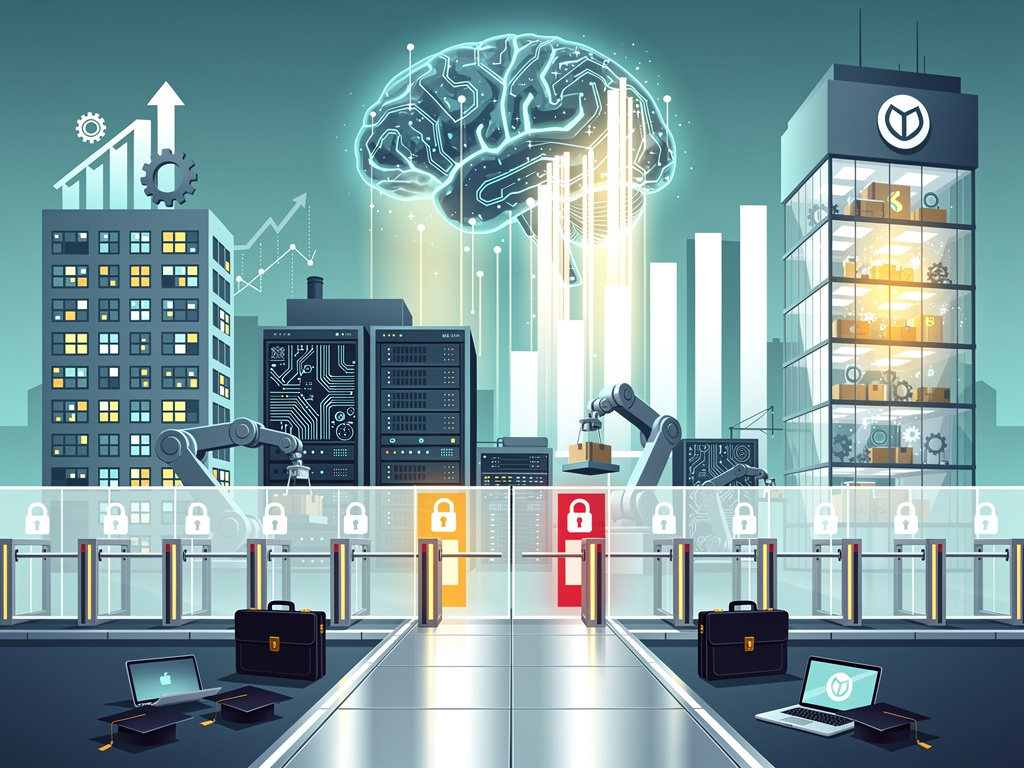
Agentic AI doesn’t announce itself with headlines of mass firings. It creeps in. Companies squeeze more from existing teams. New hires? Fewer and farther between.
That’s the warning from Yale’s Chief Executive Leadership Institute. Their research, spanning banks to logistics, shows productivity soaring—20% to 60% gains in banking workflows, over 60% drop in telecom manual ops—while entry-level openings vanish. Fortune broke the story on April 29, 2026, penned by Jeffrey Sonnenfeld and his Yale CELI team.
Unemployment hovers near 4%. Looks stable. But dig deeper. Recent grads face nearly 6% joblessness, twice the workforce rise since 2022. Computer science majors? 7.0%. Computer engineering? 7.8%. Entry-level postings in software development plunged 53% from late 2022 peaks, per Indeed data cited in the report.
And it’s not just tech. Morgan Stanley pegs 37% of U.S. real estate roles—2.2 million jobs—at risk from agentic displacement. One firm slashed on-property labor 30%. Another cut headcount 15%. Junior brokers and data labelers top the endangered list.
CEOs see it clearly. ServiceNow’s Bill McDermott reskills his stars: “If he has only hired ‘nines and tens,’ why should he fire instead of retooling them?” Salesforce trimmed 4,000 customer-service spots after AI took over. Firms like C.H. Robinson now handle 29% more volume with 30% fewer staff, half their carrier bookings from agents.
Why the Hiring Freeze Hits New Grads Hardest
Agentic AI automates workflows, not just tasks. Agents handle customer chats, document reviews, R&D cycles—slashing them 50% in manufacturing. Supervisors oversee. No need for armies of juniors to learn the ropes.
Erik Brynjolfsson’s Stanford study flags a 16% drop in early-career employment in AI-exposed fields since late 2022. Developers aged 22-25? Nearly 20% fall. Goldman Sachs tallies AI trimming U.S. jobs by 16,000 monthly.
Yet countervoices emerge. Anthropic’s Dario Amodei warned in 2025: “AI could wipe out half of all entry-level white-collar jobs—and spike unemployment to 10-20% in the next one to five years.” Axios captured his stark view. Data backs him now. Shawn Kanungo’s analysis shows top tech firms cut entry-level tech hiring 30-50% in 2025 versus 2023, Wall Street eyeing 200,000 role cuts, Big Four trimming audit juniors. Shawn Kanungo blog.
Verizon’s Dan Schulman doesn’t mince words. He predicts 20% to 30% unemployment in two to five years from AI, including humanoid robots hitting manual jobs. Wall Street Journal profiled his straight talk.
BCG agrees on scale: 50-55% of U.S. jobs reshaped in two to three years, 10-15% eliminated by 2031. White-collar spots like financial analysts face substitution, juniors in IT or sales qualification hit hardest. But augmentation creates demand in software engineering, they note. BCG report.
Not everyone buys the apocalypse. Salesforce CEO Marc Benioff pushes back. He’s hiring 1,000 new grads and interns for Agentforce and Headless360. “You are right they said AI would kill entry-level jobs. Meanwhile these grads and interns are building it.” Unemployment for 20-24-year-olds dips, he points out. Fortune, April 27, 2026.
Sonnenfeld himself amplified on X: “Our sweeping cross-industry research shows that, as Agentic AI scales, changes are already happening, just quietly.” X post by Jeffrey Sonnenfeld.
Colleges Scramble as Pipelines Clog
Yale’s survey of college presidents? 41% highly worried about entry-level white-collar vulnerability. Only 10% deem grads AI-ready. Nearly a third say they’re unprepared.
A top business school course developer admits: “Our faculty are passionate, but… AI models are developing so quickly… it’s hard for teachers to put together courses that aren’t quickly outdated.” Students often outpace profs.
Job confidence craters. U.S. workers calling it a good time to hunt? Down from 70% in 2022 to 28%. College grads fare worse at 19%.
McKinsey finds 43% of firms expect no workforce size change from AI; 32% see 3%+ cuts soon. Voluntary turnover at 13%. Age pay gaps widened 60% in four decades.
The freeze compounds. Firms reskill veterans. Juniors miss experience. Mid-managers stagnate. Talent pools shallow out.
Leaders face choices. BCG urges upskilling juniors into oversight roles. Amodei calls for steering the train—policy tweaks, not halts. Schulman pushes education overhauls.
But agentic AI marches. Entry paths narrow. New grads adapt or watch from sidelines. The jobs aren’t vanishing overnight. They’re simply never posted.


 WebProNews is an iEntry Publication