
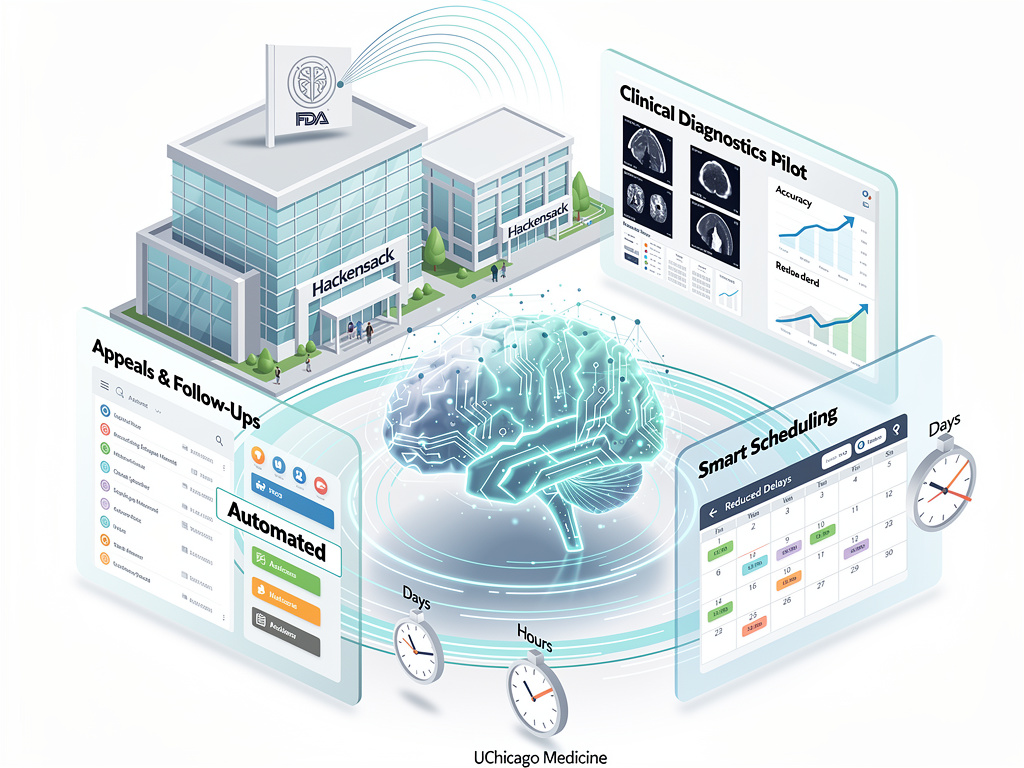
Agentic artificial intelligence, capable of autonomously planning, reasoning and executing multi-step tasks, is delivering tangible gains in healthcare efficiency as providers grapple with staffing shortages and administrative overloads. Early adopters report slashed processing times and boosted capacities, signaling a shift from experimental tools to operational necessities.
At Hackensack Meridian Health, an agentic system has transformed claims appeals, reading denial letters, pinpointing missing data, compiling corrections and routing them for nurse review. “Our whole appeals process sometimes took 15 to 16 days. Now, we do it in one or two days,” said Sameer Sethi, senior vice president and chief AI officer at the health system, according to HealthTech Magazine.
The system’s post-discharge agent, named Erin, monitors patient well-being, verifies medication adherence and flags urgent issues, helping avert readmissions. Such applications underscore agentic AI’s prowess in high-volume, repetitive workflows, where 44% of healthcare organizations now deploy it for patient experience enhancements, per a Google report cited in the same article.
Operational Wins Take Center Stage
University of Chicago Medicine is harnessing Salesforce’s Agentforce for routine patient interactions, automating appointment scheduling, prescription refills and inquiries that previously bogged down call centers. “It really helps with those redundant tasks that take time away from our live agents,” noted Tyler Bauer, senior vice president of system ambulatory operations, as reported by Forbes.
Precina Health employs an agent-first model for diabetes management, providing daily personalized coaching at scale through Salesforce tools. This approach addresses chronic disease burdens by executing tailored interventions without constant human input, aligning with broader trends where agentic systems orchestrate end-to-end workflows.
Modern Healthcare highlighted these efforts in UChicago Medicine and Precina as exemplars of positive returns on operational hurdles, though full details remain gated behind paywalls in recent coverage.
Clinical Frontiers Emerge
Beyond operations, agentic AI edges into diagnostics and planning. Microsoft’s TrustedMDT agents, developed with Oxford University’s Department of Oncology, summarize charts, stage cancers and draft treatment plans integrated into Teams, set for piloting at Oxford University Hospitals NHS Foundation Trust in early 2026, per Microsoft Industry Blogs.
Atropos Health’s Evidence Agent proactively surfaces real-world evidence in EHR workflows, answering queries in minutes. Color Health’s assistant streamlines breast cancer screenings, handling risk assessments and scheduling with complex logic that defies simple forms, as detailed by CEO Othman Laraki in HealthTech Magazine.
Vi’s 2026 State of AI Reports document multi-agent orchestration yielding 10–35% gains in physician activation, 2–3× faster evidence synthesis and 10–20% cuts in trial enrollment delays, according to PR Newswire.
Regulatory Momentum Builds
The FDA launched an agency-wide agentic AI platform on December 1, 2025, empowering staff for tasks like pre-market reviews and surveillance. “Agentic AI refers to advanced artificial intelligence systems designed to achieve specific goals by planning, reasoning, and executing multi-step actions,” with human oversight baked in, the agency stated in its press release. A January 2026 challenge invites solutions for demonstration.
BCG forecasts agentic AI compressing drug development from years to months via molecule generation and simulations, while enhancing precision medicine through wearable and EMR data analysis, as outlined in its 2026 outlook.
HHS’s strategy positions AI as health innovation’s core, dovetailing with FDA efforts amid exploding use cases—up 70% in FY 2025—mandating risk management for high-impact systems by April 2026, per Holland & Knight.
Drug Discovery Accelerates
In biopharma, agentic systems boost HCP activation and adherence, with BCG noting AI’s role in R&D, operations and functions. Mass General Brigham predicts a shift to agents orchestrating multimodal clinical workflows by late 2026.
Transcarent’s WayFinding 2.0, unveiled at CES 2026, automates scheduling and triage with a “Total Recall Memory Engine,” declared CEO Glen Tullman: “We’ve officially moved beyond the ‘chat assistant era’ into the ‘agentic action era’,” via HIT Consultant.
Amazon One Medical’s Health AI assistant, beta since 2025, now offers 24/7 guidance grounded in medical history for conditions like asthma renewals.
Challenges Persist Amid Hype
Despite gains, hurdles loom: Vi reports 3–6× KPI improvements in wellness but warns of governance needs. Chief Healthcare Executive leaders foresee agentic resets in care, with Anurag Mehta of Omega Healthcare predicting evolution from cost-cutter to innovator.
Security demands Zero Trust for agents touching systems, as HIT Consultant notes, with healthcare leading adoption at 68% per KPMG, cutting admin by 55%. Deloitte urges remapping workflows, balancing pilots with enterprise strategies.
GE HealthCare explores multi-agent systems with AWS for oncology plans, emphasizing cloud tools to shrink research from months to days.


 WebProNews is an iEntry Publication