
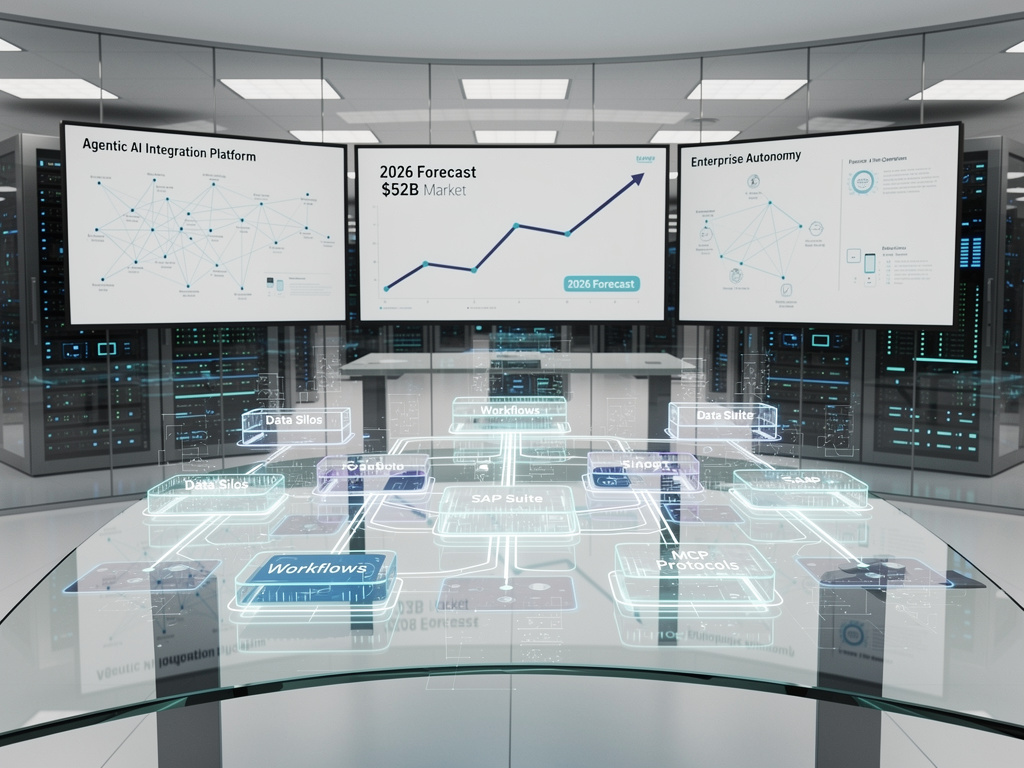
Artificial intelligence agents, capable of reasoning, deciding and acting with minimal human oversight, are pushing beyond isolated tasks into the heart of enterprise operations. But their promise hinges on seamless connectivity to fragmented data sources and systems—a challenge that integration platforms are racing to solve. Michael Ameling, president of SAP Business Technology Platform, argues that without robust integration, agentic AI remains a ‘compass’ offering direction but no path forward, akin to traditional AI’s insight-only role. His piece in The New Stack on January 25, 2026, frames this convergence as the pivotal shift from generative tools to autonomous executors.
Gartner forecasts that 40% of enterprise applications will embed task-specific AI agents by year-end, up from under 5% in 2025, driving a market surge from $7.8 billion to over $52 billion by 2030, according to analysts cited in MachineLearningMastery.com. This explosion demands more than APIs; it requires platforms that enable agents to navigate hybrid IT environments, trigger workflows and enforce governance. Oracle, for instance, is prioritizing ‘context-aware AI’ updates to data assets, as noted by executives in Nextgov/FCW, positioning cloud infrastructure as the backbone for scalable agentic deployments.
Early adopters like e&, which deployed agentic AI for governance and compliance using IBM watsonx Orchestrate in January 2026, demonstrate real-world traction. As posted by Martin Szerment on X, this marks agents graduating ‘from demos into revenue-critical control systems.’
Defining Agentic Autonomy
Agentic AI differs from predictive or generative models by executing decisions—launching workflows, coordinating systems and adapting in real time. Ameling emphasizes that true autonomy emerges only when paired with deep connectivity, allowing agents to access contextual data across silos. Deloitte’s 2025 study reveals a stark maturity gap: while 30% of organizations explore agents and 38% pilot them, only 11% have production systems, with 42% still crafting strategies, per Deloitte Insights.
Protocols like Anthropic’s Model Context Protocol (MCP), donated to the Linux Foundation’s Agentic AI Foundation in late 2025 alongside OpenAI’s AGENTS.md and Block’s Goose framework, standardize tool connections, as reported by TechCrunch. Google’s Agent2Agent (A2A) protocol further enables peer communication, evolving single agents into multi-agent orchestrations for complex tasks like supply chain optimization.
Box CEO Aaron Levie predicts on X that agent-to-agent talks will unlock growth, allowing a Salesforce agent to query a Box agent seamlessly, bypassing clunky APIs.
Integration Spectrum Challenges
Integration options span direct APIs for simple cases, open-source frameworks like LangGraph, AutoGen and CrewAI for flexibility, integration Platform as a Service (iPaaS) for abstraction, and embedded enterprise platforms like SAP Integration Suite for governance, per Ameling. Yet fragmentation breeds risks: incomplete actions from siloed data, brittle automations and compliance voids in regulated sectors.
SAP’s suite supports API-led, event-driven, B2B and application-to-application patterns with AI-assisted mapping and monitoring, ensuring security in mission-critical setups. VentureBeat highlights how orchestration frameworks simplify this ‘complex ecosystem,’ categorizing tools to avoid paralysis in agent building, as in VentureBeat.
The New Stack details tools like Beam for secure agent hubs and Microsoft’s AutoGen Studio for low-code prototyping, integrable with LangChain.
Enterprise Platforms Lead the Charge
Major vendors are embedding agentic capabilities: Microsoft’s Foundry IQ unifies data for consistent reasoning across domains, per its Ignite 2025 recap on Azure blog. IBM’s watsonx Orchestrate offers no-code builders, agent catalogs and MCP compatibility for framework-agnostic deployment, targeting over a billion gen AI apps, via IBM.
Nvidia, Microsoft and Google dominate per ZDNet’s analysis of Research and Markets’ 360 Quadrant, with Copilot’s CRM integrations and Gemini’s enterprise pivot. Payhawk’s Nexos.ai deployment slashed security investigations by 80% and costs by 75%, as in Artificial Intelligence News.
McKinsey’s 2025 survey shows high performers advancing agents in IT, sales and product development, capturing value through deeper embedding.
Multi-Agent Orchestration Evolves
Single agents yield to teams: Gartner’s 1,445% surge in multi-agent inquiries signals microservices-like modularity. Orkes provides scalable state management for long-running workflows with human checkpoints, per The New Stack. GraphRAG and knowledge graphs combat hallucinations, forming the ‘nerve center’ for traceable logic, as Intelligent CIO predicts for 2026.
X discussions from Yann Kronberg underscore orchestration for end-to-end processes like lead qualification to handoffs. Andrew Ng warns that wiring agents trumps chasing giant models, with JPMorgan eyeing 30% ops cuts.
Haider notes Jensen Huang’s vision fusing cloud models with on-prem for industrial AI, extending to robotics.
Governance and Risk Imperatives
Autonomy demands guardrails: Agentic AI Foundation standardizes interoperability, curbing fragmentation. Experian’s 2026 forecast warns of ‘autonomous, high-volume crimes’ via agentic tools, per AI Agent Store. ClawdBot’s risks—remote access via messaging, hallucinations executing malware—highlight perils, as analyzed on X by Jamie Oakley.
Deloitte stresses reimagining operations, treating agents as workers with process redesign. Ema advocates bounded autonomy with escalations for regulated environments.
Ameling urges modernizing integration as a capability, not project, with clear governance to trust autonomy levels.
2026 Roadmaps and Predictions
Trends include MCP management, parallel execution and CLI tools, per The New Stack. RAG-powered agents surge for real-time retrieval, Capgemini noting 80% planning integrations in 1-3 years. Nexos.ai envisions ‘agentic interns’ for departmental wins like compliance checks.
Forbes’ Mark Minevich predicts multi-agent systems for R&D and patient care, with hiring tests on agent orchestration. TechXplore recaps 2025’s protocols enabling interoperability amid governance pushes.
Success metrics evolve to ‘smarter connections,’ positioning integrators like SAP, IBM and Microsoft to define the agentic era for insiders building production-scale systems.


 WebProNews is an iEntry Publication